

A circle is the locus of points in the plane that are equidistant from a fixed point, called the centre. This constant distance is called the radius. The circle is a closed curve, symmetric about its centre, and it is a special case of a non-degenerate conic obtained by cutting a right circular cone with a plane perpendicular to the cone's axis that does not pass through the vertex.
Contents
- Geometric definition and derivation of the equation
- Equation of the circle centred at the origin
- Equation of the circle with an arbitrary centre
- General form and completing the square
- Conditions for representing a real circle
- Position of a point relative to the circle
- Tangent line to the circle
- Intersection of two circles
- Pencil of circles
- Symmetries and geometric properties
- Exercises
Geometric definition and derivation of the equation
Let us consider a fixed point \( C(x_0, y_0) \) in an orthonormal Cartesian coordinate system. The circle with centre \( C \) and radius \( r > 0 \) is the set of points \( P(x, y) \) of the plane such that:
\[ \text{dist}(P,C)=r \]
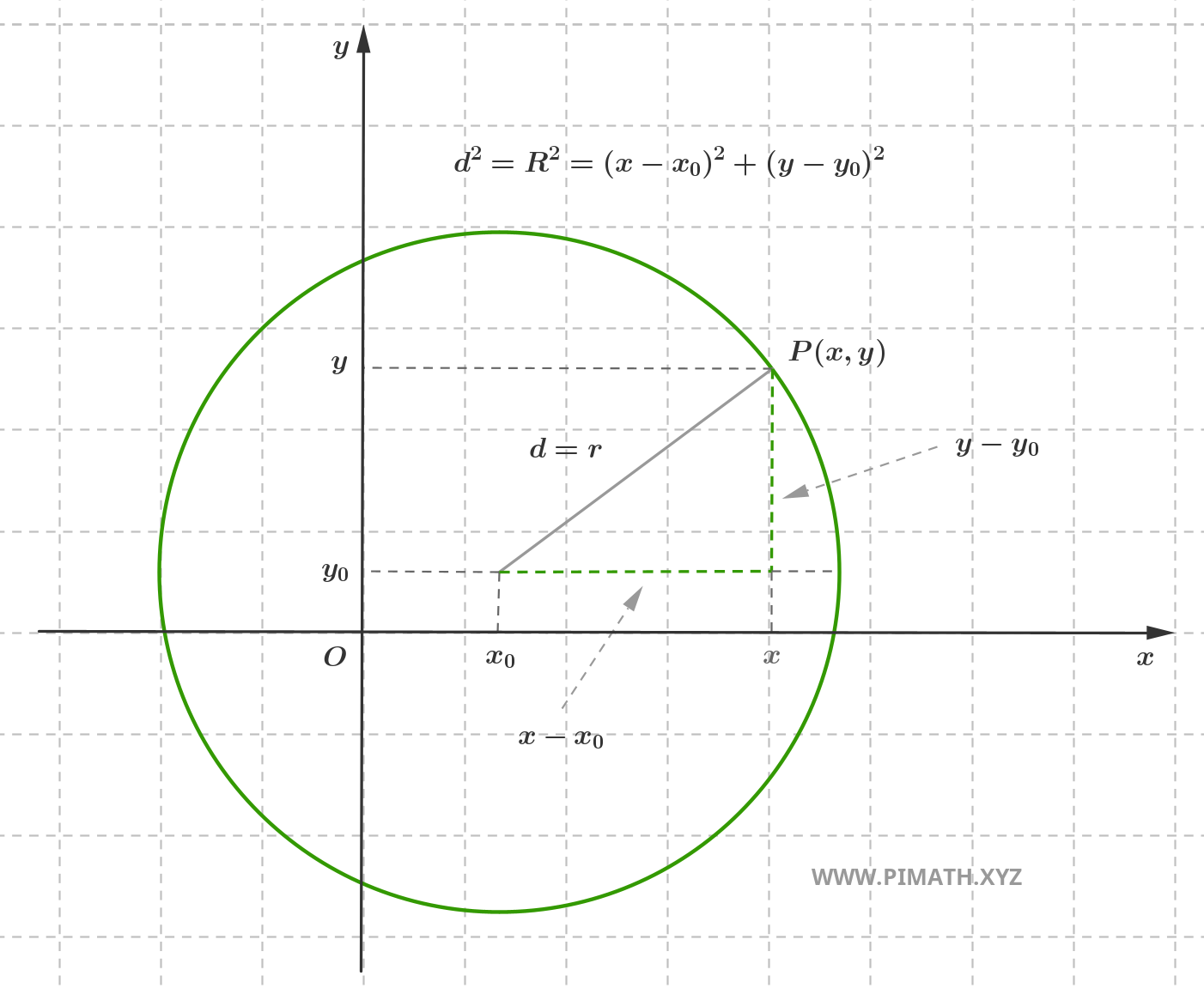
Applying the Euclidean distance formula between two points in the Cartesian plane, we have:
\[ \text{dist}(P, C) = \sqrt{(x - x_0)^2 + (y - y_0)^2} \]
Imposing the condition \( \text{dist}(P, C) = r \), we obtain:
\[ \sqrt{(x - x_0)^2 + (y - y_0)^2} = r \]
Squaring both sides (a legitimate operation, since both sides are non-negative, as \( r > 0 \) by definition):
\[ (x - x_0)^2 + (y - y_0)^2 = r^2 \]
This is the canonical form (or standard form) of the equation of the circle with centre \( C(x_0, y_0) \) and radius \( r \). The equation represents all and only those points satisfying the geometric condition of lying on the circle.
Equation of the circle centred at the origin
In the particular case in which the centre coincides with the origin of the reference frame, that is \( C(0, 0) \), setting \( x_0 = 0 \) and \( y_0 = 0 \) in the canonical form, the equation simplifies considerably:
\[ x^2 + y^2 = r^2 \]
This is the simplest equation of the circle, and it describes the set of all points equidistant from the origin of the Cartesian axes. The equation enjoys the following symmetry properties:
- Symmetry about the \(x\)-axis: if \( (x, y) \) lies on the circle, then so does \( (x, -y) \)
- Symmetry about the \(y\)-axis: if \( (x, y) \) lies on the circle, then so does \( (-x, y) \)
- Central symmetry about the origin: if \( (x, y) \) lies on the circle, then so does \( (-x, -y) \)
Furthermore, every diameter of the circle passes through the origin and has length \( 2r \). The point \( (r, 0) \) is the intersection of the circle with the positive \(x\)-axis.
Equation of the circle with an arbitrary centre
Let us now consider the general case of a circle with centre at an arbitrary point \( C(x_0, y_0) \) of the plane and radius \( r > 0 \). The canonical equation is:
\[ (x - x_0)^2 + (y - y_0)^2 = r^2 \]
Expanding the squares of the binomials by means of the algebraic identities \( (a \pm b)^2 = a^2 \pm 2ab + b^2 \), we obtain:
\[ x^2 - 2x_0x + x_0^2 + y^2 - 2y_0y + y_0^2 = r^2 \]
Rearranging the terms and moving all quantities to the left-hand side:
\[ x^2 + y^2 - 2x_0 x - 2y_0 y + (x_0^2 + y_0^2 - r^2) = 0 \]
Let us now introduce the parameters:
\[ D = -2x_0 \quad , \quad E = -2y_0 \quad , \quad F = x_0^2 + y_0^2 - r^2 \]
From these relations we may derive:
\[ x_0 = -\frac{D}{2} \quad , \quad y_0 = -\frac{E}{2} \quad , \quad r^2 = x_0^2 + y_0^2 - F = \frac{D^2 + E^2}{4} - F \]
Substituting into the expanded form, we obtain the general form of the equation of the circle:
\[ x^2 + y^2 + Dx + Ey + F = 0 \]
General form and completing the square
Given an equation in the general form:
\[ x^2 + y^2 + Dx + Ey + F = 0 \]
in order to reduce it to canonical form and determine the centre and radius, we use the technique of completing the square. The method consists in transforming the expressions \( x^2 + Dx \) and \( y^2 + Ey \) into perfect squares.
For the term in \( x \):
\[ x^2 + Dx = x^2 + Dx + \frac{D^2}{4} - \frac{D^2}{4} = \left( x + \frac{D}{2} \right)^2 - \frac{D^2}{4} \]
Similarly, for the term in \( y \):
\[ y^2 + Ey = y^2 + Ey + \frac{E^2}{4} - \frac{E^2}{4} = \left( y + \frac{E}{2} \right)^2 - \frac{E^2}{4} \]
Substituting into the general equation:
\[ \left( x + \frac{D}{2} \right)^2 - \frac{D^2}{4} + \left( y + \frac{E}{2} \right)^2 - \frac{E^2}{4} + F = 0 \]
Rearranging:
\[ \left( x + \frac{D}{2} \right)^2 + \left( y + \frac{E}{2} \right)^2 = \frac{D^2 + E^2}{4} - F \]
This is the canonical form, from which we may read off directly:
- Centre: \( C\left( -\displaystyle \frac{D}{2}, -\displaystyle\frac{E}{2} \right) \)
- Radius: \( r = \sqrt{\displaystyle\frac{D^2 + E^2}{4} - F} \) (provided that the expression under the radical is positive)
Conditions for representing a real circle
Let us consider a second-degree equation in the two variables \(x\) and \(y\):
\[ ax^2 + by^2 + cxy + dx + ey + f = 0 \]
It can represent a circle only if the coefficients of the pure quadratic terms are equal and the mixed term is absent. More precisely, the following conditions must hold:
- the coefficients of the quadratic terms are equal and non-zero: \(a=b\ne 0\);
- the mixed term is absent: \(c=0\).
In that case, dividing the equation by \(a\), we obtain:
\[ x^2+y^2+\frac{d}{a}x+\frac{e}{a}y+\frac{f}{a}=0. \]
The centre and the square of the radius are thus:
\[ C\left(-\frac{d}{2a},-\frac{e}{2a}\right), \qquad r^2=\frac{d^2+e^2}{4a^2}-\frac{f}{a}. \]
Consequently:
- if \( \displaystyle \frac{d^2+e^2}{4a^2}-\frac{f}{a}>0 \), the equation represents a non-degenerate real circle;
- if \( \displaystyle \frac{d^2+e^2}{4a^2}-\frac{f}{a}=0 \), the equation represents a degenerate circle, reduced to a single point;
- if \( \displaystyle \frac{d^2+e^2}{4a^2}-\frac{f}{a}<0 \), the equation has no real points.
In the case of the standard form
\[ x^2 + y^2 + Dx + Ey + F = 0, \]
the centre and the square of the radius are:
\[ C\left(-\frac{D}{2},-\frac{E}{2}\right), \qquad r^2=\frac{D^2+E^2}{4}-F. \]
The condition for the equation to represent a non-degenerate real circle is:
\[ \frac{D^2+E^2}{4}-F>0 \quad \Longleftrightarrow \quad D^2+E^2-4F>0. \]
We thus distinguish three cases:
- if \(D^2+E^2-4F>0\): the equation represents a non-degenerate real circle, of radius \( \displaystyle r=\frac{1}{2}\sqrt{D^2+E^2-4F} \);
- if \(D^2+E^2-4F=0\): the equation represents a degenerate circle, reduced to the centre alone;
- if \(D^2+E^2-4F<0\): the equation has no real points.
Position of a point relative to the circle
Given a circle with equation \( (x - x_0)^2 + (y - y_0)^2 = r^2 \) and a point \( P(x_P, y_P) \), we may determine the position of the point relative to the circle by computing the quantity:
\[ \delta = (x_P - x_0)^2 + (y_P - y_0)^2 - r^2 \]
Three cases arise:
- If \( \delta = 0 \): the point lies on the circle
- If \( \delta < 0 \): the point lies inside the circle
- If \( \delta > 0 \): the point lies outside the circle
Equivalently, comparing the distance \( d = \sqrt{(x_P - x_0)^2 + (y_P - y_0)^2} \) of the point from the centre with the radius:
- If \( d = r \): the point lies on the circle
- If \( d < r \): the point lies inside
- If \( d > r \): the point lies outside
Tangent line to the circle
Given a circle with centre \( C(x_0, y_0) \) and radius \( r \), and a point \( P(x_1, y_1) \) lying on the circle, the equation of the line tangent to the circle at \( P \) is:
\[ (x_1 - x_0)(x - x_0) + (y_1 - y_0)(y - y_0) = r^2 \]
In the particular case of a circle centred at the origin, \( x^2 + y^2 = r^2 \), the equation of the tangent at the point \( P(x_1, y_1) \) simplifies to:
\[ x_1 x + y_1 y = r^2 \]
The tangent line is perpendicular to the radius drawn to the point of tangency. This result follows from the fact that the vector \( \overrightarrow{CP} = (x_1 - x_0, y_1 - y_0) \) is normal to the tangent.
Tangents from an external point
From an external point \( P(x_P, y_P) \), exactly two tangent lines can be drawn to a circle. To determine them, one may consider a generic line through \(P\) and impose that its distance from the centre be equal to the radius. Alternatively, one may seek the points of tangency \(T\) directly, by imposing that \(T\) lies on the circle and that the tangent at \(T\) passes through the external point \(P\).
Intersection of two circles
Given two circles:
\[ \Gamma_1:\quad x^2 + y^2 + D_1 x + E_1 y + F_1 = 0 \]
\[ \Gamma_2:\quad x^2 + y^2 + D_2 x + E_2 y + F_2 = 0, \]
to find any points of intersection one solves the system formed by the two equations. Subtracting the second equation from the first gives:
\[ (D_1-D_2)x+(E_1-E_2)y+(F_1-F_2)=0. \]
If the two circles are not concentric and do not coincide, this equation represents a line, called the radical axis. When the circles intersect in two points, the radical axis passes through those two points of intersection; when they are tangent, it passes through their single common point.
If, on the other hand, the two circles are concentric, that is, they have the same centre, subtracting the two equations does not yield a line: one obtains an impossible equation, in the case of different radii, or an identity, in the case of coincident circles.
The relative positions of the two circles depend on the distance \(d\) between their centres and on the radii \(r_1\) and \(r_2\):
- if \(d=0\) and \(r_1=r_2\): the two circles coincide and have infinitely many points in common;
- if \(d=0\) and \(r_1\ne r_2\): the two circles are concentric and have no points in common;
- if \(d>r_1+r_2\): the two circles lie external to one another and have no points in common;
- if \(d=r_1+r_2\): the two circles are externally tangent and have exactly one point in common;
- if \(|r_1-r_2|<d<r_1+r_2\): the two circles intersect and have two points in common;
- if \(d=|r_1-r_2|\) and \(d>0\): the two circles are internally tangent and have exactly one point in common;
- if \(0<d<|r_1-r_2|\): one circle lies inside the other and they have no points in common.
Pencil of circles
Let us consider two circles with equations:
\[ \Gamma_1(x,y)=x^2+y^2+D_1x+E_1y+F_1=0 \]
\[ \Gamma_2(x,y)=x^2+y^2+D_2x+E_2y+F_2=0. \]
The pencil of circles generated by \(\Gamma_1\) and \(\Gamma_2\) is the set of equations:
\[ \lambda \Gamma_1(x,y)+\mu \Gamma_2(x,y)=0, \]
where \(\lambda\) and \(\mu\) are real parameters not both zero.
Explicitly:
\[ \lambda(x^2+y^2+D_1x+E_1y+F_1)+ \mu(x^2+y^2+D_2x+E_2y+F_2)=0. \]
If \(\lambda+\mu\ne 0\), the equation still contains the quadratic terms \(x^2+y^2\) and may represent a circle, a degenerate circle, or a locus with no real points, depending on the value of the square of the radius.
If instead \(\lambda+\mu=0\), the quadratic terms cancel. In this case, when the two circles are not concentric, one obtains the equation of the radical axis:
\[ (D_1-D_2)x+(E_1-E_2)y+(F_1-F_2)=0. \]
From a geometric point of view, several fundamental cases may be distinguished:
- intersecting generating circles: every circle of the pencil passes through the two points common to the generating circles;
- tangent generating circles: every circle of the pencil passes through the common point of tangency;
- non-intersecting generating circles: the circles of the pencil have no common real base points;
- concentric generating circles: the circles of the pencil share the same centre.
In any case, not every equation of the pencil necessarily represents a non-degenerate real circle: certain values of the parameter may yield a degenerate circle, a locus with no real points, or, when \(\lambda+\mu=0\) and the generating circles are not concentric, a line.
Symmetries and geometric properties
The circle possesses remarkable symmetry properties that make it a geometric figure of particular interest:
Symmetries
- Central symmetry: every circle is symmetric about its own centre
- Axes of symmetry: every line through the centre is an axis of symmetry
- Rotational invariance: the circle is invariant under any rotation about the centre
Metric properties
- Circumference: \( L = 2\pi r \)
- Area of the disc: \( A = \pi r^2 \)
- Inscribed and central angles: an inscribed angle is equal to half the corresponding central angle subtending the same arc
Exercises
Problem 1. Verify whether the point \( P(3, 4) \) lies on the circle with equation \( x^2 + y^2 = 25 \).
Solution. We substitute the coordinates of the point into the equation:
\[ 3^2 + 4^2 = 9 + 16 = 25 \]
Since the equality holds, the point \( P(3, 4) \) lies on the circle. Geometrically, this means that the distance of \( P \) from the origin is exactly equal to the radius \( r = 5 \).
Problem 2. Determine the equation of the circle with centre \( C(2, -3) \) and radius \( r = 4 \).
Solution. Applying the canonical form:
\[ (x - 2)^2 + (y - (-3))^2 = 4^2 \]
\[ (x - 2)^2 + (y + 3)^2 = 16. \]
Expanding, we obtain the general form:
\[ x^2 - 4x + 4 + y^2 + 6y + 9 = 16 \]
\[ x^2 + y^2 - 4x + 6y - 3 = 0. \]
Problem 3. Given the equation \( x^2 + y^2 + 6x - 8y + 5 = 0 \), determine the centre and radius of the circle.
Solution. We complete the square:
\[ x^2 + 6x = (x + 3)^2 - 9 \]
\[ y^2 - 8y = (y - 4)^2 - 16. \]
Substituting:
\[ (x + 3)^2 - 9 + (y - 4)^2 - 16 + 5 = 0 \]
\[ (x + 3)^2 + (y - 4)^2 = 20. \]
Hence:
- Centre: \( C(-3, 4) \)
- Radius: \( r = \sqrt{20} = 2\sqrt{5} \)
Problem 4. Find the equation of the circle passing through the points \( A(1, 0) \), \( B(0, 1) \), and \( R(-1, 0) \).
Solution. We use the general form \( x^2 + y^2 + Dx + Ey + F = 0 \) and impose that it pass through the three points:
For \( A(1, 0) \), we have
\[ 1 + 0 + D + 0 + F = 0 \implies D + F = -1 \]
For \( B(0, 1) \), we have
\[ 0 + 1 + 0 + E + F = 0 \implies E + F = -1 \]
For \( R(-1, 0) \), we have
\[ 1 + 0 - D + 0 + F = 0 \implies -D + F = -1 \]
Solving the system:
\[ \begin{cases} D + F = -1 \\ E + F = -1 \\ -D + F = -1 \end{cases} \]
From the first and third equations: \( D = 0 \), so \( F = -1 \). From the second equation: \( E = 0 \).
The required equation is \( x^2 + y^2 - 1 = 0 \), that is, \( x^2 + y^2 = 1 \).
This is the unit circle centred at the origin.
Problem 5. Determine the tangents to the circle \( x^2 + y^2 = 9 \) drawn from the external point \( P(5, 0) \).
Solution. Let \( T(x_T, y_T) \) be a point of tangency. Since the circle has equation \(x^2+y^2=9\), the tangent at the point \(T(x_T,y_T)\) has equation:
\[ x_T x + y_T y = 9. \]
Since this line passes through \( P(5, 0) \):
\[ 5x_T + 0 \cdot y_T = 9 \Rightarrow x_T = \frac{9}{5} \]
Since \( T \) lies on the circle: \( x_T^2 + y_T^2 = 9 \), so:
\[ \left(\frac{9}{5}\right)^2 + y_T^2 = 9 \Rightarrow y_T^2 = 9 - \frac{81}{25} = \frac{144}{25} \Rightarrow y_T = \pm\frac{12}{5} \]
The points of tangency are
\[ T_1\left(\frac{9}{5}, \frac{12}{5}\right) \quad \text{and} \quad T_2\left(\frac{9}{5}, -\frac{12}{5}\right) \]
The equations of the tangents are:
\[ \frac{9}{5}x + \frac{12}{5}y = 9 \quad \implies \quad 3x + 4y = 15 \]
\[ \frac{9}{5}x - \frac{12}{5}y = 9 \quad \implies \quad 3x - 4y = 15. \]