
Guided exercises on curve sketching: a collection of solved problems to learn how to systematically analyze a real-valued function. For each exercise we determine the domain, symmetries, intercepts with the axes, sign, asymptotes, first derivative (monotonicity, maxima and minima) and second derivative (concavity and inflection points).
Exercise 1 — level ★☆☆☆☆
\[ f(x) = 2x - 4 \]
Result
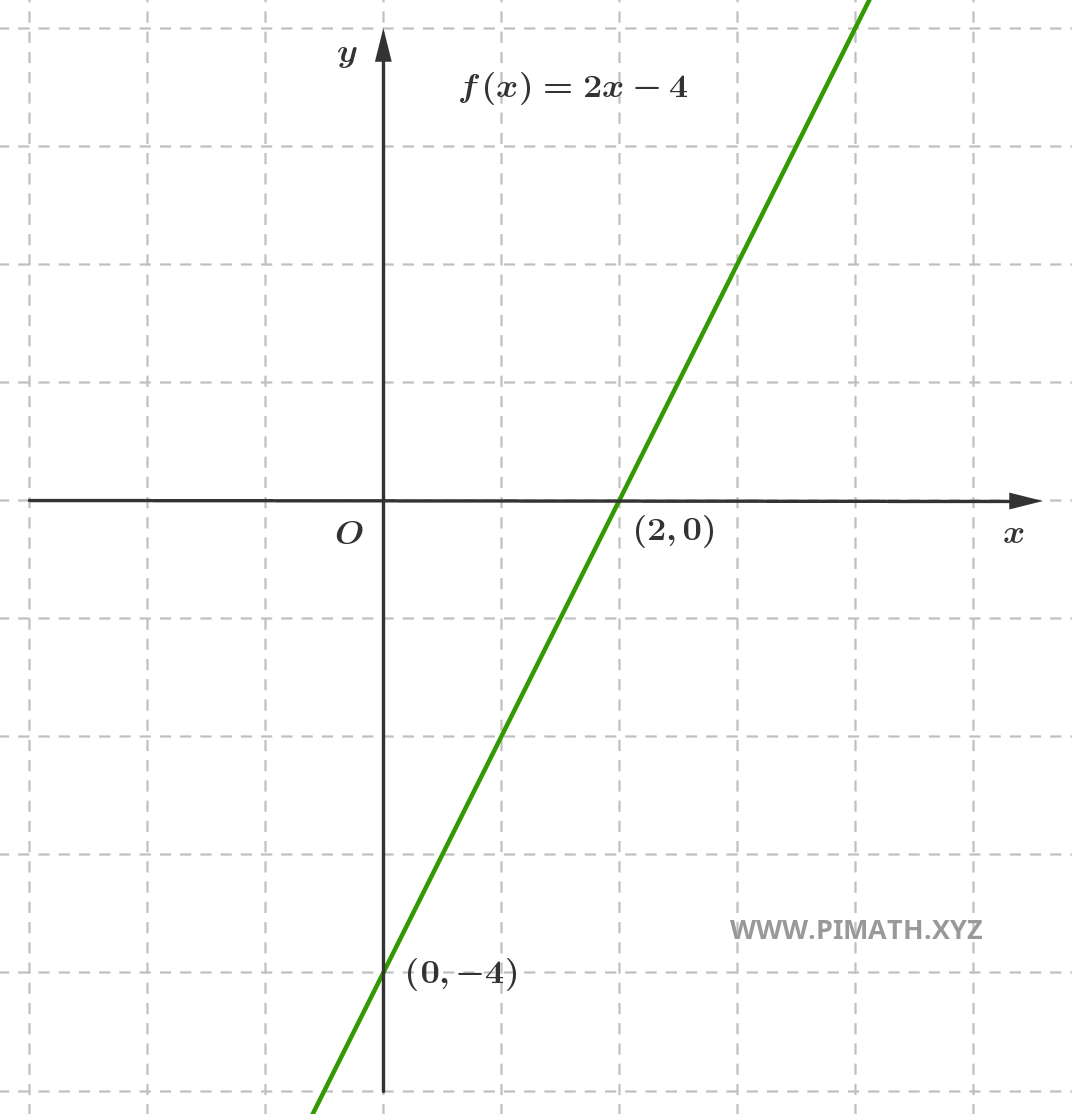
Increasing line with a zero at \(x=2\), no asymptotes, no extrema.
Solution
Domain and symmetries
The function is a first-degree polynomial, so it is defined for every real value: \(\mathcal{D}=\mathbb{R}\). To check for symmetries we compute \(f(-x)=-2x-4\): this coincides neither with \(f(x)=2x-4\) nor with \(-f(x)=-2x+4\), hence the function is neither even nor odd.
Intercepts with the axes
For the \(y\)-axis we compute \(f(0)=2\cdot0-4=-4\), so the graph intersects the \(y\)-axis at the point \((0,-4)\). For the \(x\)-axis we set \(f(x)=0\):
\[ 2x-4=0 \implies x=2 \]
The only zero is \(x=2\), i.e. the point \((2,0)\).
Sign analysis
Since the coefficient of \(x\) is positive, the function is negative to the left of the zero and positive to the right:
\[ f(x) > 0 \iff x > 2 \qquad f(x) < 0 \iff x < 2 \]
Limits and asymptotes
Since we are dealing with a polynomial, \(\lim_{x\to+\infty}f(x)=+\infty\) and \(\lim_{x\to-\infty}f(x)=-\infty\). There are no asymptotes of any kind.
First derivative and monotonicity
We compute \(f'(x)=2\). Since the derivative is constantly positive, the function is strictly increasing on all of \(\mathbb{R}\) and has neither maxima nor minima.
Second derivative and concavity
We have \(f''(x)=0\) everywhere: the graph has no inflection points and never changes concavity.
Result
\[ \boxed{f \text{ is an increasing line with a zero at } x=2} \]
Graph of the Function
Exercise 2 — level ★☆☆☆☆
\[ f(x) = x^2 - 4 \]
Result
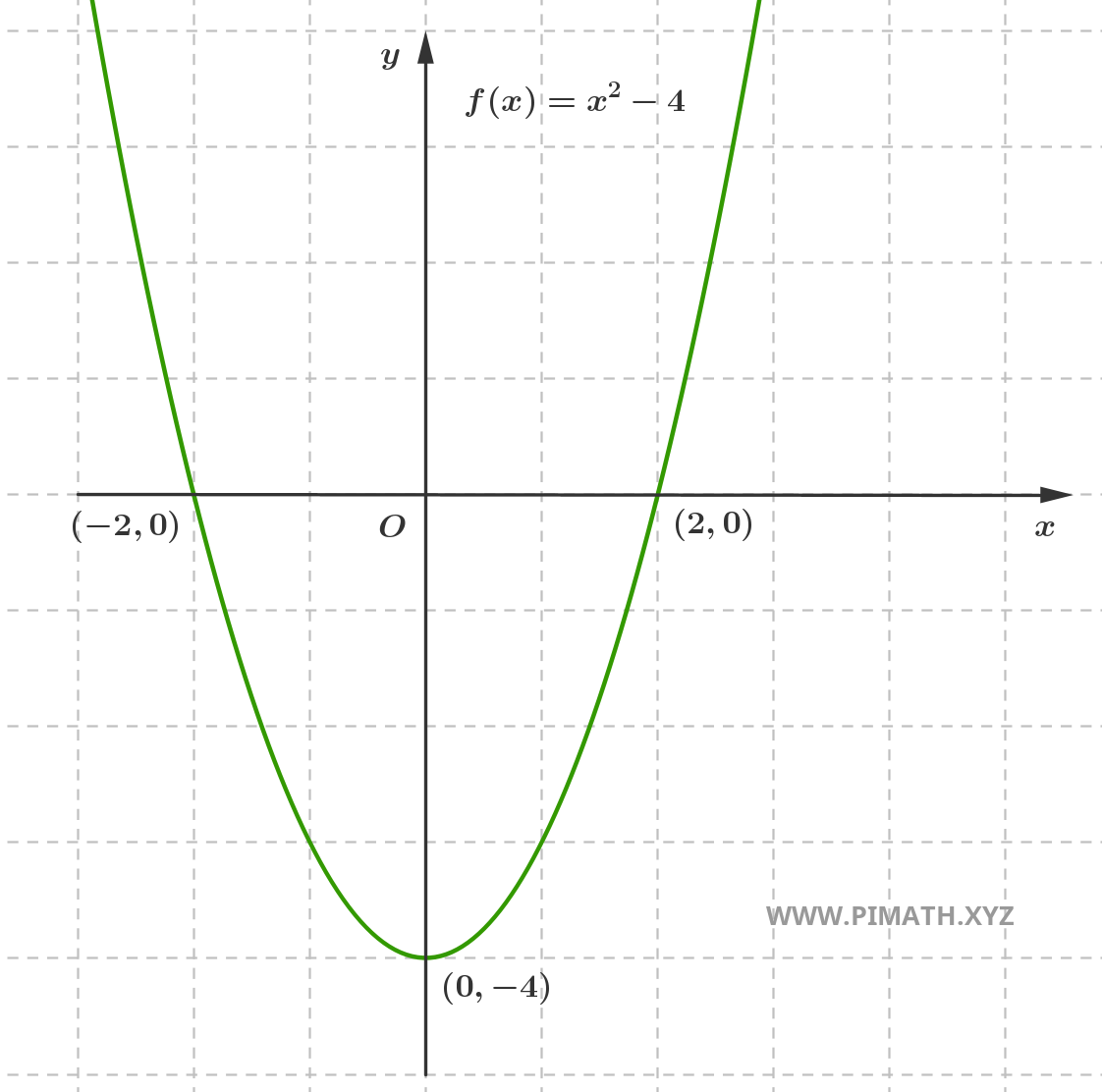
Even parabola with vertex \((0,-4)\), zeros at \(x=\pm2\), absolute minimum at \(x=0\).
Solution
Domain and symmetries
The domain is \(\mathbb{R}\). Since \(f(-x)=(-x)^2-4=x^2-4=f(x)\), the function is even: the graph is symmetric with respect to the \(y\)-axis, so it is enough to study it for \(x\geq0\) and then reflect.
Intercepts with the axes
The graph intersects the \(y\)-axis at the point \((0,-4)\). The zeros are found by solving \(x^2-4=0\), from which \(x^2=4\) and hence \(x=\pm2\): the graph crosses the \(x\)-axis at the points \((\pm2,0)\).
Sign analysis
The expression \(x^2-4=(x-2)(x+2)\) is a product of two linear factors. The sign changes at the points \(x=-2\) and \(x=2\):
\[ f(x) > 0 \iff x < -2 \text{ or } x > 2 \qquad f(x) < 0 \iff -2 < x < 2 \]
Limits and asymptotes
The dominant term is \(x^2\), so \(\lim_{x\to\pm\infty}f(x)=+\infty\). There are no asymptotes.
First derivative and monotonicity
We compute \(f'(x)=2x\), which vanishes at \(x=0\). For \(x<0\) the derivative is negative (decreasing function), for \(x>0\) it is positive (increasing function). The point \(x=0\) is therefore an absolute minimum, with \(f(0)=-4\).
| \(x\) | \((-\infty,0)\) | \(0\) | \((0,+\infty)\) |
| \(f'(x)\) | − | 0 | + |
| \(f(x)\) | ↘ | min | ↗ |
Second derivative and concavity
We have \(f''(x)=2>0\) everywhere: the parabola is always concave up (U-shaped) and exhibits no inflection points.
Result
\[ \boxed{\text{absolute minimum at }(0,-4),\quad \text{zeros at }x=\pm2} \]
Graph of the Function
Exercise 3 — level ★★☆☆☆
\[ f(x) = x^3 - 3x \]
Result
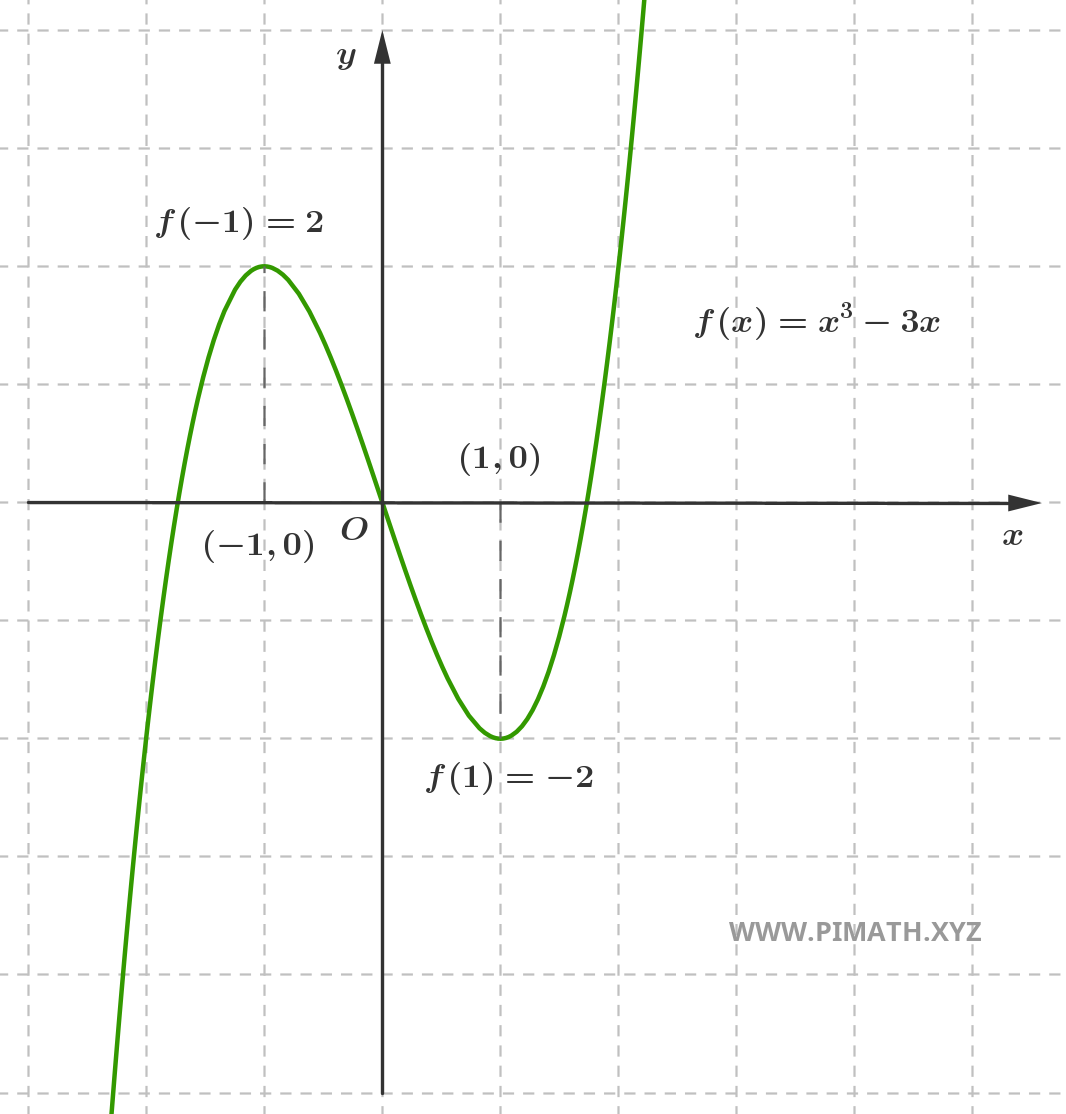
Odd function with a local maximum at \((-1,2)\), a local minimum at \((1,-2)\) and an inflection point at the origin.
Solution
Domain and symmetries
The domain is \(\mathbb{R}\). Since \(f(-x)=-x^3+3x=-(x^3-3x)=-f(x)\), the function is odd: the graph is symmetric with respect to the origin. This halves the work: we will study the behavior for \(x\geq0\) and then reflect.
Intercepts with the axes
The graph passes through the origin \((0,0)\). To find the other zeros we factor:
\[ x^3-3x = x(x^2-3) = 0 \implies x=0,\quad x=\sqrt{3},\quad x=-\sqrt{3} \]
Sign analysis
The function can be written as \(f(x)=x(x-\sqrt{3})(x+\sqrt{3})\). The three factors change sign respectively at \(x=-\sqrt{3}\), \(x=0\) and \(x=\sqrt{3}\):
\[ f(x)>0 \iff -\sqrt{3} < x < 0 \text{ or } x > \sqrt{3} \]
Limits and asymptotes
Like any odd-degree polynomial with positive leading coefficient, \(f(x)\to+\infty\) as \(x\to+\infty\) and \(f(x)\to-\infty\) as \(x\to-\infty\). There are no asymptotes.
First derivative and monotonicity
We compute \(f'(x)=3x^2-3=3(x^2-1)=3(x-1)(x+1)\). The derivative vanishes at \(x=-1\) and \(x=1\). The sign of \(f'\) is determined by observing that the coefficient \(3>0\) and the roots are \(\pm1\):
| \(x\) | \((-\infty,-1)\) | \(-1\) | \((-1,1)\) | \(1\) | \((1,+\infty)\) |
| \(f'(x)\) | + | 0 | − | 0 | + |
| \(f(x)\) | ↗ | max | ↘ | min | ↗ |
The point \(x=-1\) is a local maximum with \(f(-1)=2\), the point \(x=1\) is a local minimum with \(f(1)=-2\).
Second derivative and inflection points
We compute \(f''(x)=6x\), which vanishes at \(x=0\). For \(x<0\) we have \(f''<0\) (concave down), for \(x>0\) we have \(f''>0\) (concave up): the concavity changes at \(x=0\), so the origin is an inflection point.
Result
\[ \boxed{\max(-1,\,2),\quad \min(1,\,-2),\quad \text{inflection point at }(0,0)} \]
Cartesian Graph
Exercise 4 — level ★★☆☆☆
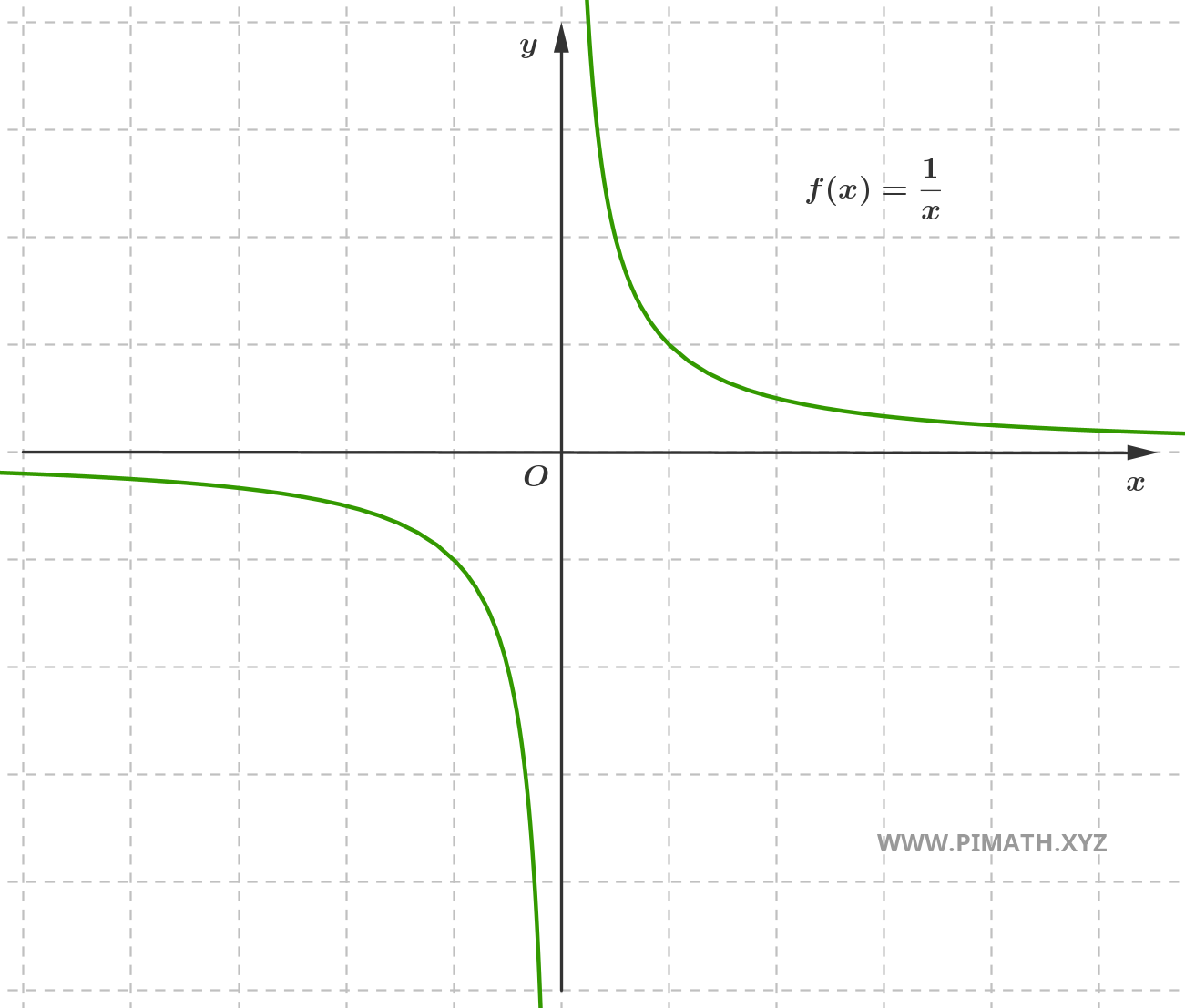
\[ f(x) = \frac{1}{x} \]
Result
Odd function, domain \(\mathbb{R}\setminus\{0\}\), asymptotes \(x=0\) and \(y=0\), strictly decreasing on each branch.
Solution
Domain and symmetries
The function is not defined at \(x=0\), so \(\mathcal{D}=\mathbb{R}\setminus\{0\}\). Since \(f(-x)=\tfrac{1}{-x}=-\tfrac{1}{x}=-f(x)\), the function is odd and the graph is symmetric with respect to the origin.
Intercepts with the axes and sign
The equation \(\tfrac{1}{x}=0\) has no solutions, so there are no zeros. The value \(f(0)\) is not defined, so there is not even an intersection with the \(y\)-axis either. The sign is immediate: the function has the same sign as the denominator \(x\), so
\[ f(x)>0 \iff x>0 \qquad f(x)<0 \iff x<0 \]
Limits and asymptotes
Let us compute the limits at the endpoints of the domain. Approaching zero:
\[ \lim_{x\to0^+}\frac{1}{x}=+\infty \qquad \lim_{x\to0^-}\frac{1}{x}=-\infty \]
So the \(y\)-axis (the line \(x=0\)) is a vertical asymptote. At infinity:
\[ \lim_{x\to\pm\infty}\frac{1}{x}=0 \]
So the \(x\)-axis (the line \(y=0\)) is a horizontal asymptote.
First derivative and monotonicity
We compute \(f'(x)=-\tfrac{1}{x^2}\). Since \(x^2>0\) for every \(x\neq0\), the derivative is always negative: the function is strictly decreasing on \((-\infty,0)\) and on \((0,+\infty)\). It has no extrema.
Second derivative and concavity
We compute \(f''(x)=\tfrac{2}{x^3}\). For \(x>0\) the second derivative is positive (concave up), for \(x<0\) it is negative (concave down). There are no inflection points in the domain because \(x=0\) does not belong to \(\mathcal{D}\).
Result
\[ \boxed{\text{vertical asymptote }x=0,\quad \text{horizontal asymptote }y=0} \]
Cartesian Graph
Exercise 5 — level ★★☆☆☆
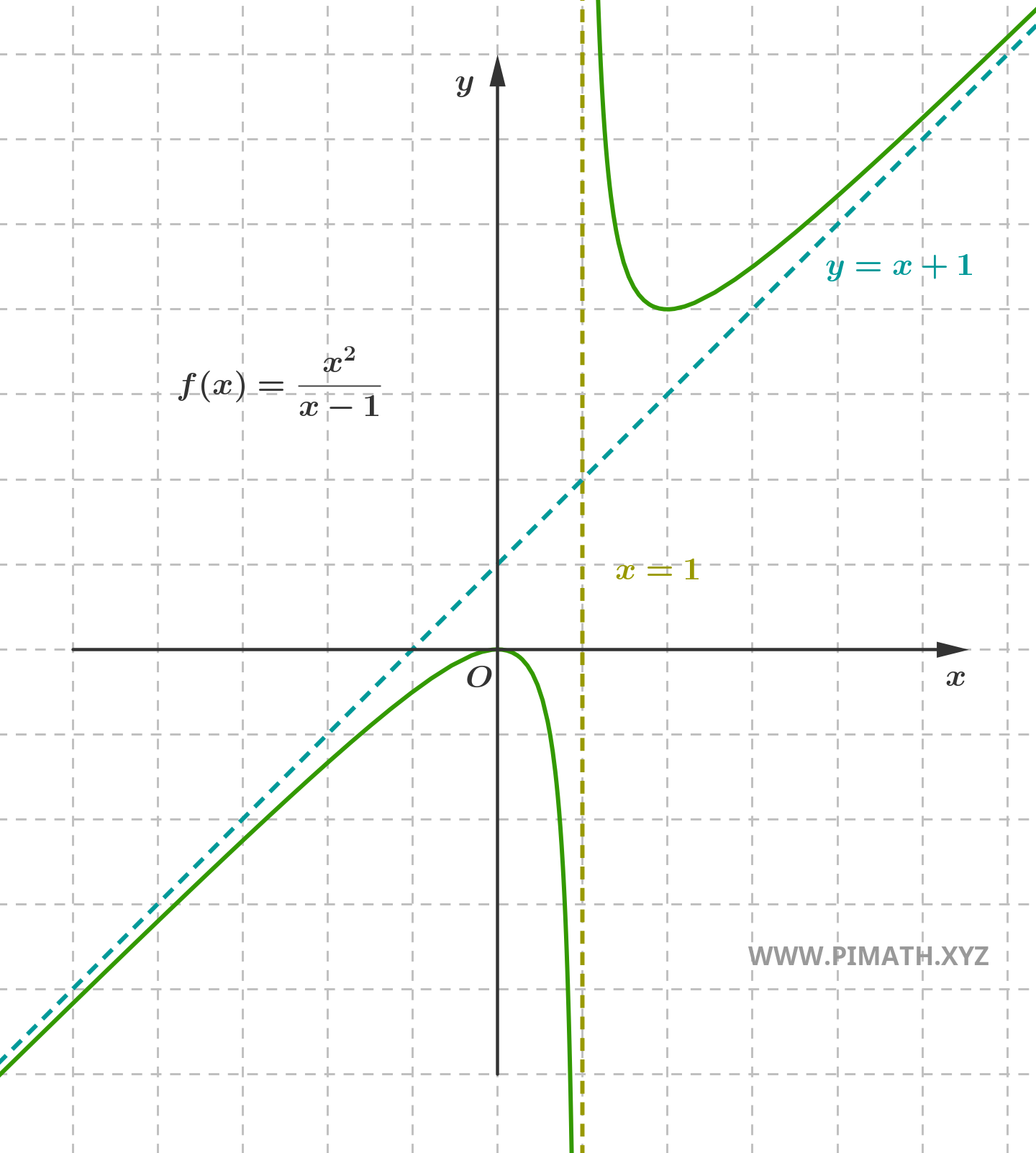
\[ f(x) = \frac{x^2}{x-1} \]
Result
Domain \(\mathbb{R}\setminus\{1\}\), vertical asymptote \(x=1\), oblique asymptote \(y=x+1\), local maximum at \((0,0)\) and local minimum at \((2,4)\).
Solution
Domain and symmetries
The function is defined for every \(x\) that does not make the denominator vanish: \(\mathcal{D}=\mathbb{R}\setminus\{1\}\). The function has no symmetries (it is neither even nor odd).
Intercepts with the axes and sign
The only intersection with the axes is the origin \((0,0)\). Since the numerator \(x^2\) is always non-negative, the sign of \(f(x)\) matches that of the denominator: \[ f(x) > 0 \iff x > 1 \qquad f(x) < 0 \iff x < 1 \; (x \neq 0) \]
Asymptotes
Vertical asymptote: \[ \lim_{x\to1^+} \frac{x^2}{x-1} = +\infty, \quad \lim_{x\to1^-} \frac{x^2}{x-1} = -\infty \] The line \(x=1\) is a vertical asymptote.
Oblique asymptote: Since the degree of the numerator is one unit higher than that of the denominator, we perform polynomial long division: \[ \frac{x^2}{x-1} = x + 1 + \frac{1}{x-1} \] As \(x \to \pm\infty\), the fractional term tends to zero. Therefore, the line \(y = x + 1\) is the oblique asymptote.
First derivative and monotonicity
We compute the first derivative: \[ f'(x) = \frac{2x(x-1) - x^2(1)}{(x-1)^2} = \frac{x^2 - 2x}{(x-1)^2} = \frac{x(x-2)}{(x-1)^2} \] The derivative vanishes at \(x=0\) and \(x=2\). Studying its sign:
| \(x\) | \((-\infty,0)\) | \(0\) | \((0,1)\) | \(1\) | \((1,2)\) | \(2\) | \((2,+\infty)\) |
| \(f'(x)\) | + | 0 | - | undef. | - | 0 | + |
| \(f(x)\) | ↗ | max | ↘ | ∞ | ↘ | min | ↗ |
We have a local maximum at \(M(0,0)\) and a local minimum at \(m(2,4)\).
Final result
\[ \boxed{\text{Oblique asymptote: } y=x+1; \quad \text{Max}(0,0); \quad \text{Min}(2,4)} \]
Graph of the Function
Exercise 6 — level ★★★☆☆
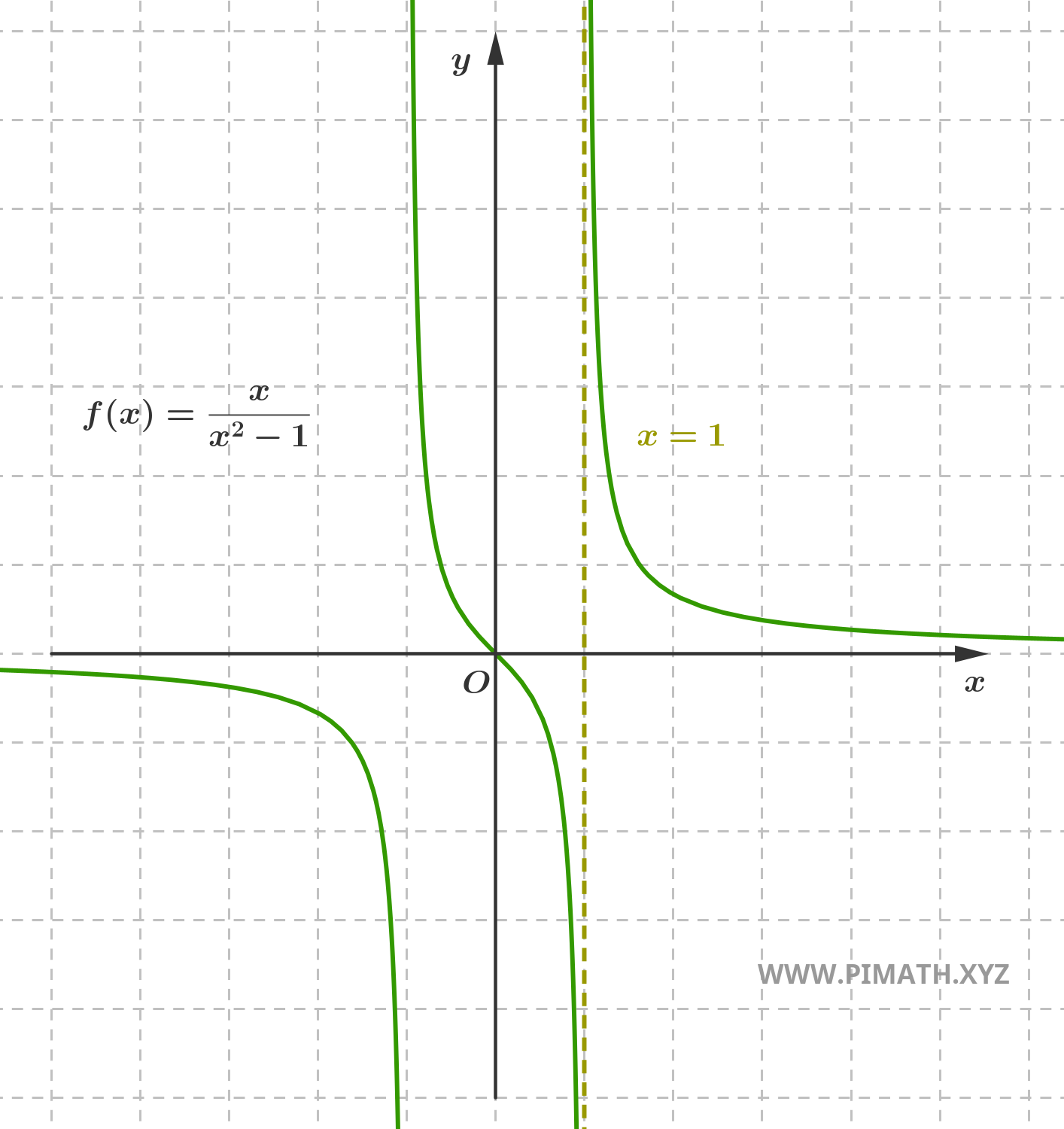
\[ f(x) = \frac{x}{x^2-1} \]
Result
Odd function, domain \(\mathbb{R}\setminus\{\pm1\}\), vertical asymptotes \(x=\pm1\), horizontal asymptote \(y=0\), strictly decreasing on each interval of the domain.
Solution
Domain and symmetries
The denominator \(x^2-1=(x-1)(x+1)\) vanishes at \(x=\pm1\), so \(\mathcal{D}=\mathbb{R}\setminus\{-1,1\}\). Since \(f(-x)=\tfrac{-x}{x^2-1}=-f(x)\), the function is odd.
Intercepts with the axes and sign
The only zero is \(x=0\), with \(f(0)=0\). To study the sign we analyze the numerator and the denominator separately. The denominator \((x-1)(x+1)\) is positive for \(|x|>1\) and negative for \(|x|<1\):
\[ f(x)>0 \iff \frac{x}{(x-1)(x+1)}>0 \iff x\in(-1,0)\cup(1,+\infty) \]
Limits and asymptotes
We compute the limits at the excluded points. At \(x=1\): the numerator equals \(1\) and the denominator tends to \(0\), so \(f(x)\to\pm\infty\): vertical asymptote \(x=1\). Similarly \(x=-1\) is a vertical asymptote.
As \(x\to\pm\infty\): the degree of the numerator is lower than that of the denominator, so
\[ \lim_{x\to\pm\infty}\frac{x}{x^2-1}=0 \]
The \(x\)-axis is a horizontal asymptote \(y=0\).
First derivative and monotonicity
Applying the quotient rule:
\[ f'(x)=\frac{(x^2-1)-x\cdot2x}{(x^2-1)^2}=\frac{-x^2-1}{(x^2-1)^2} \]
The numerator \(-(x^2+1)\) is always negative (since \(x^2+1\geq1>0\)), and the denominator is always positive. So \(f'(x)<0\) on the whole domain: the function is strictly decreasing on each interval and has no extrema.
Result
\[ \boxed{f \text{ strictly decreasing on each interval of the domain, no extrema}} \]
Graph of the Function
Exercise 7 — level ★★★☆☆
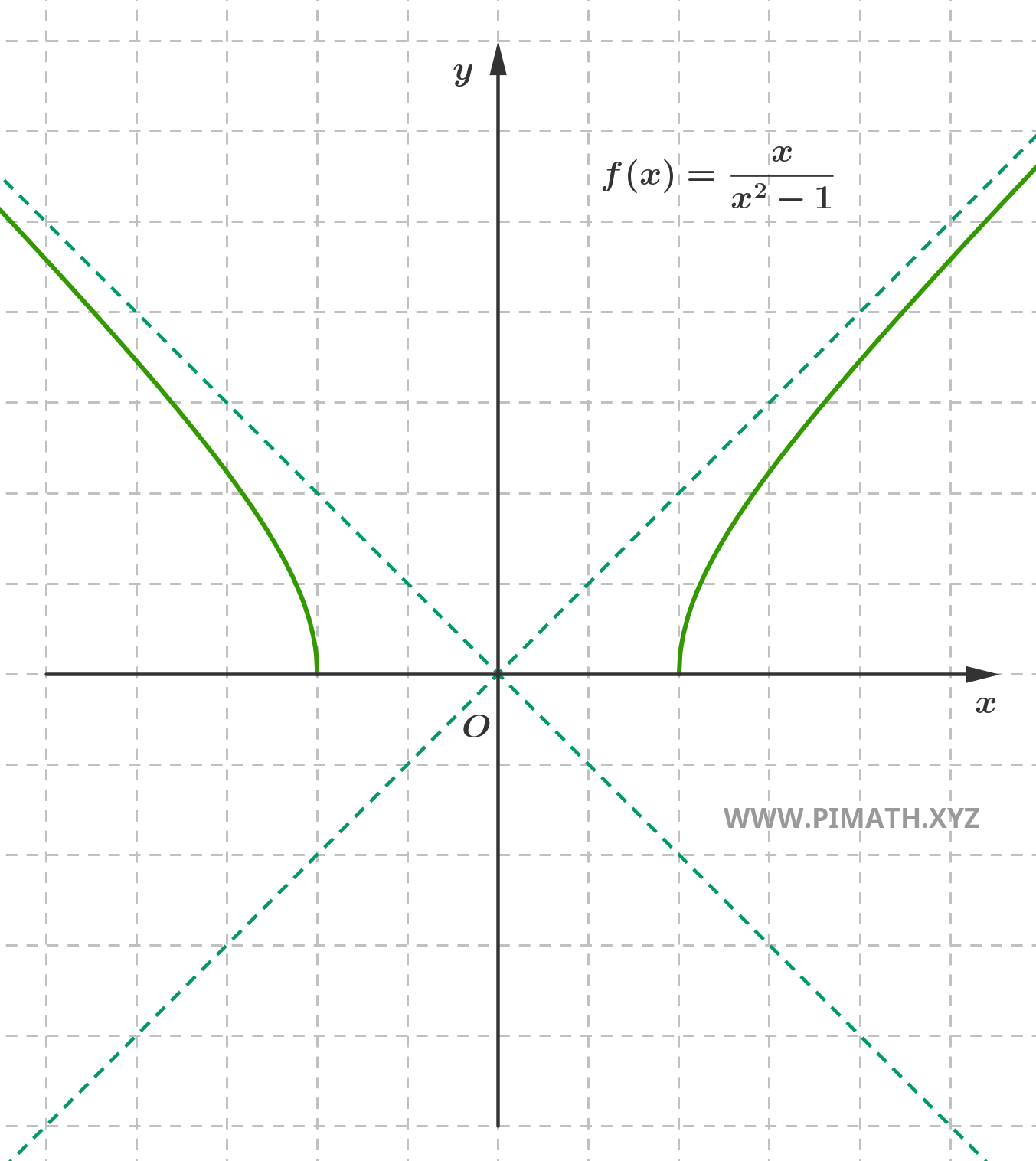
\[ f(x) = \sqrt{x^2 - 4} \]
Result
Even function, domain \((-\infty,-2]\cup[2,+\infty)\), zeros at \(x=\pm2\), oblique asymptotes \(y=\pm x\).
Solution
Domain and symmetries
The expression under the square root must be non-negative: \(x^2-4\geq0\) if and only if \((x-2)(x+2)\geq0\), i.e. \(x\leq-2\) or \(x\geq2\). The domain is therefore \(\mathcal{D}=(-\infty,-2]\cup[2,+\infty)\). Since \(f(-x)=\sqrt{(-x)^2-4}=\sqrt{x^2-4}=f(x)\), the function is even.
Intercepts with the axes and sign
The endpoints of the domain \(x=\pm2\) are the only zeros, because at these points the argument of the square root equals zero. There are no intersections with the \(y\)-axis since \(0\notin\mathcal{D}\). The function is non-negative by construction: \(f(x)\geq0\) always.
Oblique asymptotes
As \(x\to+\infty\) we first compute the slope:
\[ m=\lim_{x\to+\infty}\frac{f(x)}{x}=\lim_{x\to+\infty}\frac{\sqrt{x^2-4}}{x}=\lim_{x\to+\infty}\sqrt{1-\frac{4}{x^2}}=1 \]
Then the intercept:
\[ q=\lim_{x\to+\infty}(f(x)-x)=\lim_{x\to+\infty}(\sqrt{x^2-4}-x)=\lim_{x\to+\infty}\frac{(x^2-4)-x^2}{\sqrt{x^2-4}+x}=\lim_{x\to+\infty}\frac{-4}{\sqrt{x^2-4}+x}=0 \]
The asymptote as \(x\to+\infty\) is \(y=x\). By symmetry (since the function is even), as \(x\to-\infty\) the asymptote is \(y=-x\).
First derivative and monotonicity
We compute \(f'(x)=\dfrac{2x}{2\sqrt{x^2-4}}=\dfrac{x}{\sqrt{x^2-4}}\). For \(x>2\) the numerator is positive: the function is increasing. For \(x<-2\) the numerator is negative: the function is decreasing. The points \(x=\pm2\) are absolute minima with \(f(\pm2)=0\).
Result
\[ \boxed{\text{minima at }(\pm2,0),\quad \text{oblique asymptotes }y=\pm x} \]
Graph of the Function
Exercise 8 — level ★★★☆☆
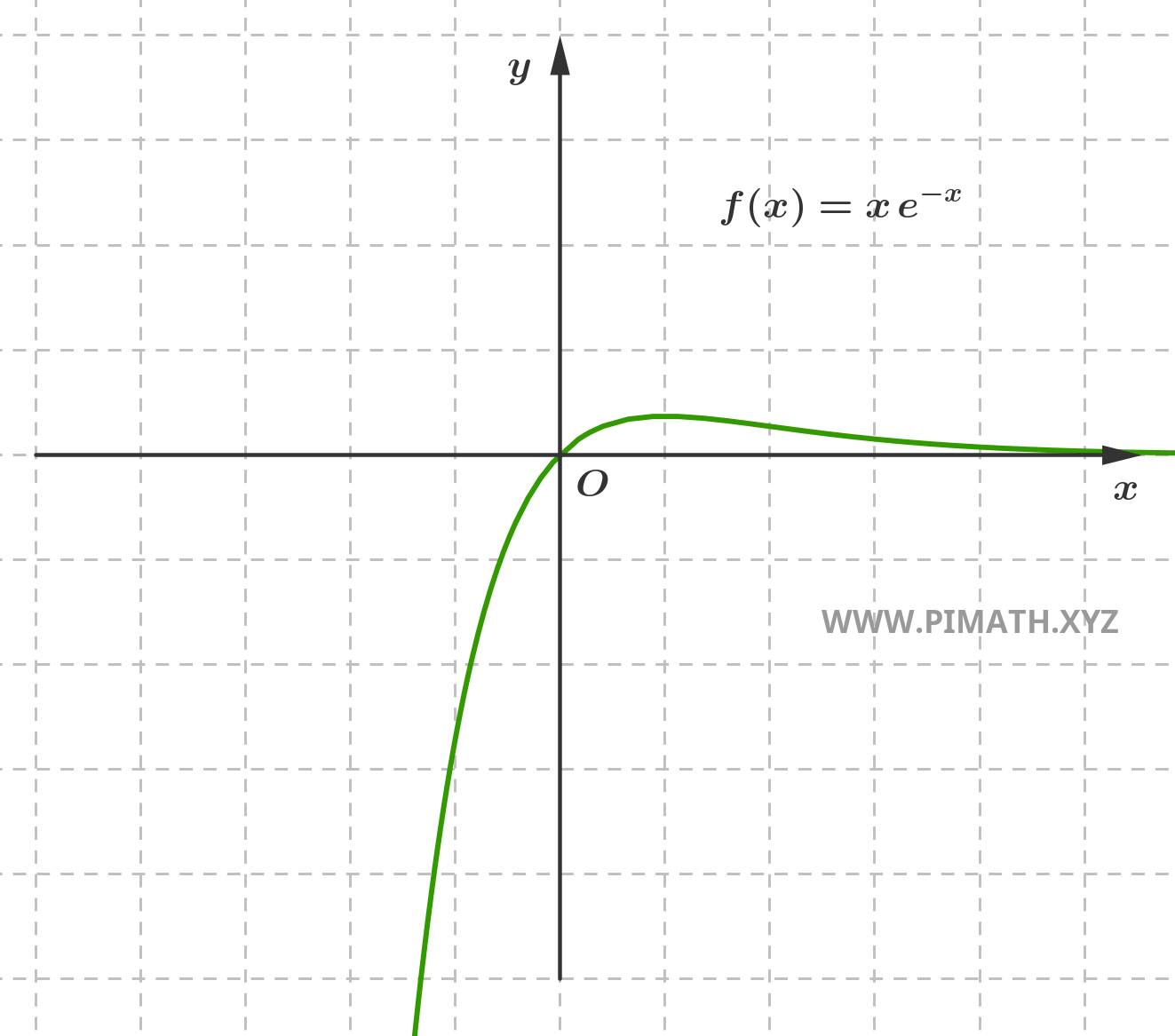
\[ f(x) = x\,e^{-x} \]
Result
Domain \(\mathbb{R}\), zero at \(x=0\), maximum at \((1,e^{-1})\), inflection point at \((2,2e^{-2})\), horizontal asymptote \(y=0\).
Solution
Domain and symmetries
The function is defined on \(\mathbb{R}\). It is neither even nor odd.
Intercepts with the axes and sign
We have \(f(0)=0\). Since \(e^{-x}>0\) for every \(x\), the sign of \(f\) coincides with that of \(x\):
\[ f(x)>0 \iff x>0 \qquad f(x)<0 \iff x<0 \]
Limits and asymptotes
As \(x\to+\infty\) the decaying exponential \(e^{-x}\) tends to zero much faster than \(x\) grows, so \(f(x)\to0\): there is a horizontal asymptote \(y=0\). As \(x\to-\infty\), however, \(e^{-x}\to+\infty\) and \(x\to-\infty\), so \(f(x)\to-\infty\).
First derivative and monotonicity
Applying the product rule:
\[ f'(x)=1\cdot e^{-x}+x\cdot(-e^{-x})=e^{-x}(1-x) \]
Since \(e^{-x}>0\) always, the sign of \(f'\) depends on \((1-x)\):
| \(x\) | \((-\infty,1)\) | \(1\) | \((1,+\infty)\) |
| \(1-x\) | + | 0 | − |
| \(f'(x)\) | + | 0 | − |
| \(f(x)\) | ↗ | max | ↘ |
The point \(x=1\) is an absolute maximum with \(f(1)=e^{-1}\).
Second derivative and inflection points
We compute:
\[ f''(x)=-e^{-x}(1-x)+e^{-x}(-1)=e^{-x}(x-2) \]
Since \(e^{-x}>0\), the sign of \(f''\) depends on \((x-2)\): the function is concave down for \(x<2\) and concave up for \(x>2\). At \(x=2\) the concavity changes: the point \((2,2e^{-2})\) is an inflection point.
Result
\[ \boxed{\max(1,e^{-1}),\quad \text{inflection point at }(2,2e^{-2}),\quad \text{asymptote }y=0} \]
Graph of the Function
Exercise 9 — level ★★★★☆
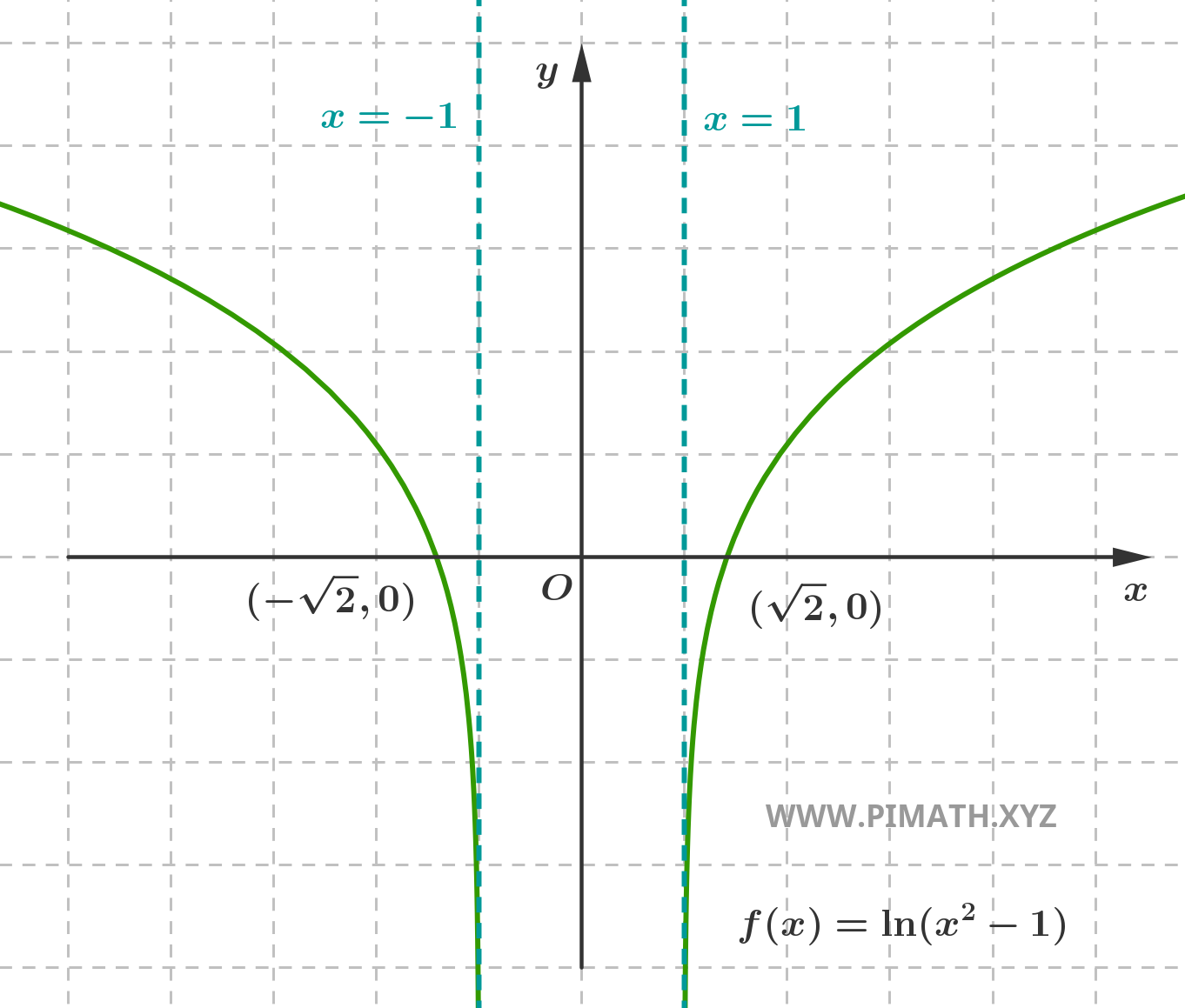
\[ f(x) = \ln(x^2 - 1) \]
Result
Even function, domain \((-\infty,-1)\cup(1,+\infty)\), vertical asymptotes \(x=\pm1\), zeros at \(x=\pm\sqrt{2}\), concave down.
Solution
Domain and symmetries
The logarithm is defined only for strictly positive argument: we need to solve \(x^2-1>0\), i.e. \((x-1)(x+1)>0\), which holds for \(x<-1\) or \(x>1\). The domain is \(\mathcal{D}=(-\infty,-1)\cup(1,+\infty)\). Since \(f(-x)=\ln(x^2-1)=f(x)\), the function is even.
Intercepts with the axes
There are no intersections with the \(y\)-axis because \(0\notin\mathcal{D}\). To find the zeros we set \(\ln(x^2-1)=0\), i.e. \(x^2-1=1\), so \(x^2=2\) and hence \(x=\pm\sqrt{2}\).
Sign
The logarithm is positive when its argument is greater than \(1\), i.e. when \(x^2-1>1\), that is \(|x|>\sqrt{2}\). It is negative for \(1<|x|<\sqrt{2}\).
Asymptotes
Approaching \(x=1^+\) the argument \(x^2-1\to0^+\), so \(\ln(x^2-1)\to-\infty\): the line \(x=1\) is a vertical asymptote. By symmetry, so is \(x=-1\). As \(x\to+\infty\) the function tends to \(+\infty\): there are no horizontal asymptotes.
First derivative and monotonicity (for \(x>1\))
Differentiating via the chain rule:
\[ f'(x)=\frac{1}{x^2-1}\cdot2x=\frac{2x}{x^2-1} \]
For \(x>1\) both the numerator \(2x\) and the denominator \(x^2-1\) are positive, so \(f'(x)>0\): the function is increasing on \((1,+\infty)\). By symmetry it is decreasing on \((-\infty,-1)\). There are no local extrema.
Second derivative and concavity
We compute:
\[ f''(x)=\frac{2(x^2-1)-2x\cdot2x}{(x^2-1)^2}=\frac{-2x^2-2}{(x^2-1)^2}=\frac{-2(x^2+1)}{(x^2-1)^2} \]
Since \(x^2+1>0\) always, we have \(f''(x)<0\) on the whole domain: the graph is everywhere concave down and exhibits no inflection points.
Result
\[ \boxed{\text{zeros at }x=\pm\sqrt{2},\quad \text{asymptotes }x=\pm1,\quad \text{concave down}} \]
Graph of the Function
Exercise 10 — level ★★★★☆
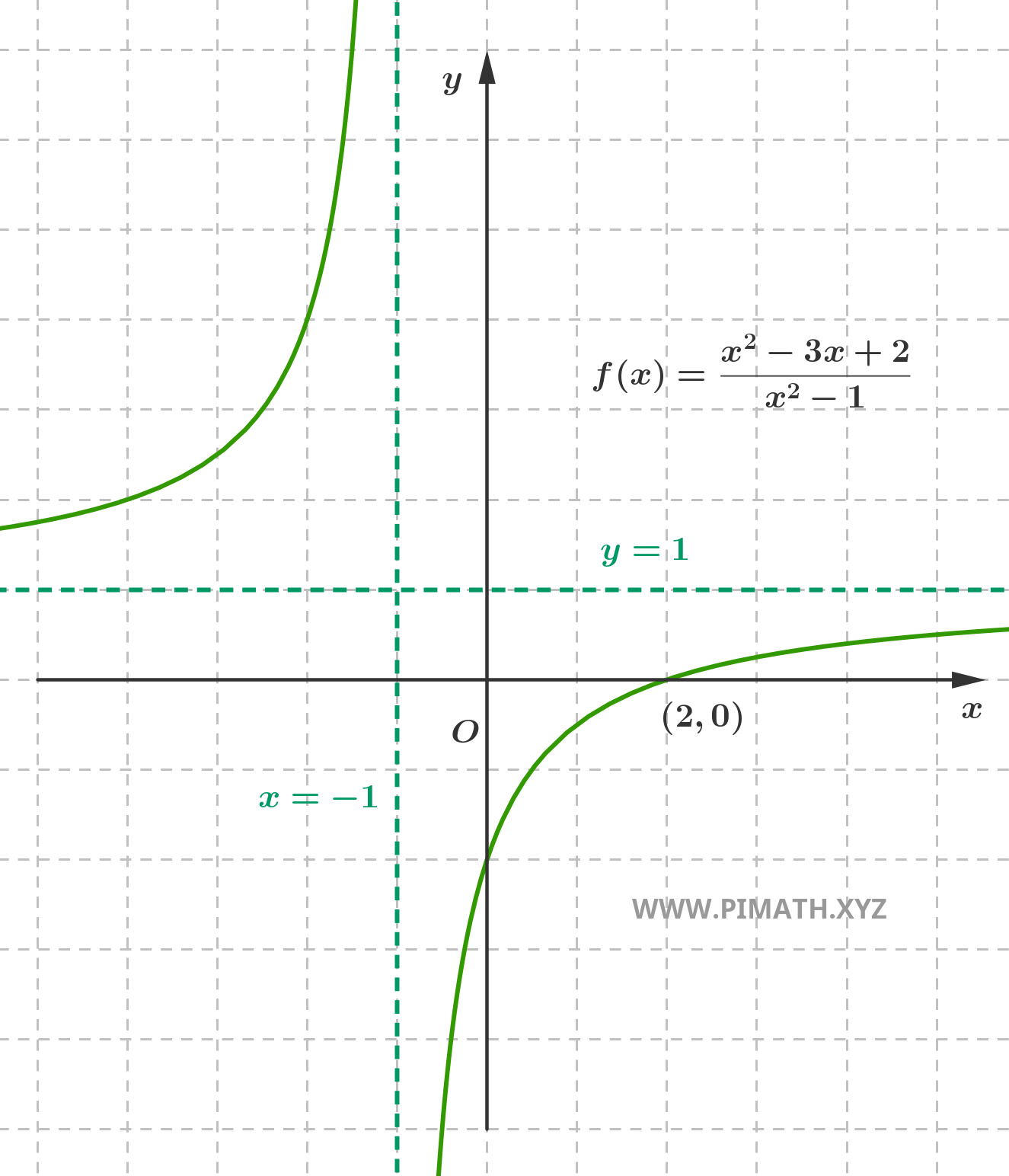
\[ f(x) = \frac{x^2 - 3x + 2}{x^2 - 1} \]
Result
Domain \(\mathbb{R}\setminus\{-1,1\}\), "hole" at \(x=1\), vertical asymptote \(x=-1\), horizontal asymptote \(y=1\), zero at \(x=2\), strictly increasing.
Solution
Preliminary simplification
Before proceeding, it is convenient to factor numerator and denominator:
\[ f(x)=\frac{(x-1)(x-2)}{(x-1)(x+1)} \]
The factor \((x-1)\) is common: cancelling it we obtain the reduced form \(g(x)=\dfrac{x-2}{x+1}\), valid for \(x\neq1\). At \(x=1\) the original function is not defined, but the limit exists and is finite:
\[ \lim_{x\to1}f(x)=\frac{1-2}{1+1}=-\frac{1}{2} \]
This is a removable discontinuity.
Domain
The original denominator vanishes at \(x=\pm1\), so \(\mathcal{D}=\mathbb{R}\setminus\{-1,1\}\).
Intercepts with the axes and sign
On the \(y\)-axis: \(f(0)=\tfrac{0-2}{0+1}=-2\). On the \(x\)-axis: the reduced numerator vanishes at \(x=2\), the only zero of the function. The sign is studied on the reduced form: \(\dfrac{x-2}{x+1}>0\) for \(x<-1\) or \(x>2\).
Asymptotes
Vertical asymptote. At \(x=-1\) the reduced denominator vanishes while the numerator equals \(-3\neq0\): the line \(x=-1\) is a vertical asymptote. (At \(x=1\), on the other hand, there is the hole, not an asymptote.)
Horizontal asymptote. As \(x\to\pm\infty\):
\[ \lim_{x\to\pm\infty}\frac{x-2}{x+1}=\lim_{x\to\pm\infty}\frac{1-2/x}{1+1/x}=1 \]
The line \(y=1\) is a horizontal asymptote.
First derivative and monotonicity
Differentiating the reduced form with the quotient rule:
\[ f'(x)=\frac{1\cdot(x+1)-(x-2)\cdot1}{(x+1)^2}=\frac{3}{(x+1)^2} \]
Since \((x+1)^2>0\) always, we have \(f'(x)>0\) on the whole domain: the function is strictly increasing on \((-\infty,-1)\), on \((-1,1)\) and on \((1,+\infty)\). It has no extrema.
Result
\[ \boxed{\text{hole at }x=1,\quad \text{asymptotes }x=-1\text{ and }y=1,\quad \text{zero at }x=2} \]
Graph of the Function
Exercise 11 — level ★★☆☆☆
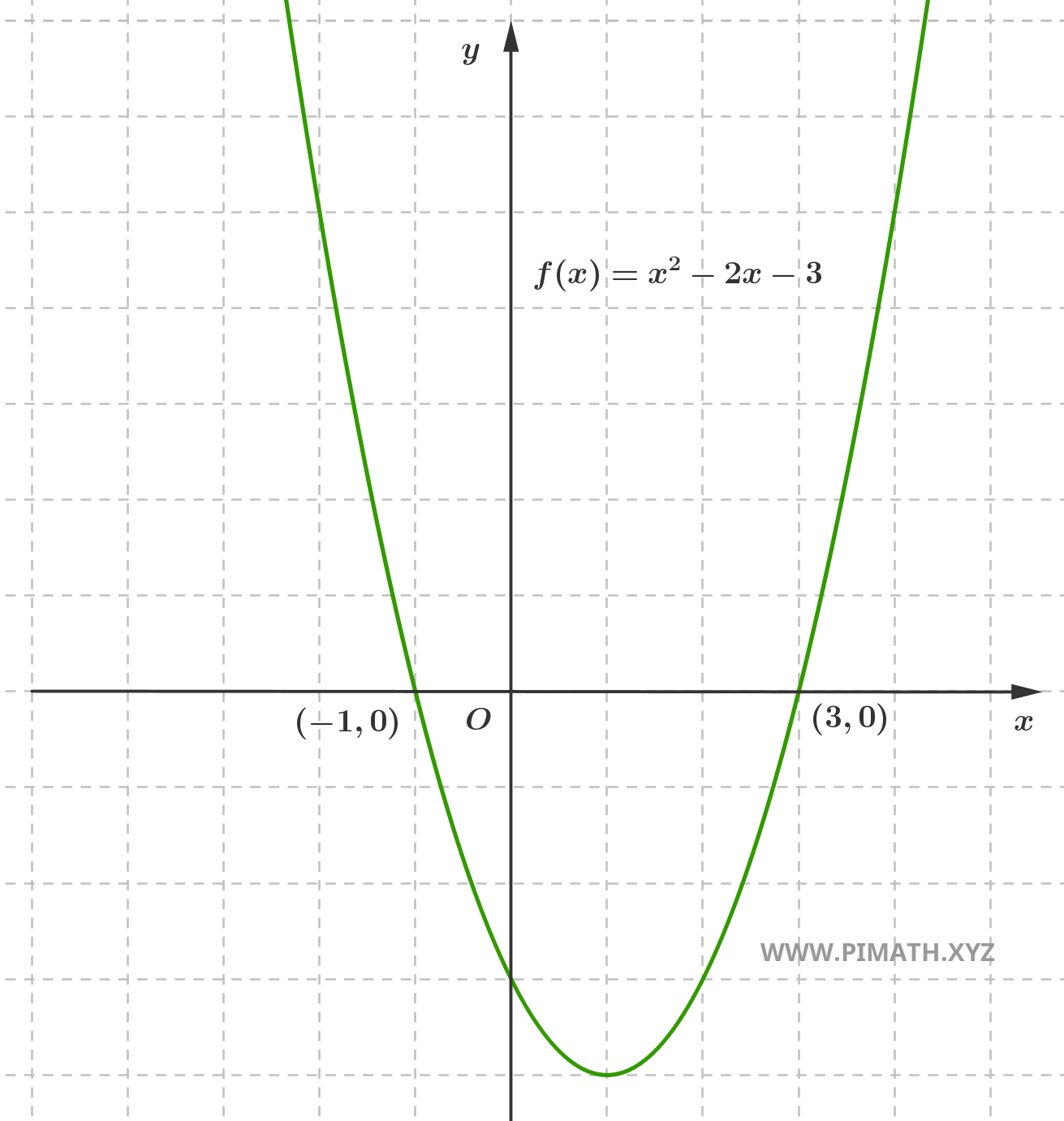
\[ f(x) = x^2 - 2x - 3 \]
Result
Parabola with zeros at \(x=-1\) and \(x=3\), absolute minimum at \((1,-4)\).
Solution
Domain and symmetries
The domain is \(\mathbb{R}\). The function is neither even nor odd. The axis of symmetry of the parabola is the vertical line \(x=1\), obtained from the formula \(x_V = -\frac{b}{2a} = -\frac{-2}{2} = 1\).
Intercepts with the axes
On the \(y\)-axis: we compute \(f(0) = -3\), yielding the point \((0,-3)\).
On the \(x\)-axis: solving \(x^2-2x-3=0\) (by factoring as \((x-3)(x+1)=0\) or via the quadratic formula), we obtain the points \(x=-1\) and \(x=3\).
Sign analysis
Since the coefficient of \(x^2\) is positive (\(a=1\)), the parabola opens upward. The function is positive for values outside the zeros and negative for values between them: \[ f(x) > 0 \iff x < -1 \lor x > 3 \qquad f(x) < 0 \iff -1 < x < 3 \]
Limits and asymptotes
Since we are dealing with a second-degree polynomial: \[ \lim_{x\to\pm\infty} f(x) = +\infty \] There are no horizontal, vertical or oblique asymptotes.
First derivative and monotonicity
The first derivative is \(f'(x) = 2x - 2\). Setting \(f'(x) = 0\) we find the stationary point at \(x=1\). Studying the sign of the derivative (\(2x-2 > 0 \implies x > 1\)), we confirm that the function decreases for \(x < 1\) and increases for \(x > 1\). The point \(V(1, -4)\) is the absolute minimum of the function.
Second derivative and concavity
We have \(f''(x) = 2\). Since the second derivative is constantly positive, the function is always concave up and has no inflection points.
Final result
\[ \boxed{\text{Zeros: } x=-1, 3; \quad \text{Absolute minimum: } (1,-4)} \]
Graph of the Function
Exercise 12 — level ★★☆☆☆
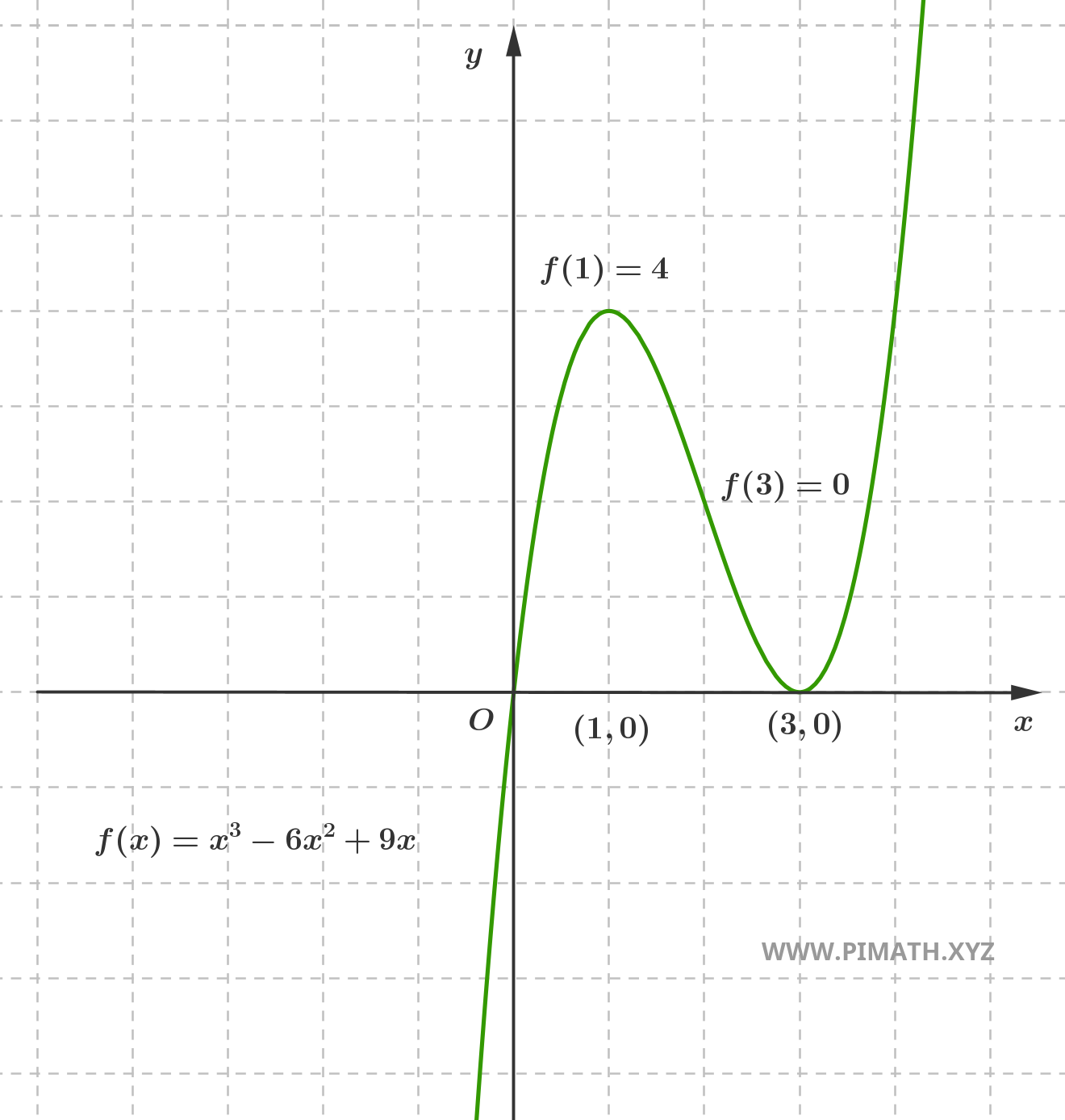
\[ f(x) = x^3 - 6x^2 + 9x \]
Result
Zeros at \(x=0\) and \(x=3\) (double), local maximum at \((1,4)\), local minimum at \((3,0)\), inflection point at \((2,2)\).
Solution
Domain and symmetries
The domain is \(\mathbb{R}\). The function is neither even nor odd.
Intercepts with the axes
On the \(y\)-axis: \(f(0)=0\). Factoring out \(x\) we obtain \(f(x)=x(x^2-6x+9)=x(x-3)^2\): the zeros are \(x=0\) and \(x=3\). Since \(x=3\) is a zero of multiplicity two, the graph touches the \(x\)-axis at that point without crossing it.
Sign analysis
From the product \(x(x-3)^2\), the factor \((x-3)^2\) is always non-negative. The sign of \(f\) therefore depends only on \(x\):
\[ f(x)>0 \iff x>0,\;x\neq3 \qquad f(x)<0 \iff x<0 \]
Limits and asymptotes
Like any cubic with positive leading coefficient, \(f(x)\to+\infty\) as \(x\to+\infty\) and \(f(x)\to-\infty\) as \(x\to-\infty\). There are no asymptotes.
First derivative and monotonicity
We compute \(f'(x)=3x^2-12x+9=3(x^2-4x+3)=3(x-1)(x-3)\), which vanishes at \(x=1\) and \(x=3\).
| \(x\) | \((-\infty,1)\) | \(1\) | \((1,3)\) | \(3\) | \((3,+\infty)\) |
| \(f'(x)\) | + | 0 | − | 0 | + |
| \(f(x)\) | ↗ | max | ↘ | min | ↗ |
The point \(x=1\) is a local maximum with \(f(1)=1-6+9=4\). The point \(x=3\) is a local minimum with \(f(3)=0\): the graph touches the \(x\)-axis with a horizontal tangent.
Second derivative and inflection points
We compute \(f''(x)=6x-12=6(x-2)\), which vanishes at \(x=2\). The second derivative is negative for \(x<2\) (concave down) and positive for \(x>2\) (concave up): the point \((2,\,f(2))=(2,\,8-24+18)=(2,2)\) is an inflection point.
Result
\[ \boxed{\max(1,4),\quad \min(3,0),\quad \text{inflection point at }(2,2)} \]
Graph of the Function
Exercise 13 — level ★★★☆☆
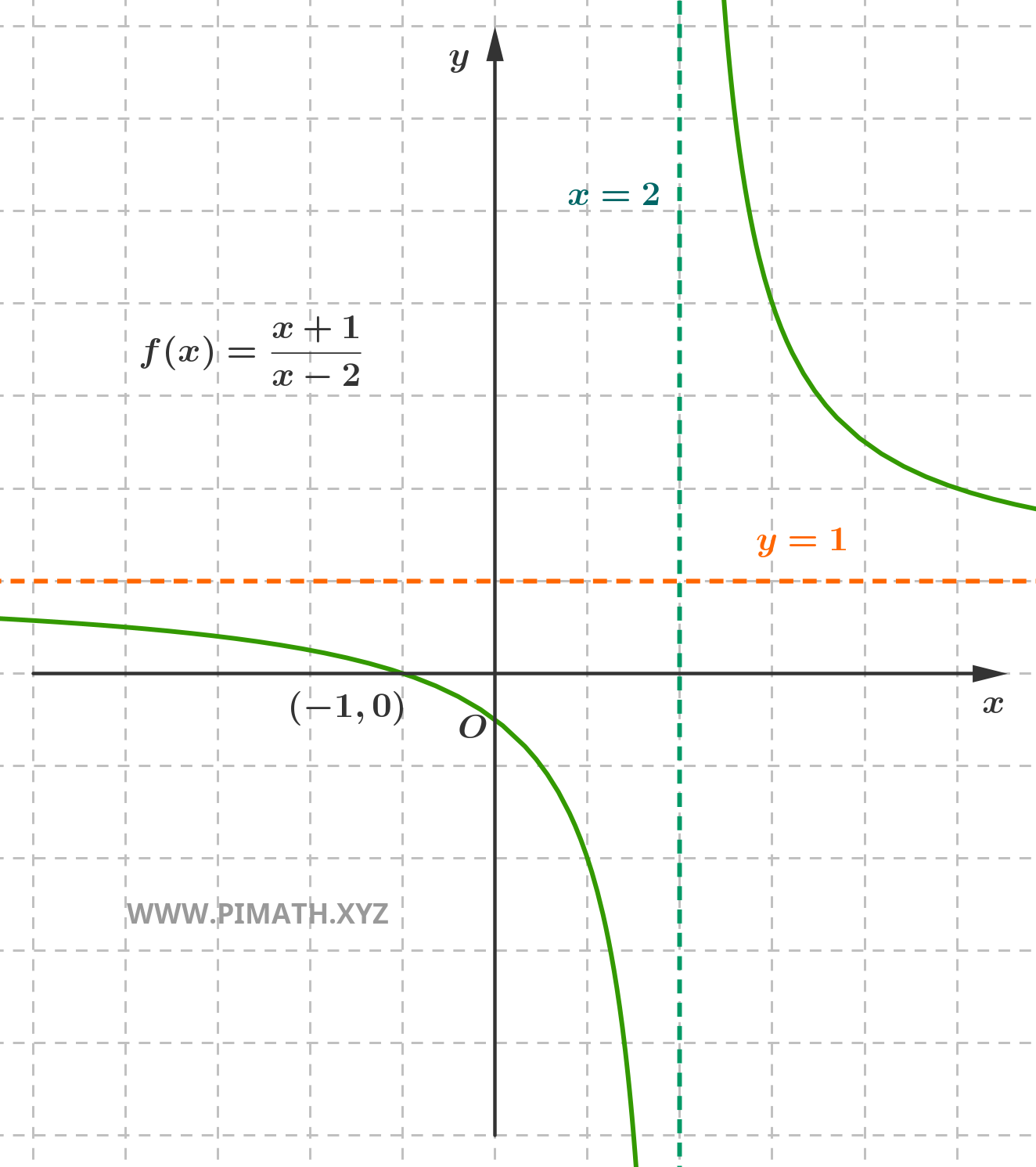
\[ f(x) = \frac{x+1}{x-2} \]
Result
Domain \(\mathbb{R}\setminus\{2\}\), vertical asymptote \(x=2\), horizontal asymptote \(y=1\), zero at \(x=-1\), strictly decreasing on each branch.
Solution
Domain and symmetries
The denominator vanishes at \(x=2\), so \(\mathcal{D}=\mathbb{R}\setminus\{2\}\). The function has no symmetries (it is neither even nor odd).
Intercepts with the axes and sign
On the \(y\)-axis: we compute \(f(0) = \frac{1}{-2} = -0.5\).
On the \(x\)-axis: we set the numerator \(x+1=0\), obtaining \(x=-1\).
Studying the sign of the quotient yields: \[ f(x)>0 \iff x < -1 \lor x > 2 \qquad f(x)<0 \iff -1 < x < 2 \]
Asymptotes
Vertical asymptote: We compute the limits as \(x \to 2\): \[ \lim_{x\to2^+} \frac{x+1}{x-2} = +\infty, \quad \lim_{x\to2^-} \frac{x+1}{x-2} = -\infty \] The line \(x=2\) is a vertical asymptote.
Horizontal asymptote: Since numerator and denominator have the same degree: \[ \lim_{x\to\pm\infty} \frac{x+1}{x-2} = 1 \] The line \(y=1\) is a horizontal asymptote.
First derivative and monotonicity
Using the quotient rule: \[ f'(x) = \frac{1\cdot(x-2) - (x+1)\cdot1}{(x-2)^2} = \frac{x-2-x-1}{(x-2)^2} = \frac{-3}{(x-2)^2} \] Since the numerator is a negative constant and the denominator is a square and therefore always positive, \(f'(x) < 0\) on the whole domain. The function is strictly decreasing on \((-\infty, 2)\) and on \((2, +\infty)\).
Final result
\[ \boxed{\text{Asymptotes: } x=2, y=1; \quad \text{Zero: } x=-1; \quad \text{Decreasing}} \]
Graph of the Function
Exercise 14 — level ★★★☆☆
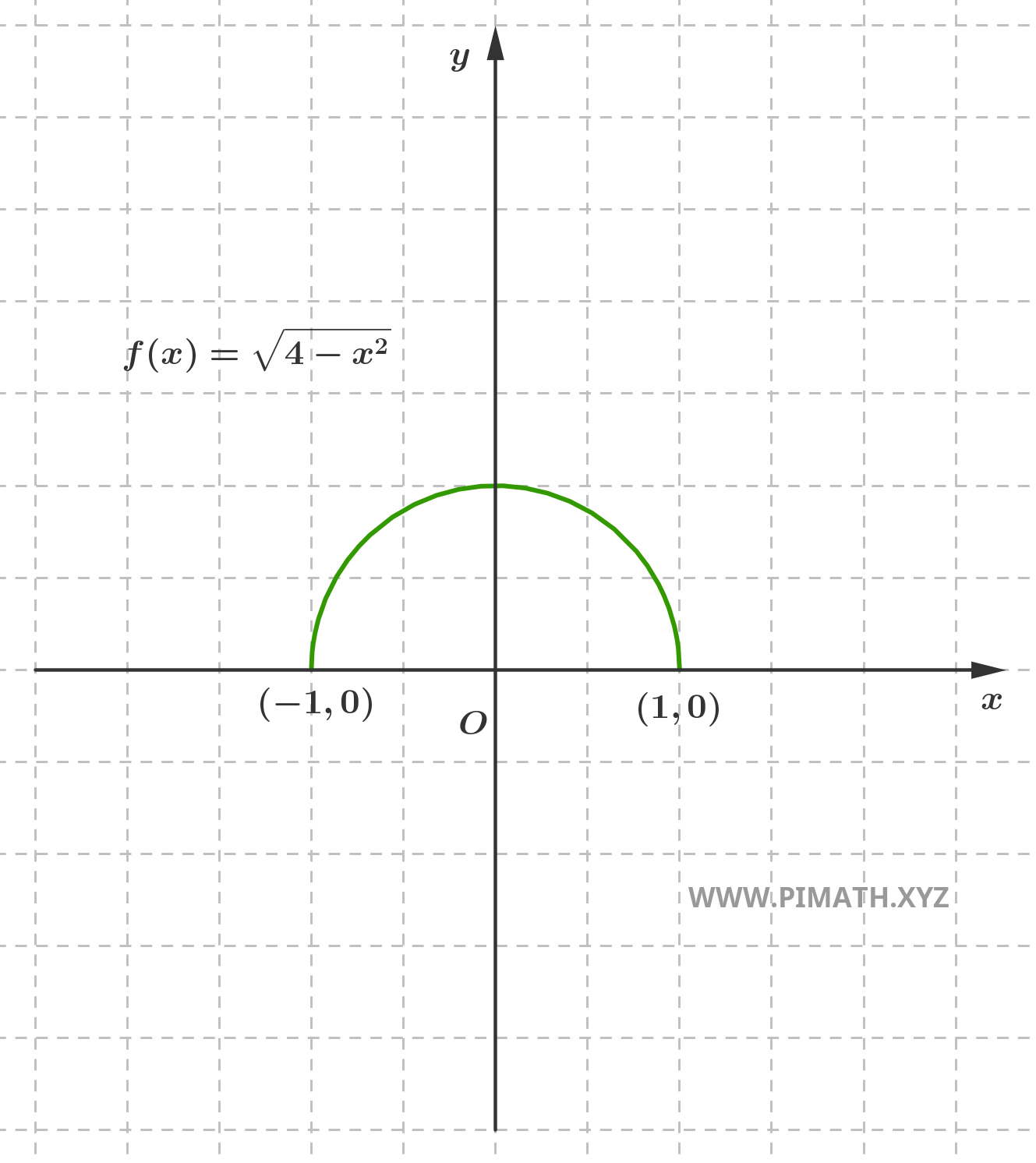
\[ f(x) = \sqrt{4 - x^2} \]
Result
Even function, domain \([-2,2]\), zeros at \(x=\pm2\), absolute maximum at \((0,2)\), always concave down.
Solution
Domain and symmetries
The argument of the square root must be non-negative: \(4-x^2 \geq 0 \iff x^2 \leq 4 \iff |x| \leq 2\). The domain is \(\mathcal{D}=[-2,2]\).
Since \(f(-x)=\sqrt{4-(-x)^2}=\sqrt{4-x^2}=f(x)\), the function is even (symmetric with respect to the \(y\)-axis). Geometrically, it represents the upper half of the circle \(x^2 + y^2 = 4\).
Intercepts with the axes and sign
On the \(y\)-axis: \(f(0) = \sqrt{4} = 2\).
On the \(x\)-axis: \(f(x) = 0 \iff 4-x^2 = 0 \iff x = \pm 2\).
The function is always non-negative (\(f(x) \geq 0\)) on its domain.
First derivative and monotonicity
We compute the first derivative: \[ f'(x) = \frac{-2x}{2\sqrt{4-x^2}} = \frac{-x}{\sqrt{4-x^2}} \] The derivative vanishes at \(x=0\). Studying its sign on the open domain \((-2, 2)\): \[ f'(x) > 0 \iff -x > 0 \iff x < 0 \quad (\text{increasing}) \] \[ f'(x) < 0 \iff -x < 0 \iff x > 0 \quad (\text{decreasing}) \] The point \((0,2)\) is an absolute maximum. At the endpoints \(x = \pm 2\), the limit of the derivative tends to \(\infty\), indicating vertical tangents.
Second derivative and concavity
We compute the second derivative: \[ f''(x) = \frac{-1 \cdot \sqrt{4-x^2} - (-x) \cdot \frac{-x}{\sqrt{4-x^2}}}{4-x^2} = \frac{-(4-x^2) - x^2}{(4-x^2)\sqrt{4-x^2}} = \frac{-4}{(4-x^2)^{3/2}} \] Since the denominator is always positive and the numerator is \(-4\), we have \(f''(x) < 0\) for every \(x \in (-2,2)\). The function is always concave down.
Final result
\[ \boxed{\text{Semicircle: Max}(0,2), \text{ Zeros } x=\pm 2, \text{ Concave down}} \]
Graph of the Function
Exercise 15 — level ★★★☆☆
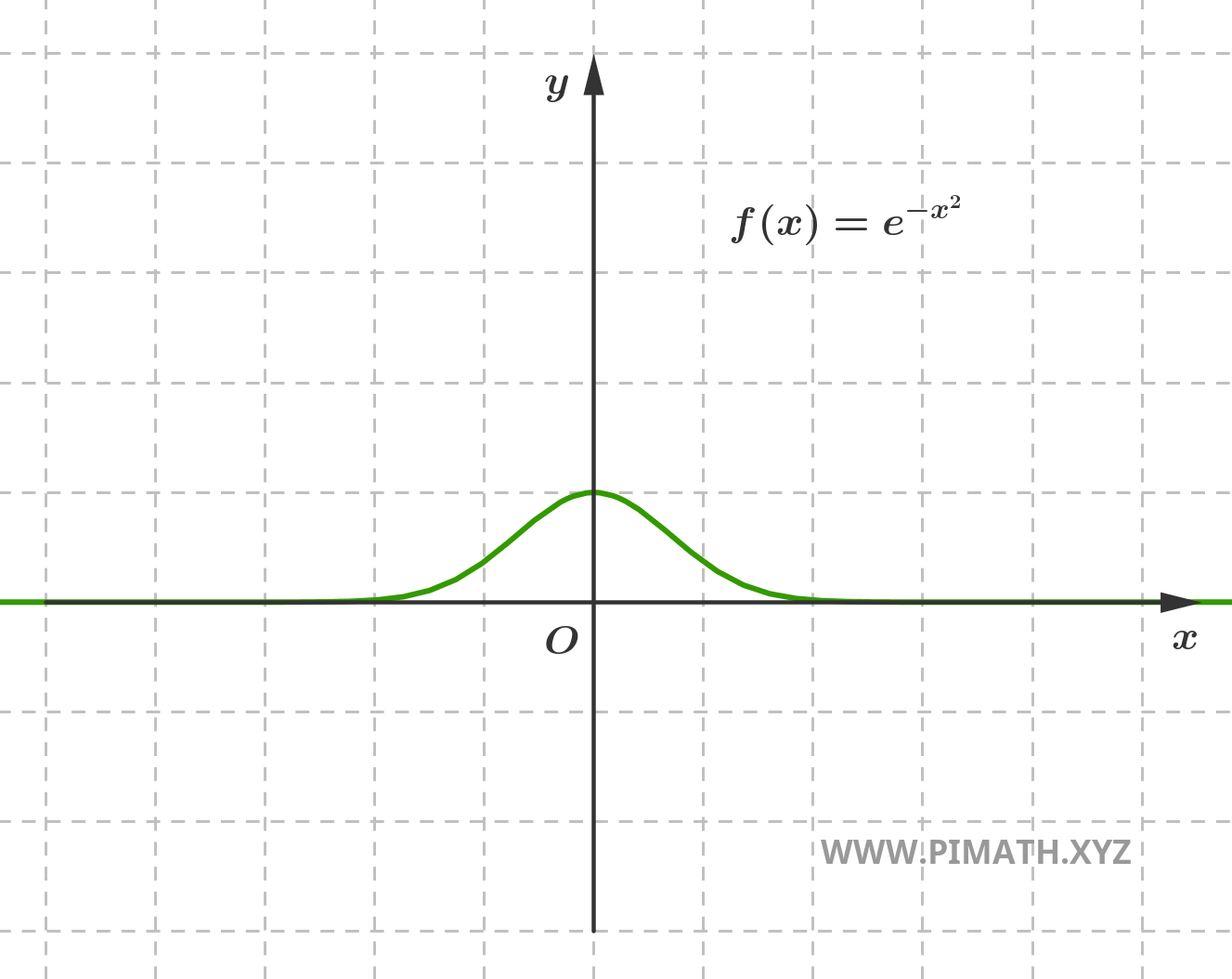
\[ f(x) = e^{-x^2} \]
Result
Even function, domain \(\mathbb{R}\), always positive, absolute maximum at \((0,1)\), horizontal asymptote \(y=0\), inflection points at \(\left(\pm\frac{\sqrt{2}}{2},\,e^{-1/2}\right)\).
Solution
Domain and symmetries
The domain is \(\mathbb{R}\). Since \(f(-x) = e^{-(-x)^2} = e^{-x^2} = f(x)\), the function is even: the graph is symmetric with respect to the \(y\)-axis.
Intercepts with the axes and sign
Since the exponential function is always positive (\(e^{-x^2} > 0\)), there are no intersections with the \(x\)-axis.
The intersection with the \(y\)-axis is at the point \((0,1)\).
Limits and asymptotes
We compute the behavior at infinity: \[ \lim_{x\to\pm\infty} e^{-x^2} = 0 \] The \(x\)-axis (the line \(y=0\)) is a horizontal asymptote for the function.
First derivative and monotonicity
Using the chain rule: \[ f'(x) = -2x \cdot e^{-x^2} \] The sign of the derivative depends only on the factor \(-2x\):
- \(f'(x) > 0\) for \(x < 0\) (increasing function)
- \(f'(x) < 0\) for \(x > 0\) (decreasing function)
The point \((0,1)\) is an absolute maximum.
Second derivative and concavity
Differentiating \(f'(x)\) further using the product rule: \[ f''(x) = -2 \cdot e^{-x^2} + (-2x) \cdot (-2x \cdot e^{-x^2}) = e^{-x^2}(4x^2 - 2) = 2e^{-x^2}(2x^2 - 1) \] The inflection points occur where \(2x^2 - 1 = 0\), that is \(x = \pm\frac{\sqrt{2}}{2}\).
The concavity is upward for \(x < -\frac{\sqrt{2}}{2}\) and \(x > \frac{\sqrt{2}}{2}\), while it is downward on the central interval.
Final result
\[ \boxed{\text{Max}(0,1); \quad \text{Inflection points: } \left(\pm\frac{\sqrt{2}}{2}, \frac{1}{\sqrt{e}}\right); \quad \text{Asymptote: } y=0} \]
Graph of the Function
Exercise 16 — level ★★★☆☆
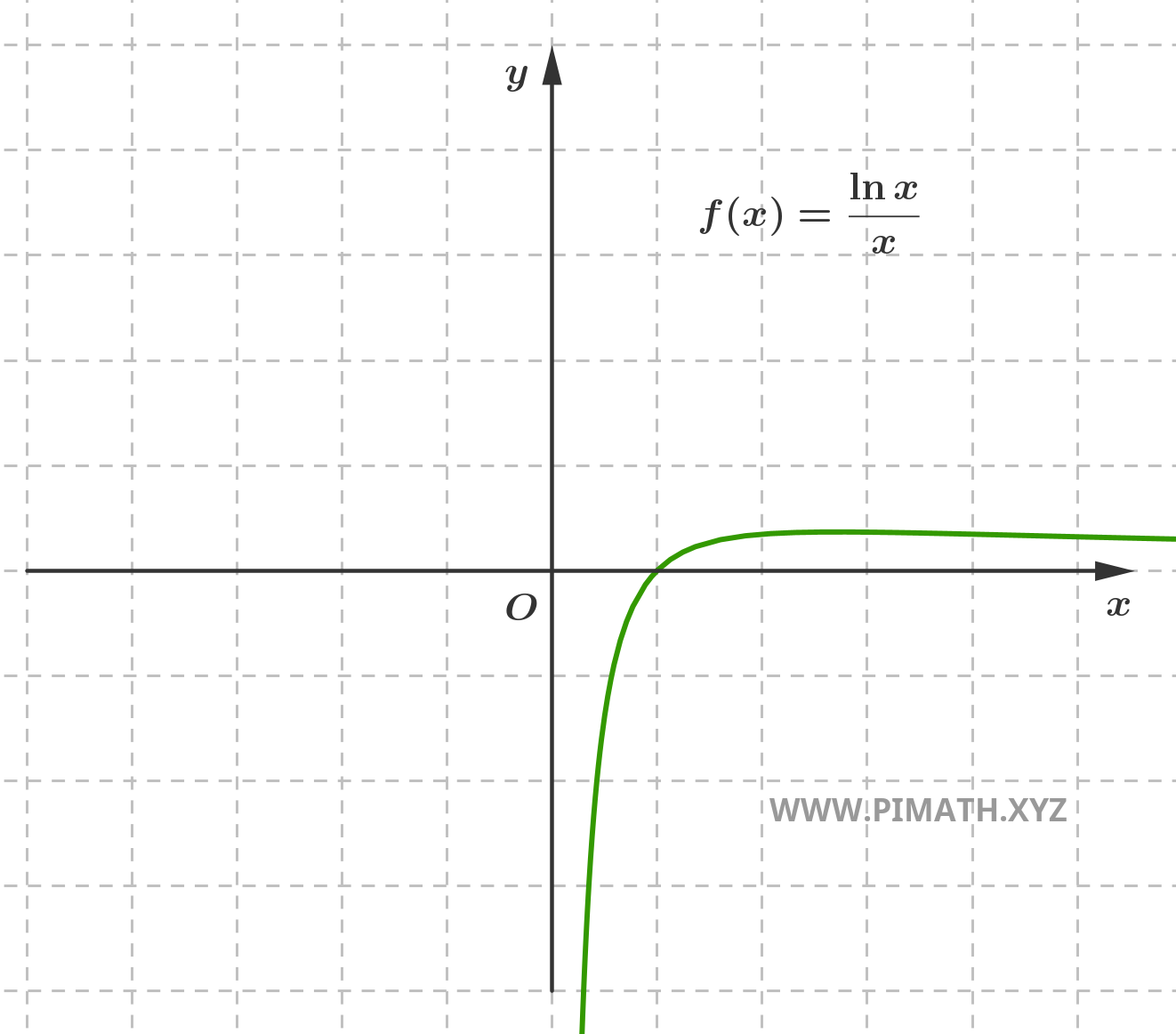
\[ f(x) = \frac{\ln x}{x} \]
Result
Domain \((0,+\infty)\), zero at \(x=1\), absolute maximum at \((e,\,e^{-1})\), inflection point at \((e^{3/2},\,\frac{3}{2}e^{-3/2})\), asymptotes \(x=0\) and \(y=0\).
Solution
Domain and symmetries
The function is defined for \(x > 0\) due to the logarithm. The denominator \(x\) does not vanish in the domain, so \(\mathcal{D}=(0,+\infty)\). It has no symmetries with respect to the origin or to the \(y\)-axis.
Intercepts with the axes and sign
On the \(x\)-axis: we set \(\ln x = 0\), yielding \(x=1\).
The sign of \(f(x)\) depends only on the numerator, since the denominator is always positive in the domain: \[ f(x) > 0 \iff x > 1 \qquad f(x) < 0 \iff 0 < x < 1 \]
Limits and asymptotes
Vertical asymptote: As \(x \to 0^+\), the numerator tends to \(-\infty\) and the denominator to \(0^+\), therefore: \[ \lim_{x\to 0^+} \frac{\ln x}{x} = -\infty \] The line \(x=0\) is a vertical asymptote.
Horizontal asymptote: As \(x \to +\infty\), by the hierarchy of infinities (linear growth dominates logarithmic growth): \[ \lim_{x\to +\infty} \frac{\ln x}{x} = 0 \] The line \(y=0\) is a horizontal asymptote.
First derivative and monotonicity
Applying the quotient rule: \[ f'(x) = \frac{\frac{1}{x} \cdot x - \ln x \cdot 1}{x^2} = \frac{1 - \ln x}{x^2} \] The derivative vanishes for \(\ln x = 1\), that is \(x=e\).
Studying the sign: \(f'(x) > 0\) for \(x < e\) (increasing) and \(f'(x) < 0\) for \(x > e\) (decreasing).
The point \((e, e^{-1})\) is an absolute maximum.
Second derivative and inflection points
Differentiating further: \[ f''(x) = \frac{-\frac{1}{x} \cdot x^2 - (1 - \ln x) \cdot 2x}{x^4} = \frac{-x - 2x + 2x \ln x}{x^4} = \frac{2\ln x - 3}{x^3} \] The second derivative vanishes for \(\ln x = 3/2\), i.e. \(x = e^{3/2}\). At this point the function exhibits an inflection, passing from concave down to concave up.
Final result
\[ \boxed{\text{Max}(e, 1/e); \quad \text{Inflection point: } (e^{3/2}, 3/2e^{-3/2}); \quad \text{Asymptotes: } x=0, y=0} \]
Graph of the Function
Exercise 17 — level ★★★★☆
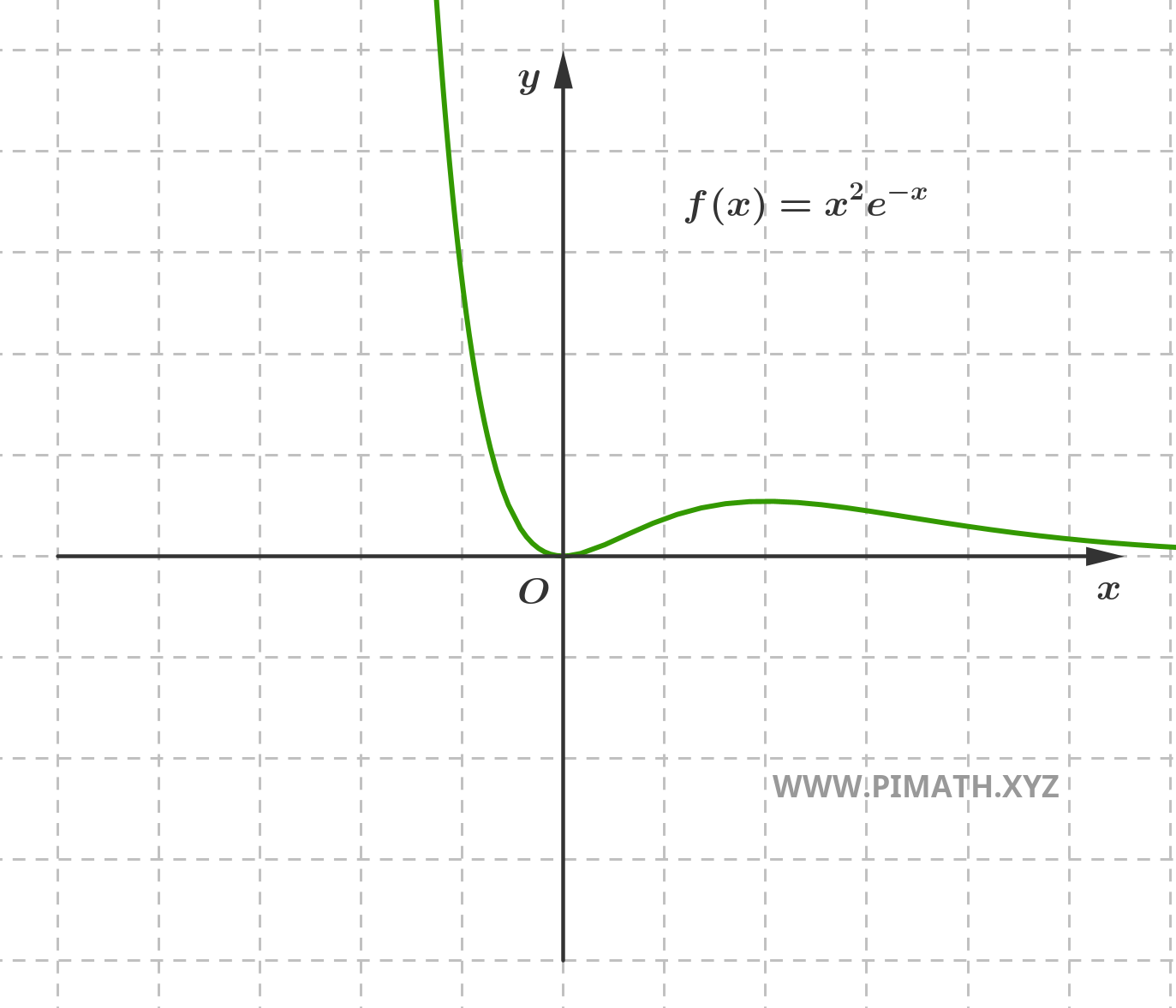
\[ f(x) = x^2 e^{-x} \]
Result
Domain \(\mathbb{R}\), double zero at \(x=0\), minimum at \((0,0)\), maximum at \((2,4e^{-2})\), inflection points at \((2\pm\sqrt{2},\,f(2\pm\sqrt{2}))\), asymptote \(y=0\).
Solution
Domain and symmetries
The domain is \(\mathbb{R}\). The function is neither even nor odd.
Intercepts with the axes and sign
The only zero is \(x=0\) (double, since \(e^{-x}>0\) always). The graph touches the \(x\)-axis at the origin without crossing it: \(f(x)\geq0\) for every \(x\).
Limits and asymptotes
As \(x\to+\infty\) the decaying exponential dominates over the polynomial: \(f(x)\to0\), so \(y=0\) is a horizontal asymptote. As \(x\to-\infty\), on the other hand, \(e^{-x}\to+\infty\) and \(x^2\to+\infty\): \(f(x)\to+\infty\).
First derivative and monotonicity
Applying the product rule:
\[ f'(x)=2x\cdot e^{-x}+x^2\cdot(-e^{-x})=e^{-x}(2x-x^2)=e^{-x}\cdot x(2-x) \]
Since \(e^{-x}>0\), the sign of \(f'\) depends on the product \(x(2-x)\):
| \(x\) | \((-\infty,0)\) | \(0\) | \((0,2)\) | \(2\) | \((2,+\infty)\) |
| \(x\) | − | 0 | + | + | + |
| \(2-x\) | + | + | + | 0 | − |
| \(f'(x)\) | − | 0 | + | 0 | − |
| \(f(x)\) | ↘ | min | ↗ | max | ↘ |
The point \(x=0\) is a minimum with \(f(0)=0\), the point \(x=2\) is a maximum with \(f(2)=4e^{-2}\).
Second derivative and inflection points
Differentiating \(f'(x)=e^{-x}(2x-x^2)\):
\[ f''(x)=-e^{-x}(2x-x^2)+e^{-x}(2-2x)=e^{-x}(x^2-4x+2) \]
It vanishes for \(x^2-4x+2=0\), i.e. \(x=2\pm\sqrt{2}\). At both points the concavity changes: we get two inflection points at \(x_1=2-\sqrt{2}\approx0.59\) and \(x_2=2+\sqrt{2}\approx3.41\).
Result
\[ \boxed{\min(0,0),\quad \max(2,4e^{-2}),\quad \text{inflection points at }x=2\pm\sqrt{2},\quad \text{asymptote }y=0} \]
Graph of the Function
Exercise 18 — level ★★★★☆
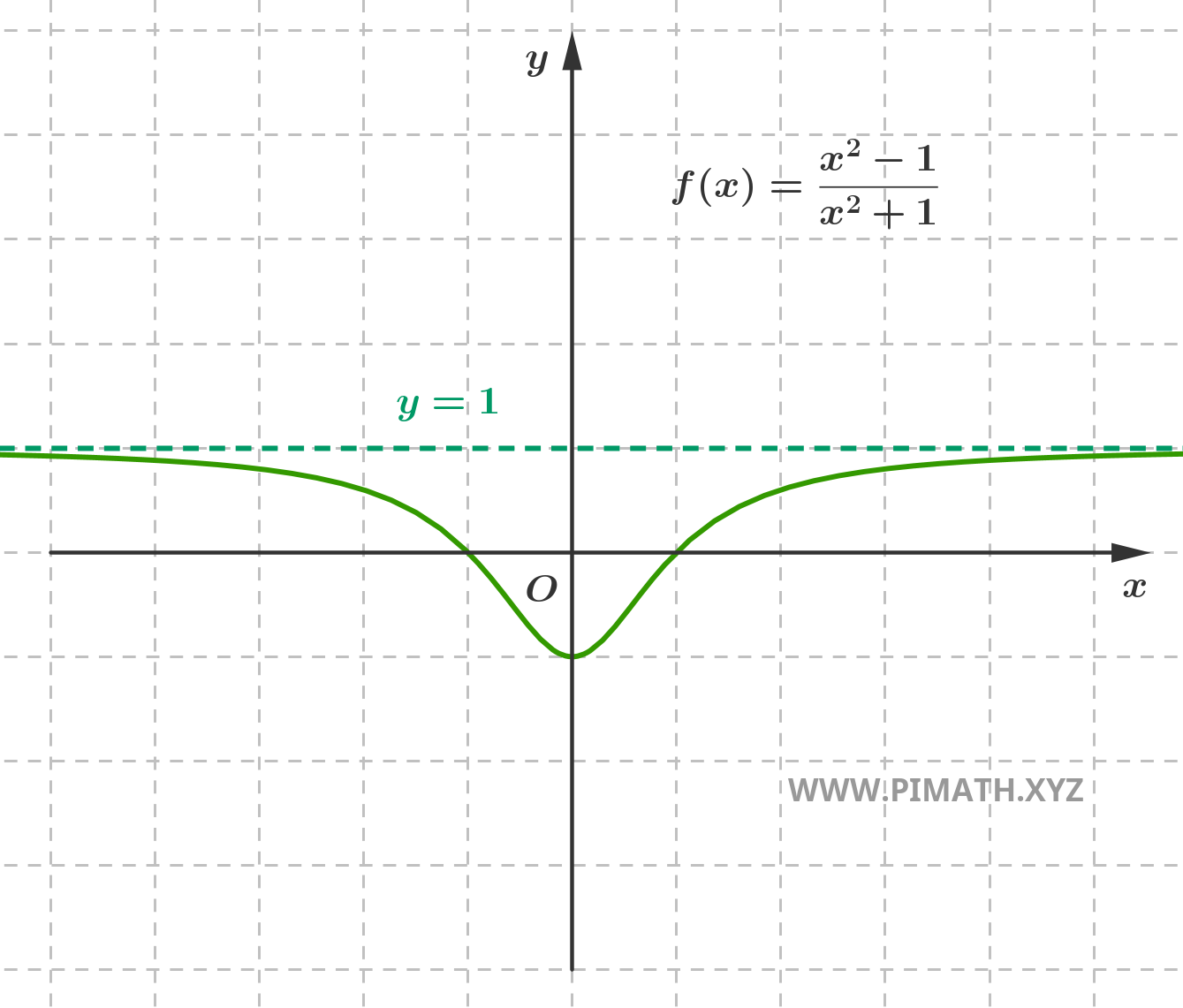
\[ f(x) = \frac{x^2-1}{x^2+1} \]
Result
Even function, domain \(\mathbb{R}\), zeros at \(x=\pm1\), absolute minimum at \((0,-1)\), horizontal asymptote \(y=1\), inflection points at \(\left(\pm\frac{\sqrt{3}}{3},\,-\frac{1}{2}\right)\).
Solution
Domain and symmetries
The denominator \(x^2+1\) is always greater than or equal to \(1\), so it never vanishes. The domain is \(\mathcal{D}=\mathbb{R}\).
Since \(f(-x) = \frac{(-x)^2-1}{(-x)^2+1} = f(x)\), the function is even (symmetric with respect to the \(y\)-axis).
Intercepts with the axes and sign
On the \(y\)-axis: \(f(0) = \frac{-1}{1} = -1\).
On the \(x\)-axis: \(x^2-1=0 \implies x = \pm 1\).
The sign of the function is positive for \(|x| > 1\) and negative for \(-1 < x < 1\).
Asymptotes
There are no vertical asymptotes. Let us check the behavior at infinity: \[ \lim_{x\to\pm\infty} \frac{x^2-1}{x^2+1} = 1 \] The line \(y=1\) is a horizontal asymptote. Since \(f(x) = 1 - \frac{2}{x^2+1}\), the function always stays below the asymptote.
First derivative and monotonicity
Applying the quotient rule: \[ f'(x) = \frac{2x(x^2+1) - (x^2-1)(2x)}{(x^2+1)^2} = \frac{2x^3+2x-2x^3+2x}{(x^2+1)^2} = \frac{4x}{(x^2+1)^2} \] The sign of \(f'(x)\) is determined by the numerator \(4x\):
- \(f'(x) < 0\) for \(x < 0\) (decreasing)
- \(f'(x) > 0\) for \(x > 0\) (increasing)
The point \((0, -1)\) is an absolute minimum.
Second derivative and inflection points
We compute \(f''(x)\): \[ f''(x) = \frac{4(x^2+1)^2 - 4x[2(x^2+1) \cdot 2x]}{(x^2+1)^4} = \frac{4(x^2+1) - 16x^2}{(x^2+1)^3} = \frac{4(1-3x^2)}{(x^2+1)^3} \] The second derivative vanishes for \(1-3x^2 = 0 \implies x = \pm\frac{1}{\sqrt{3}} = \pm\frac{\sqrt{3}}{3}\).
At these points (\(x \approx \pm 0.58\)) there are two inflection points with \(y\)-coordinate \(y = -1/2\).
Final result
\[ \boxed{\text{Min}(0,-1); \quad \text{Asymptote } y=1; \quad \text{Inflection points } \left(\pm\frac{\sqrt{3}}{3}, -\frac{1}{2}\right)} \]
Graph of the Function
Exercise 19 — level ★★★★☆
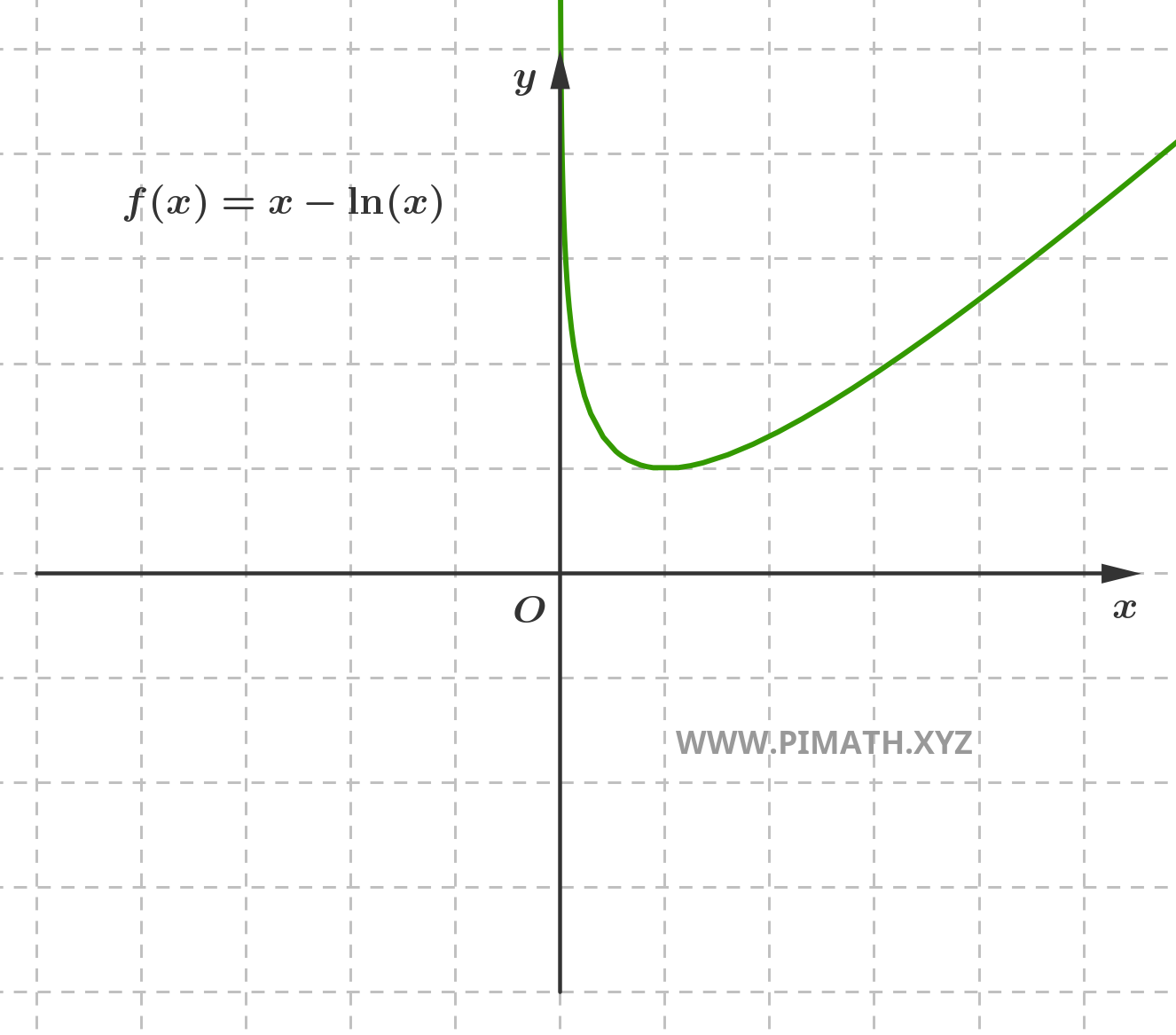
\[ f(x) = x - \ln x \]
Result
Domain \((0,+\infty)\), no zeros (the function is always positive), absolute minimum at \((1,1)\), always concave up.
Solution
Domain and symmetries
Due to the presence of the logarithm, we need \(x > 0\). The domain is therefore \(\mathcal{D}=(0,+\infty)\). The function has no symmetries.
Intercepts with the axes and sign
There are no intersections with the \(y\)-axis (\(0 \notin \mathcal{D}\)). As for the zeros, the equation \(x = \ln x\) has no real solutions (the line \(y=x\) always lies above the curve \(y=\ln x\)). We shall see from the study of the minimum that the function is always positive.
Limits and asymptotes
Vertical asymptote: As \(x \to 0^+\), we have \(0 - (-\infty) = +\infty\). The line \(x=0\) is a vertical asymptote.
Behavior at infinity: As \(x \to +\infty\), by the hierarchy of infinities the linear component dominates the logarithmic one: \[ \lim_{x\to +\infty} (x - \ln x) = +\infty \] There are no horizontal or oblique asymptotes.
First derivative and monotonicity
We compute the first derivative: \[ f'(x) = 1 - \frac{1}{x} = \frac{x-1}{x} \] Since \(x > 0\), the sign depends only on \(x-1\):
- \(f'(x) < 0\) for \(0 < x < 1\) (decreasing)
- \(f'(x) > 0\) for \(x > 1\) (increasing)
The point \((1,1)\) is an absolute minimum. Since the \(y\)-coordinate of the minimum is positive (\(y=1\)), it is confirmed that the function has no zeros.
Second derivative and concavity
We compute the second derivative: \[ f''(x) = \frac{1}{x^2} \] Since \(1/x^2\) is always positive on the domain, the function is consistently concave up and has no inflection points.
Final result
\[ \boxed{\text{Min}(1,1); \quad \text{Asymptote: } x=0; \quad \text{Always positive}} \]
Graph of the Function
Exercise 20 — level ★★★★☆
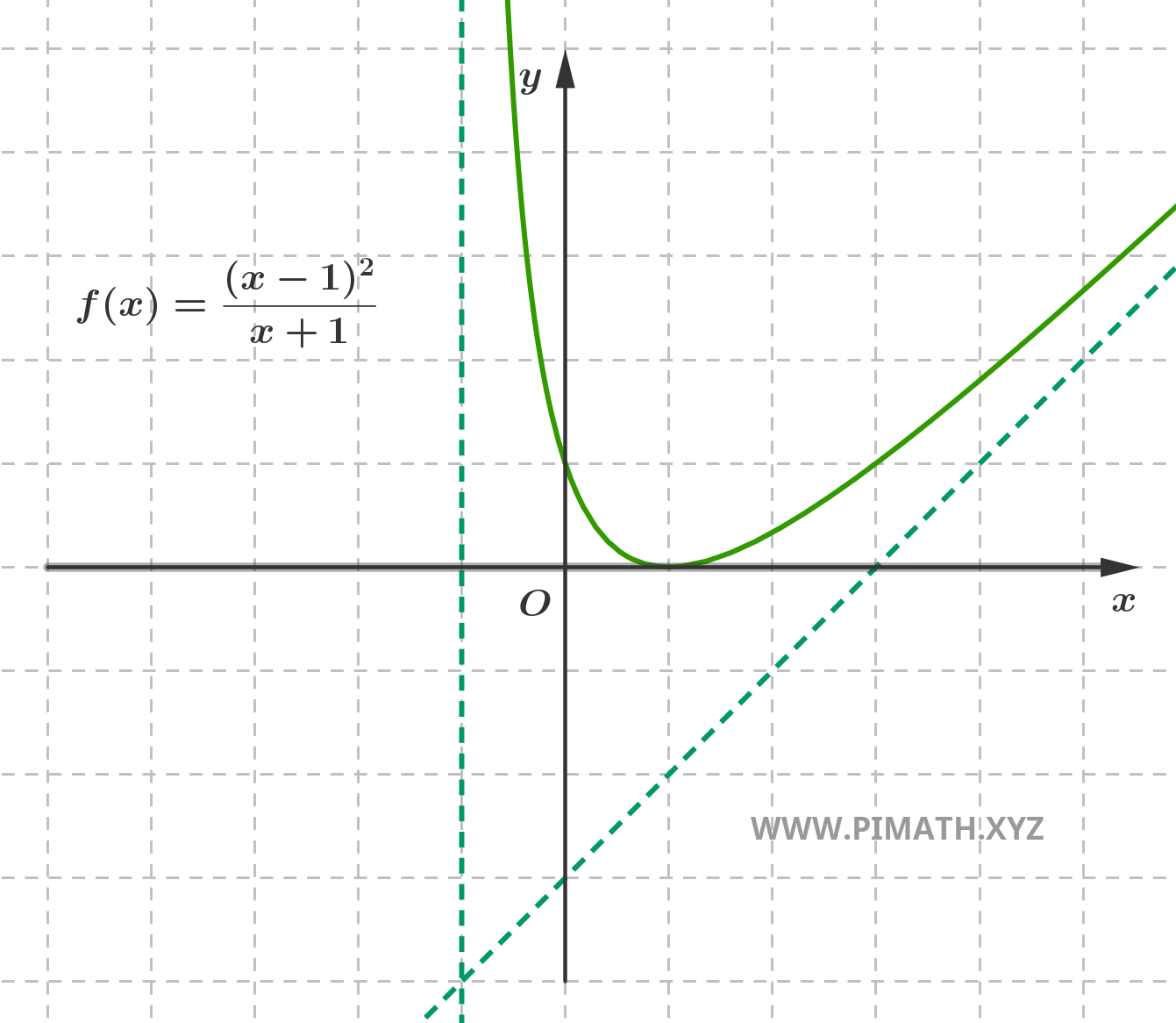
\[ f(x) = \frac{(x-1)^2}{x+1} \]
Result
Domain \(\mathbb{R}\setminus\{-1\}\), vertical asymptote \(x=-1\), oblique asymptote \(y=x-3\), local maximum at \((-3,-8)\), local minimum at \((1,0)\).
Solution
Domain and symmetries
The function is defined for every \(x\) such that the denominator does not vanish: \(\mathcal{D}=\mathbb{R}\setminus\{-1\}\). There are no obvious symmetries.
Intercepts and Sign
The intersection with the \(y\)-axis is \(f(0) = 1\).
The only intersection with the \(x\)-axis occurs at \(x=1\). Since the numerator is a perfect square, the zero is double: the graph is tangent to the \(x\)-axis without crossing it.
The sign of the function depends exclusively on the denominator: \(f(x) > 0\) for \(x > -1\) and \(f(x) < 0\) for \(x < -1\).
Asymptotes
Vertical asymptote: Since \(\lim_{x\to -1} f(x) = \infty\), the line \(x=-1\) is a vertical asymptote.
Oblique asymptote: Performing polynomial long division or noting that: \[ f(x) = \frac{x^2-2x+1}{x+1} = x - 3 + \frac{4}{x+1} \] We immediately deduce that the line \(y = x - 3\) is the oblique asymptote.
First derivative and monotonicity
We compute \(f'(x)\) using the quotient rule: \[ f'(x) = \frac{2(x-1)(x+1) - (x-1)^2}{(x+1)^2} = \frac{(x-1)(x+3)}{(x+1)^2} \] The zeros of the derivative are \(x=1\) and \(x=-3\). Studying the sign of the product in the numerator:
- Increasing on \((-\infty, -3)\) and \((1, +\infty)\)
- Decreasing on \((-3, -1)\) and \((-1, 1)\)
We have a local maximum at \((-3, -8)\) and a local minimum at \((1, 0)\).
Final result
\[ \boxed{\text{Asymptotes: } x=-1, y=x-3; \quad \text{Max}(-3,-8); \quad \text{Min}(1,0)} \]
Graph of the Function
Exercise 21 — level ★★★☆☆
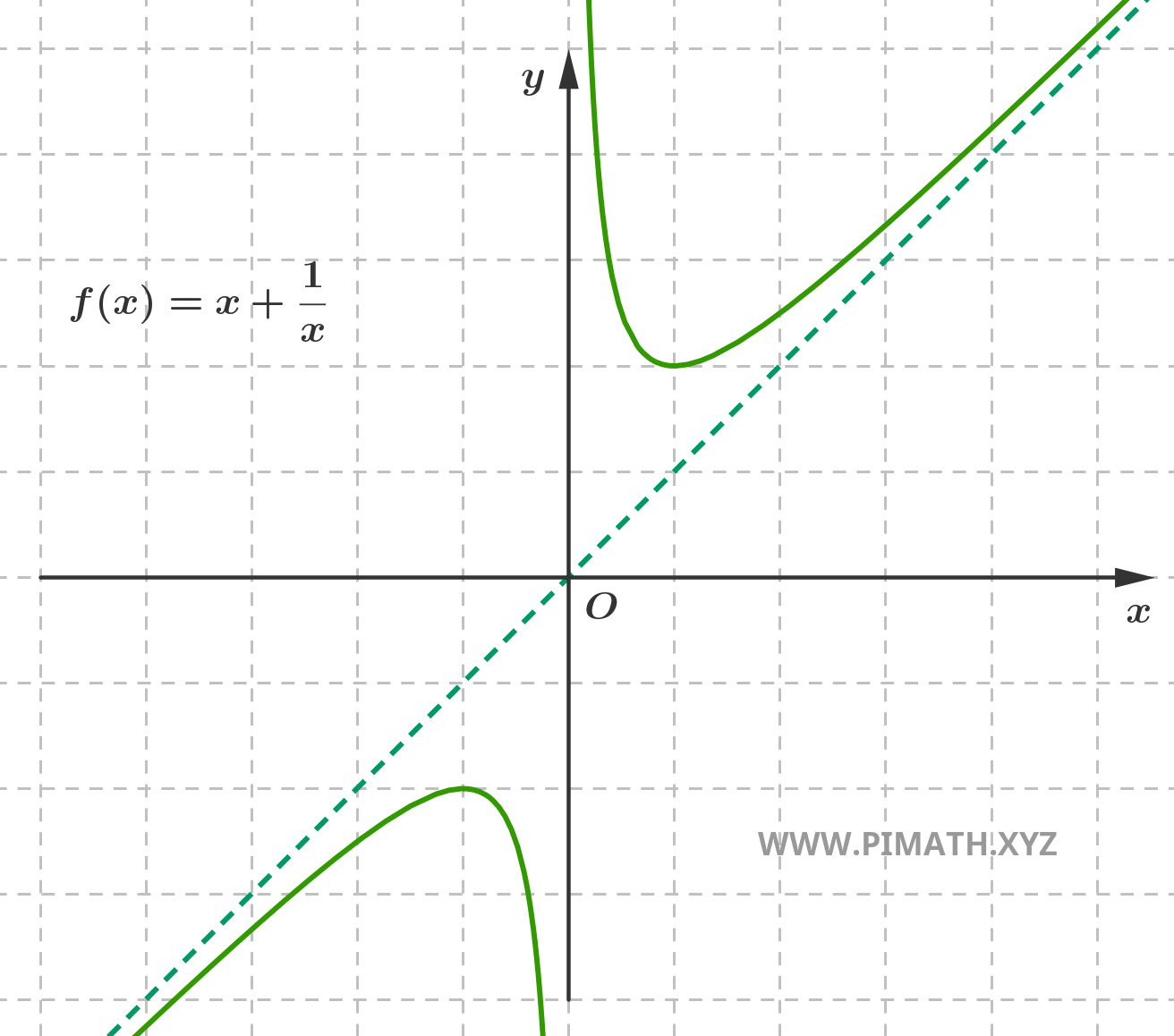
\[ f(x) = x + \frac{1}{x} \]
Result
Odd function, domain \(\mathbb{R}\setminus\{0\}\), asymptotes \(x=0\) and \(y=x\), local maximum at \((-1,-2)\) and local minimum at \((1,2)\).
Solution
Domain and symmetries
The function is not defined for \(x=0\), so \(\mathcal{D}=\mathbb{R}\setminus\{0\}\).
We check the symmetry: \(f(-x) = -x + \frac{1}{-x} = -(x + \frac{1}{x}) = -f(x)\).
The function is odd: the graph is symmetric with respect to the origin.
Intercepts and sign
There are no intersections with the \(x\)-axis since \(x + \frac{1}{x} = 0 \implies x^2 + 1 = 0\), which has no real solutions.
The sign of the function agrees with that of \(x\): positive for \(x > 0\) and negative for \(x < 0\).
Asymptotes
Vertical asymptote: \(\lim_{x\to 0^\pm} f(x) = \pm\infty\). The line \(x=0\) is a vertical asymptote.
Oblique asymptote: Since as \(x \to \infty\) the term \(\frac{1}{x}\) tends to zero, the function approaches the line \(y=x\) indefinitely.
First derivative and monotonicity
We compute the derivative: \[ f'(x) = 1 - \frac{1}{x^2} = \frac{x^2 - 1}{x^2} \] The derivative vanishes at \(x = \pm 1\). Studying its sign:
- Increasing for \(x < -1\) and \(x > 1\)
- Decreasing for \(-1 < x < 0\) and \(0 < x < 1\)
There is a local maximum at \((-1, -2)\) and a local minimum at \((1, 2)\).
Second derivative and concavity
\[ f''(x) = \frac{2}{x^3} \] The concavity is upward for \(x > 0\) and downward for \(x < 0\). There are no inflection points since \(x=0\) does not belong to the domain.
Final result
\[ \boxed{\text{Asymptotes: } x=0, y=x; \quad \text{Max}(-1,-2); \quad \text{Min}(1,2)} \]
Graph of the Function
Exercise 22 — level ★★★☆☆
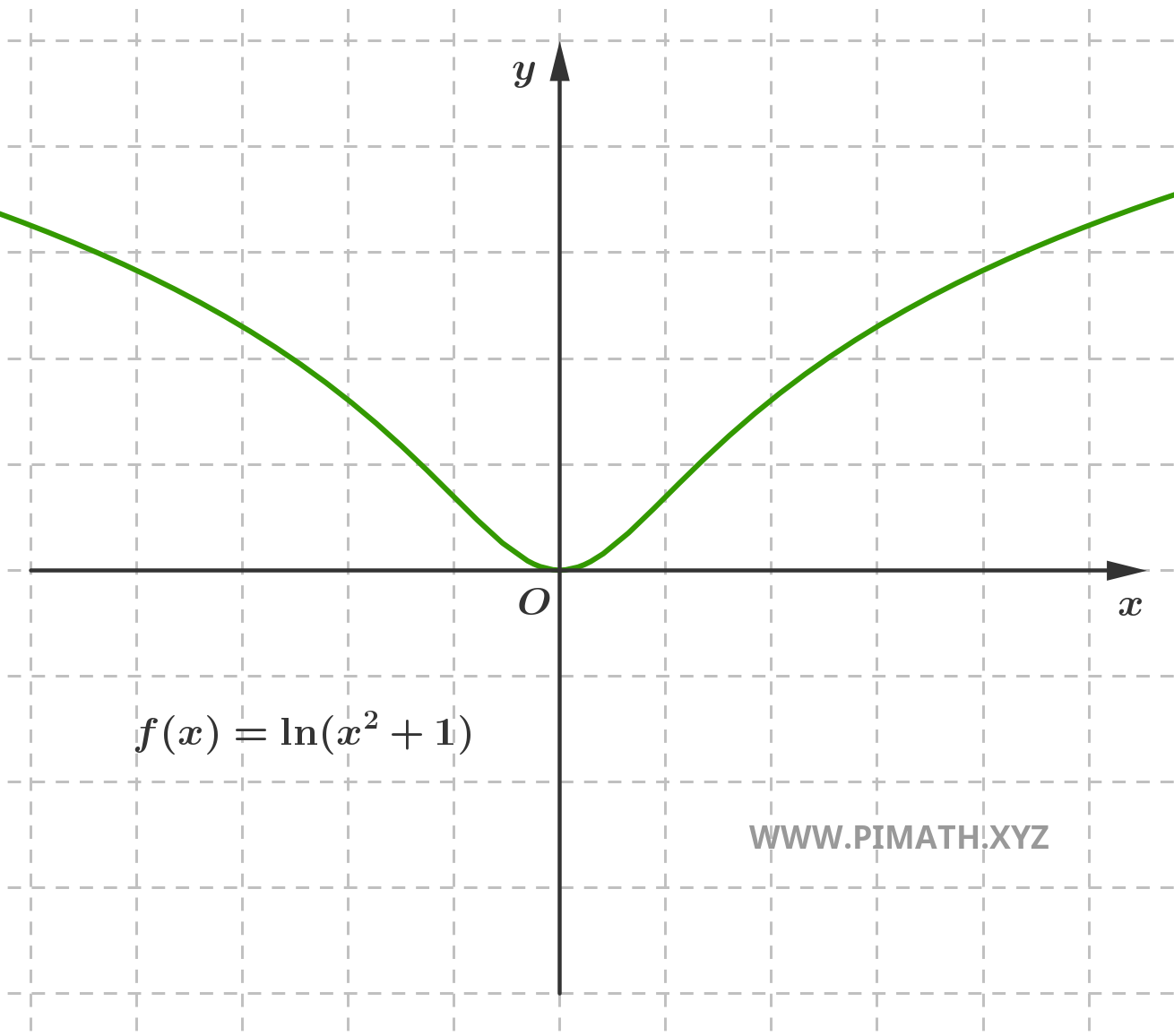
\[ f(x) = \ln(x^2+1) \]
Result
Even function, domain \(\mathbb{R}\), zero at \(x=0\), absolute minimum at \((0,0)\), inflection points at \((\pm1,\,\ln 2)\).
Solution
Domain and symmetries
The argument of the logarithm \(x^2+1\) is always greater than or equal to \(1\), so the function is defined on the entire real line: \(\mathcal{D}=\mathbb{R}\).
Since \(f(-x) = \ln((-x)^2+1) = \ln(x^2+1) = f(x)\), the function is even (symmetric with respect to the \(y\)-axis).
Intercepts and sign
The only intersection with the axes is at the origin \((0,0)\), since \(\ln(x^2+1)=0 \iff x^2+1=1 \iff x=0\).
The function is always non-negative (\(f(x) \geq 0\)) because the argument of the logarithm is always \(\geq 1\).
Limits and asymptotes
As \(x \to \pm\infty\), \(f(x) \to +\infty\).
There are no vertical asymptotes (the domain is \(\mathbb{R}\)) nor horizontal ones. Checking for an oblique asymptote, we note that \(\lim_{x\to \infty} f(x)/x = 0\), so there are no oblique asymptotes either.
First derivative and monotonicity
Applying the chain rule: \[ f'(x) = \frac{2x}{x^2+1} \] The sign of \(f'(x)\) depends only on the numerator \(2x\):
- Decreasing for \(x < 0\)
- Increasing for \(x > 0\)
The origin \((0,0)\) is an absolute minimum.
Second derivative and concavity
Using the quotient rule: \[ f''(x) = \frac{2(x^2+1) - 2x(2x)}{(x^2+1)^2} = \frac{2 - 2x^2}{(x^2+1)^2} = \frac{2(1-x^2)}{(x^2+1)^2} \] The second derivative vanishes at \(x = \pm 1\).
The concavity is upward for \(-1 < x < 1\) and downward for \(|x| > 1\). The points \((\pm 1, \ln 2)\) are inflection points.
Final result
\[ \boxed{\text{Min}(0,0); \quad \text{Inflection points: } (\pm 1, \ln 2) \approx (\pm 1; 0.69)} \]
Graph of the Function
Exercise 23 — level ★★★☆☆
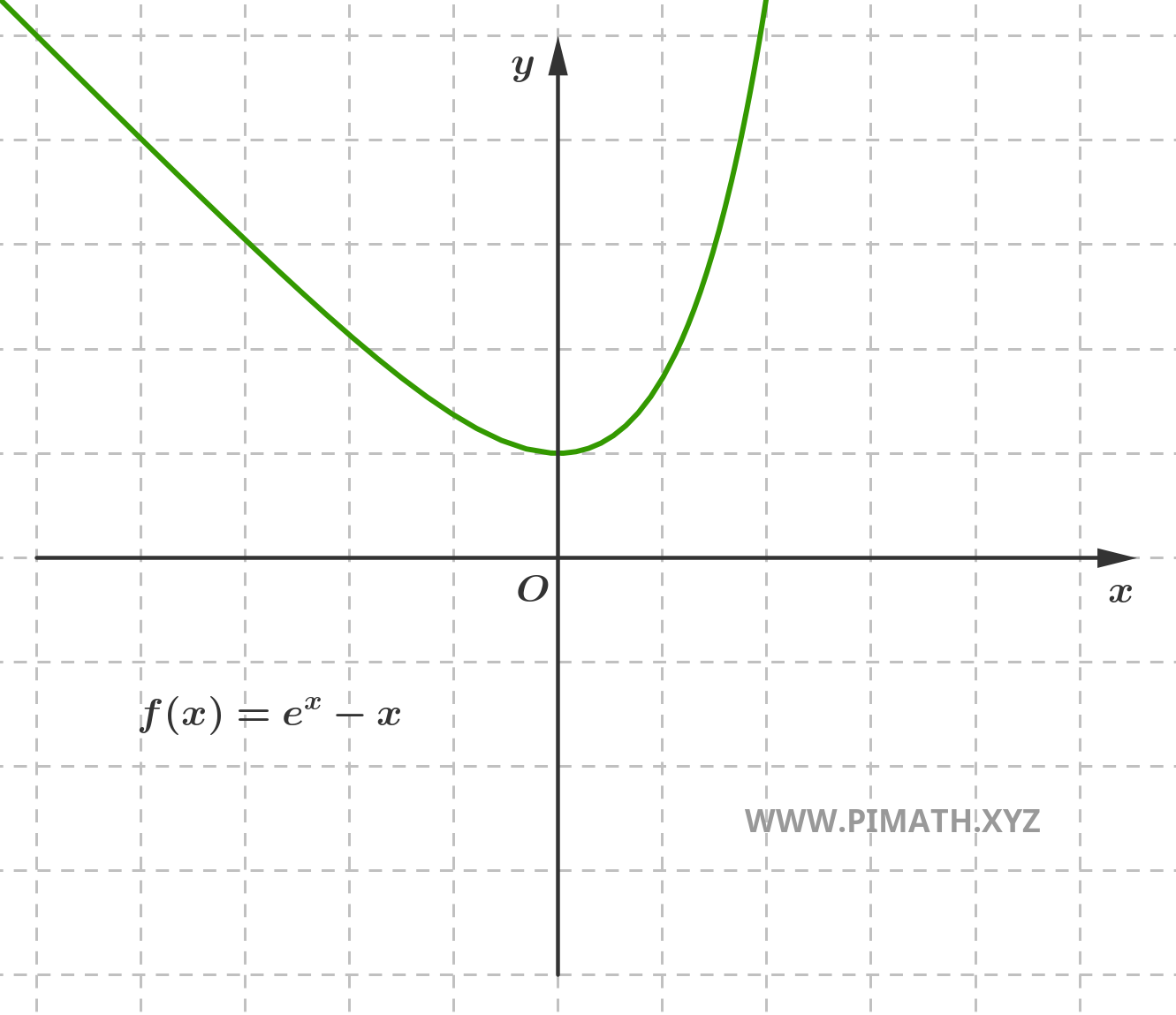
\[ f(x) = e^x - x \]
Result
Domain \(\mathbb{R}\), always positive function (no zeros), absolute minimum at \((0,1)\), always concave up.
Solution
Domain and symmetries
The function is composed of the sum of an exponential and a polynomial, both defined everywhere. Therefore, \(\mathcal{D}=\mathbb{R}\). There are no symmetries (neither even nor odd).
Intercepts and Sign
The intersection with the \(y\)-axis is \(f(0) = e^0 - 0 = 1\).
As for the zeros, the equation \(e^x = x\) has no real solutions. As we shall see from the study of the minimum, the smallest value taken by the function is \(1\), which guarantees that \(f(x) > 0\) for every \(x\).
Limits and asymptotes
At \(+\infty\): \(\lim_{x\to +\infty} (e^x - x) = +\infty\), since the exponential is an infinity of higher order than the linear term.
At \(-\infty\): \(\lim_{x\to -\infty} (e^x - x) = 0 - (-\infty) = +\infty\).
There are no horizontal or vertical asymptotes. Despite the divergence, there are no oblique asymptotes either.
First derivative and monotonicity
We compute the derivative: \[ f'(x) = e^x - 1 \] We study the sign of \(f'(x)\):
- \(f'(x) > 0 \iff e^x > 1 \iff x > 0\)
- \(f'(x) < 0 \iff e^x < 1 \iff x < 0\)
The function decreases on \((-\infty, 0)\) and increases on \((0, +\infty)\). The point \((0, 1)\) is an absolute minimum.
Second derivative and concavity
\[ f''(x) = e^x \] Since \(e^x > 0\) for every \(x \in \mathbb{R}\), the function is always concave up (convex) and has no inflection points.
Final result
\[ \boxed{\text{Min}(0,1); \quad \text{Always positive}; \quad \text{Concave up}} \]
Graph of the Function
Exercise 24 — level ★★★★☆
\[ f(x) = x\ln x \]
Result
Domain \((0, +\infty)\), zero at \(x=1\), absolute minimum at \(\left(\frac{1}{e}, -\frac{1}{e}\right)\), always concave up.
Solution
Domain and symmetries
The presence of the logarithm imposes \(x > 0\). Therefore, \(\mathcal{D}=(0, +\infty)\). The function has no symmetries with respect to the \(y\)-axis or the origin.
Intercepts and Sign
The intersection with the \(x\)-axis occurs where \(x\ln x = 0\). Since \(x=0\) is outside the domain, the only solution is \(\ln x = 0 \implies x = 1\).
Since for \(x > 0\) the sign of \(f(x)\) depends only on the logarithm:
- \(f(x) < 0\) for \(0 < x < 1\)
- \(f(x) > 0\) for \(x > 1\)
Limits and behavior at the boundary
At \(0^+\): \(\lim_{x\to 0^+} x\ln x\) is an indeterminate form of type \(0 \cdot \infty\).
Using L'Hôpital's rule on \(\frac{\ln x}{1/x}\), we obtain \(\lim_{x\to 0^+} (-x) = 0\).
The graph "emerges" from the origin (accumulation point), but the origin is not included in the graph.
At \(+\infty\): \(\lim_{x\to +\infty} x\ln x = +\infty\). The function grows faster than any line, so there are no oblique asymptotes.
First derivative and monotonicity
We compute the derivative of the product: \[ f'(x) = 1 \cdot \ln x + x \cdot \frac{1}{x} = \ln x + 1 \] The derivative vanishes for \(\ln x = -1 \implies x = e^{-1} = \frac{1}{e}\).
- Decreasing on \((0, 1/e)\)
- Increasing on \((1/e, +\infty)\)
The point \(\left(\frac{1}{e}, -\frac{1}{e}\right)\) is an absolute minimum.
Second derivative and concavity
\[ f''(x) = \frac{1}{x} \] Since \(x > 0\), the second derivative is always positive. The function is always concave up.
Final result
\[ \boxed{\text{Min}\left(\frac{1}{e}, -\frac{1}{e}\right); \quad \text{Zero: } x=1; \quad \lim_{x\to 0^+} f(x) = 0} \]
Graph of the Function
Exercise 25 — level ★★★★☆
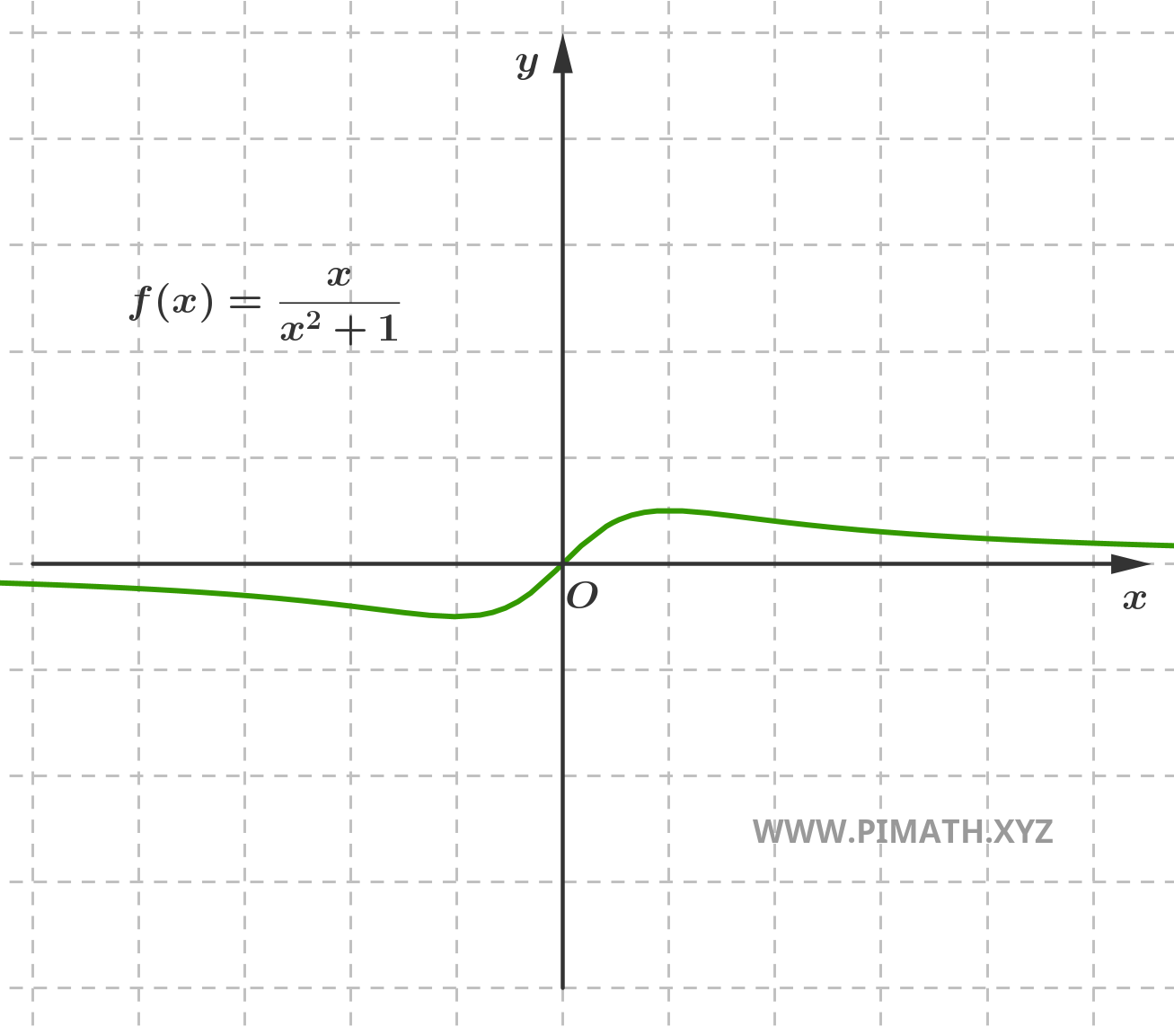
\[ f(x) = \frac{x}{x^2+1} \]
Result
Odd function, domain \(\mathbb{R}\), local maximum at \((1, 1/2)\), local minimum at \((-1, -1/2)\), horizontal asymptote \(y=0\), inflection points at \((0,0)\) and \((\pm\sqrt{3}, \pm\frac{\sqrt{3}}{4})\).
Solution
Domain and symmetries
The denominator \(x^2+1\) never vanishes in the real field (\(x^2+1 \geq 1\)). Therefore, \(\mathcal{D}=\mathbb{R}\).
We check the symmetry: \(f(-x) = \frac{-x}{(-x)^2+1} = -\frac{x}{x^2+1} = -f(x)\).
The function is odd: the graph exhibits central symmetry with respect to the origin.
Intercepts and Sign
The graph intersects the axes only at the origin \((0,0)\).
Since the denominator is always positive, the sign of the function depends only on the numerator: \(f(x) > 0\) for \(x > 0\) and \(f(x) < 0\) for \(x < 0\).
Asymptotes
There are no vertical asymptotes.
We compute the limit as \(x \to \infty\): \[ \lim_{x\to \pm\infty} \frac{x}{x^2+1} = 0 \] The \(x\)-axis (the line \(y=0\)) is a horizontal asymptote.
First derivative and monotonicity
Applying the quotient rule: \[ f'(x) = \frac{1(x^2+1) - x(2x)}{(x^2+1)^2} = \frac{1-x^2}{(x^2+1)^2} \] The zeros of the derivative are \(x = \pm 1\). Studying the sign of the numerator \((1-x)(1+x)\):
- Increasing for \(-1 < x < 1\)
- Decreasing for \(x < -1\) and \(x > 1\)
We have a local minimum at \((-1, -1/2)\) and a local maximum at \((1, 1/2)\).
Second derivative and inflection points
We compute the second derivative: \[ f''(x) = \frac{-2x(x^2+1)^2 - (1-x^2)[2(x^2+1) \cdot 2x]}{(x^2+1)^4} = \frac{2x(x^2-3)}{(x^2+1)^3} \] The second derivative vanishes at \(x = 0\) and \(x = \pm \sqrt{3}\).
At these three points the concavity changes, identifying three inflection points:
- \(F_1(0, 0)\)
- \(F_{2,3}(\pm\sqrt{3}, \pm\frac{\sqrt{3}}{4})\) with \(y\)-coordinate \(\approx \pm 0.43\)
Final result
\[ \boxed{\text{Max}(1, 1/2); \quad \text{Min}(-1, -1/2); \quad \text{3 Inflection points}} \]
Graph of the Function
Exercise 26 — level ★★★★☆
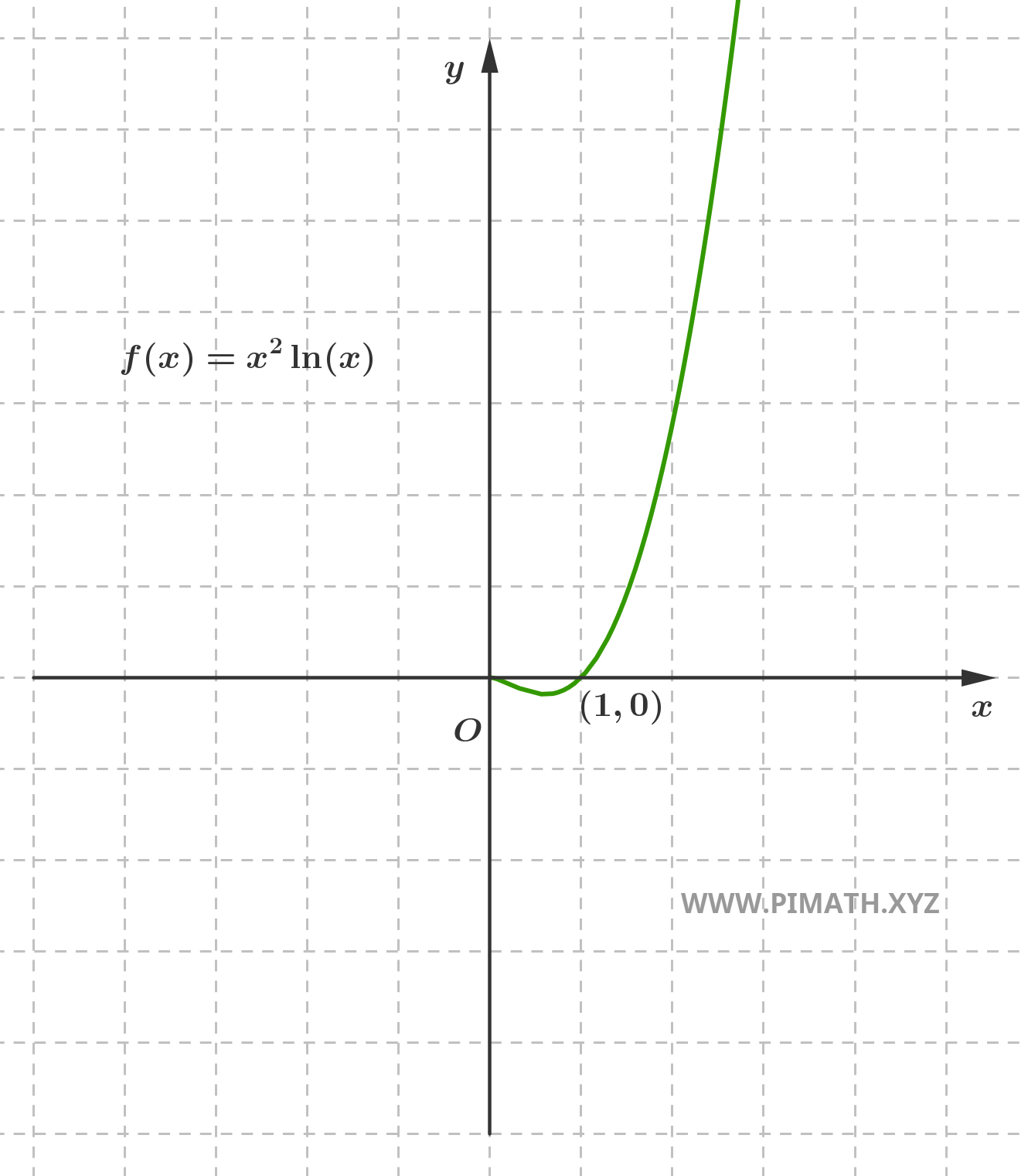
\[ f(x) = x^2\ln x \]
Result
Domain \((0, +\infty)\), zero at \(x=1\), absolute minimum at \(\left(\frac{1}{\sqrt{e}}, -\frac{1}{2e}\right)\), inflection point at \(\left(e^{-3/2}, -\frac{3}{2e^3}\right)\).
Solution
Domain and symmetries
The domain is dictated by the condition of existence of the logarithm: \(\mathcal{D}=(0, +\infty)\). The function has no symmetries.
Intercepts and Sign
The only intersection with the \(x\)-axis occurs for \(x^2\ln x = 0 \implies \ln x = 0 \implies x = 1\).
Since \(x^2 > 0\) throughout the domain, the sign of \(f(x)\) is determined exclusively by \(\ln x\):
\(f(x) < 0\) for \(x \in (0, 1)\)
\(f(x) > 0\) for \(x \in (1, +\infty)\)
Behavior at the boundary
At \(0^+\): \(\lim_{x\to 0^+} x^2\ln x = 0\) (by the hierarchy of infinities or L'Hôpital's rule). The graph "closes off" at the origin.
At \(+\infty\): \(\lim_{x\to +\infty} x^2\ln x = +\infty\). The growth is faster than that of any line, so there are no oblique asymptotes.
First derivative and monotonicity
\[ f'(x) = 2x\ln x + x^2 \cdot \frac{1}{x} = x(2\ln x + 1) \] We study \(f'(x) \geq 0\): since \(x > 0\), we solve \(2\ln x + 1 \geq 0 \implies \ln x \geq -1/2 \implies x \geq e^{-1/2}\).
- Decreasing on \((0, 1/\sqrt{e})\)
- Increasing on \((1/\sqrt{e}, +\infty)\)
The point \(\left(\frac{1}{\sqrt{e}}, -\frac{1}{2e}\right)\) is an absolute minimum.
Second derivative and concavity
\[ f''(x) = (2\ln x + 1) + x \cdot \frac{2}{x} = 2\ln x + 3 \] It vanishes for \(\ln x = -3/2 \implies x = e^{-3/2}\).
The function is concave down for \(x < e^{-3/2}\) and concave up for \(x > e^{-3/2}\).
The point \(F(e^{-3/2}, -3/2e^3)\) is an inflection point.
Final result
\[ \boxed{\text{Min}\left(\frac{1}{\sqrt{e}}, -\frac{1}{2e}\right); \quad \text{Inflection point: } x=e^{-1.5} \approx 0.22} \]
Graph of the Function
Exercise 27 — level ★★★★☆
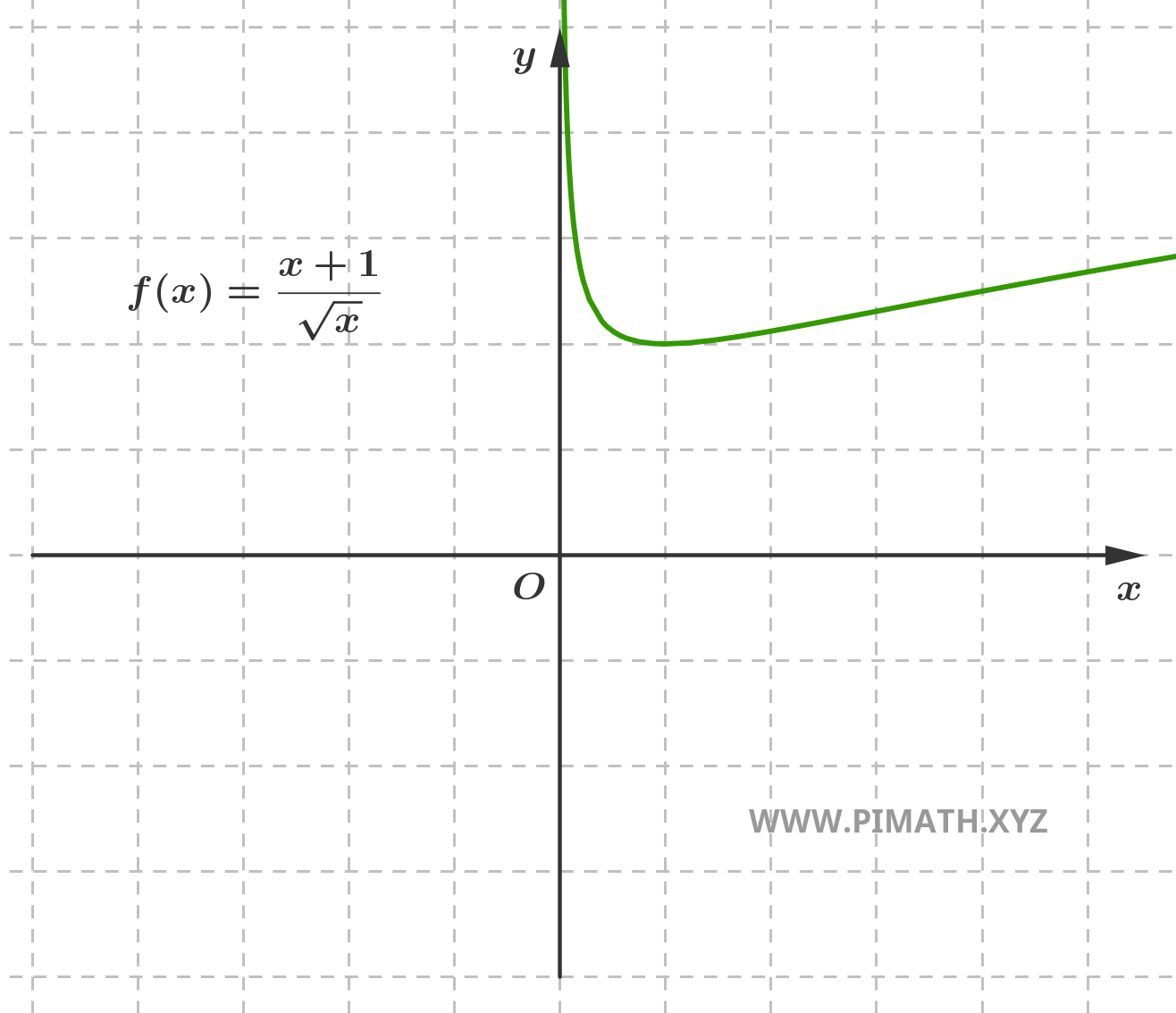
\[ f(x) = \frac{x+1}{\sqrt{x}} \]
Result
Domain \((0, +\infty)\), vertical asymptote \(x=0\), absolute minimum at \((1, 2)\), inflection point at \(\left(3, \frac{4\sqrt{3}}{3}\right)\).
Solution
Domain and symmetries
The condition of existence of the square root in the denominator imposes \(x > 0\). Therefore, \(\mathcal{D}=(0, +\infty)\). The function has no symmetries since the domain is not symmetric with respect to the origin.
Intercepts and Sign
There are no intersections with the \(y\)-axis (\(0 \notin \mathcal{D}\)).
There are no intersections with the \(x\)-axis since \(x+1=0 \implies x=-1\), which lies outside the domain.
Since both numerator and denominator are always positive for \(x > 0\), the function is always positive.
Limits and asymptotes
At \(0^+\): \(\lim_{x\to 0^+} \frac{x+1}{\sqrt{x}} = \frac{1}{0^+} = +\infty\). The line \(x=0\) is a vertical asymptote.
At \(+\infty\): \(\lim_{x\to +\infty} \frac{x+1}{\sqrt{x}} = +\infty\).
We check for an oblique asymptote: \(m = \lim_{x\to +\infty} \frac{f(x)}{x} = \lim_{x\to +\infty} \frac{x+1}{x\sqrt{x}} = 0\). There are no oblique asymptotes (the function grows like \(\sqrt{x}\)).
First derivative and monotonicity
Rewriting \(f(x) = x^{1/2} + x^{-1/2}\), the derivative is simpler: \[ f'(x) = \frac{1}{2}x^{-1/2} - \frac{1}{2}x^{-3/2} = \frac{1}{2\sqrt{x}} - \frac{1}{2x\sqrt{x}} = \frac{x-1}{2x\sqrt{x}} \] The sign depends only on \(x-1\):
- Decreasing on \((0, 1)\)
- Increasing on \((1, +\infty)\)
The point \((1, 2)\) is an absolute minimum.
Second derivative and concavity
\[ f''(x) = -\frac{1}{4}x^{-3/2} + \frac{3}{4}x^{-5/2} = \frac{-x+3}{4x^2\sqrt{x}} \] The second derivative vanishes at \(x = 3\).
- Concave up for \(0 < x < 3\)
- Concave down for \(x > 3\)
The point \(F(3, 4\sqrt{3}/3)\) is an inflection point.
Final result
\[ \boxed{\text{Min}(1,2); \quad \text{Inflection point: } x=3; \quad \text{Vertical asymptote: } x=0} \]
Graph of the Function
Exercise 28 — level ★★★★★
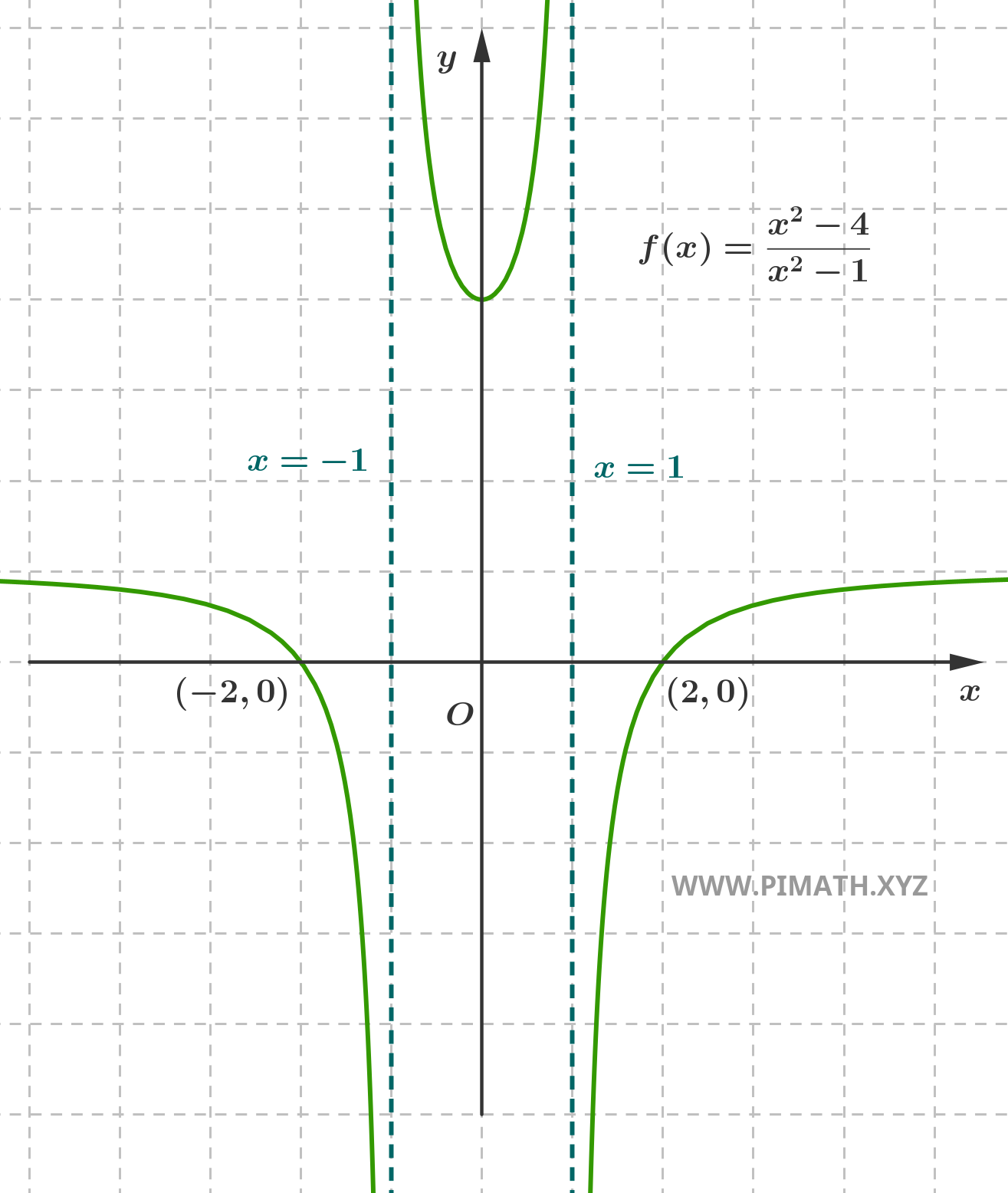
\[ f(x) = \frac{x^2-4}{x^2-1} \]
Result
Even function, domain \(\mathbb{R}\setminus\{\pm 1\}\), zeros at \(x=\pm 2\), vertical asymptotes \(x=\pm 1\), horizontal asymptote \(y=1\), local minimum at \((0,4)\).
Solution
Domain and symmetries
The denominator vanishes for \(x^2-1=0 \implies x = \pm 1\).
Therefore, \(\mathcal{D}=\mathbb{R}\setminus\{-1, 1\}\).
Since \(f(-x) = \frac{(-x)^2-4}{(-x)^2-1} = f(x)\), the function is even: the graph is symmetric with respect to the \(y\)-axis.
Intercepts and Sign
\(y\)-axis: \(f(0) = \frac{-4}{-1} = 4\). The point is \((0,4)\).
\(x\)-axis: \(x^2-4=0 \implies x = \pm 2\). The points are \((\pm 2, 0)\).
Sign: Studying the sign of the numerator and denominator, the function turns out to be positive for \(x < -2\), \(-1 < x < 1\) and \(x > 2\). It is negative on the intervals \((-2, -1)\) and \((1, 2)\).
Asymptotes
Vertical: Near \(x=1\), we have \(\lim_{x\to 1^-} f(x) = +\infty\) and \(\lim_{x\to 1^+} f(x) = -\infty\). By symmetry, the same holds at \(x=-1\). The lines \(x = \pm 1\) are vertical asymptotes.
Horizontal: \(\lim_{x\to \pm\infty} \frac{x^2-4}{x^2-1} = 1\). The line \(y = 1\) is the horizontal asymptote.
First derivative and monotonicity
\[ f'(x) = \frac{2x(x^2-1) - 2x(x^2-4)}{(x^2-1)^2} = \frac{6x}{(x^2-1)^2} \] The derivative vanishes only at \(x=0\).
- Decreasing for \(x < 0\) (excluding \(x=-1\))
- Increasing for \(x > 0\) (excluding \(x=1\))
The point \((0, 4)\) is a local minimum on the central branch of the function.
Second derivative and concavity
\[ f''(x) = \frac{6(x^2-1)^2 - 6x \cdot 2(x^2-1) \cdot 2x}{(x^2-1)^4} = \frac{-6(3x^2+1)}{(x^2-1)^3} \] The numerator is always negative (\(-6 \cdot \text{positive}\)). The sign depends on the denominator:
- Concave up for \(-1 < x < 1\) (where \(x^2-1 < 0\))
- Concave down for \(|x| > 1\) (where \(x^2-1 > 0\))
There are no inflection points.
Final result
\[ \boxed{\text{Asymptotes: } x=\pm 1, y=1; \quad \text{Min}(0,4); \quad \text{Zeros: } \pm 2} \]
Graph of the Function
Exercise 29 — level ★★★★★
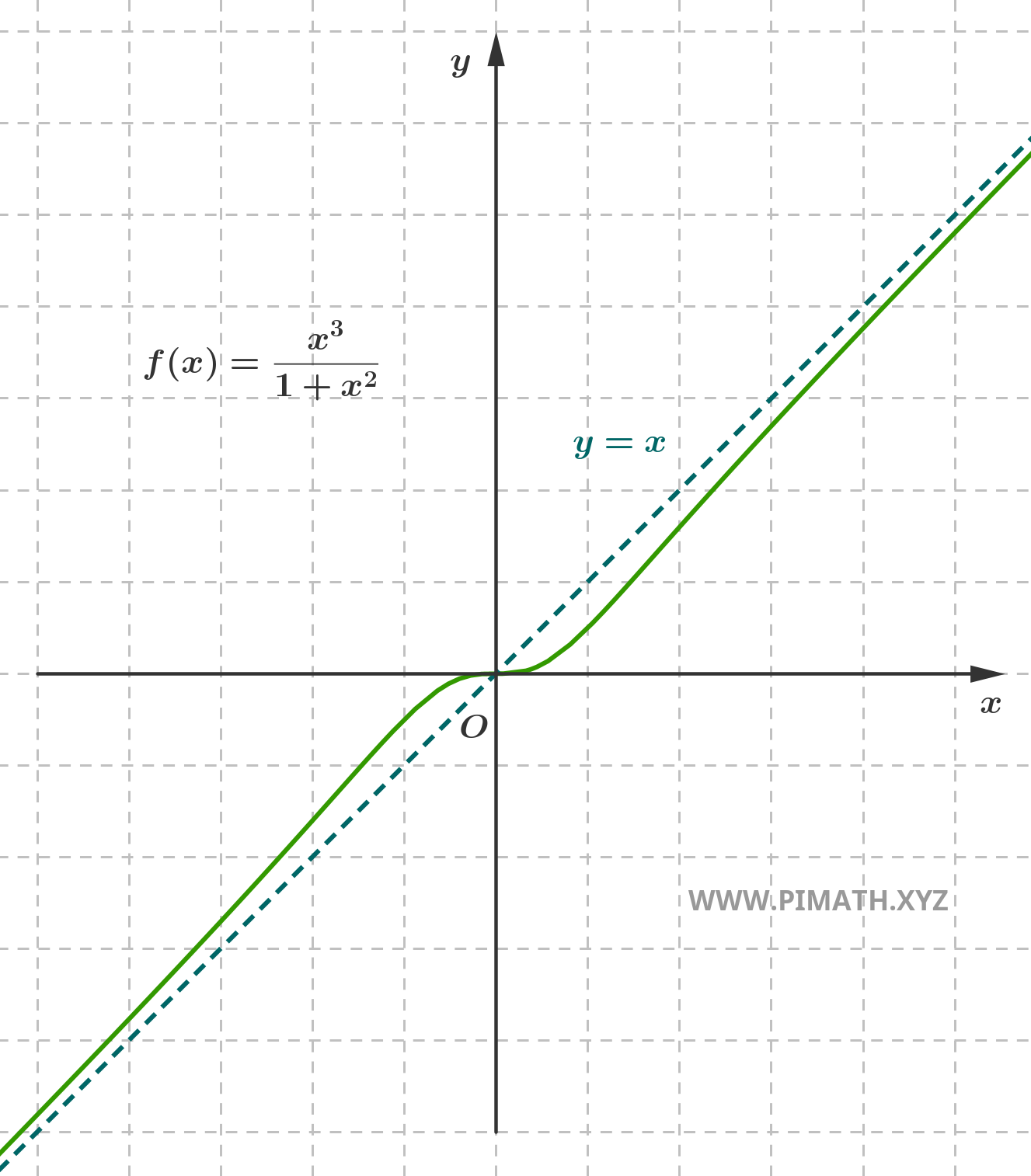
\[ f(x) = \frac{x^3}{1+x^2} \]
Result
Odd function, domain \(\mathbb{R}\), oblique asymptote \(y=x\), inflection points at \(x=0\) and \(x=\pm\sqrt{3}\), strictly increasing function on the entire domain.
Solution
Domain and symmetries
The denominator \(1+x^2\) is always positive, therefore \(\mathcal{D}=\mathbb{R}\).
Since \(f(-x) = \frac{(-x)^3}{1+(-x)^2} = -\frac{x^3}{1+x^2} = -f(x)\), the function is odd: central symmetry with respect to the origin.
Intercepts and Sign
The only point of intersection with the axes is the origin \((0,0)\).
The sign of the function follows that of the numerator \(x^3\): the function is positive for \(x > 0\) and negative for \(x < 0\).
Oblique asymptote
Performing polynomial long division (or adding and subtracting \(x\) in the numerator): \[ f(x) = \frac{x^3 + x - x}{1+x^2} = \frac{x(x^2+1) - x}{1+x^2} = x - \frac{x}{x^2+1} \] As \(x \to \pm\infty\), the term \(\frac{x}{x^2+1}\) tends to \(0\).
Therefore, the line \(y = x\) is an oblique asymptote.
Since for \(x > 0\) we subtract a positive quantity, the graph stays below the asymptote for positive \(x\) (and above for negative \(x\)).
First derivative and monotonicity
\[ f'(x) = \frac{3x^2(1+x^2) - x^3(2x)}{(1+x^2)^2} = \frac{3x^2 + 3x^4 - 2x^4}{(1+x^2)^2} = \frac{x^2(x^2+3)}{(1+x^2)^2} \] The derivative vanishes only at \(x=0\) and is positive for every \(x \neq 0\).
The function is therefore strictly increasing on all of \(\mathbb{R}\). The point \(x=0\) is an inflection point with horizontal tangent.
Second derivative and concavity
Differentiating further the form \(f'(x) = 1 - \frac{1-x^2}{(1+x^2)^2}\) (or the previous derivative): \[ f''(x) = \frac{2x(3-x^2)}{(1+x^2)^3} \] The zeros of the second derivative are \(x = 0\) and \(x = \pm\sqrt{3}\).
- Concave up for \(x < -\sqrt{3}\) and \(0 < x < \sqrt{3}\)
- Concave down for \(-\sqrt{3} < x < 0\) and \(x > \sqrt{3}\)
There are three inflection points: \(F_1(0,0)\) and \(F_{2,3}(\pm\sqrt{3}, \pm\frac{3\sqrt{3}}{4})\).
Final result
\[ \boxed{\text{Asymptote: } y=x; \quad \text{Always increasing}; \quad \text{3 Inflection points}} \]
Graph of the Function
Exercise 30 — level ★★★★★
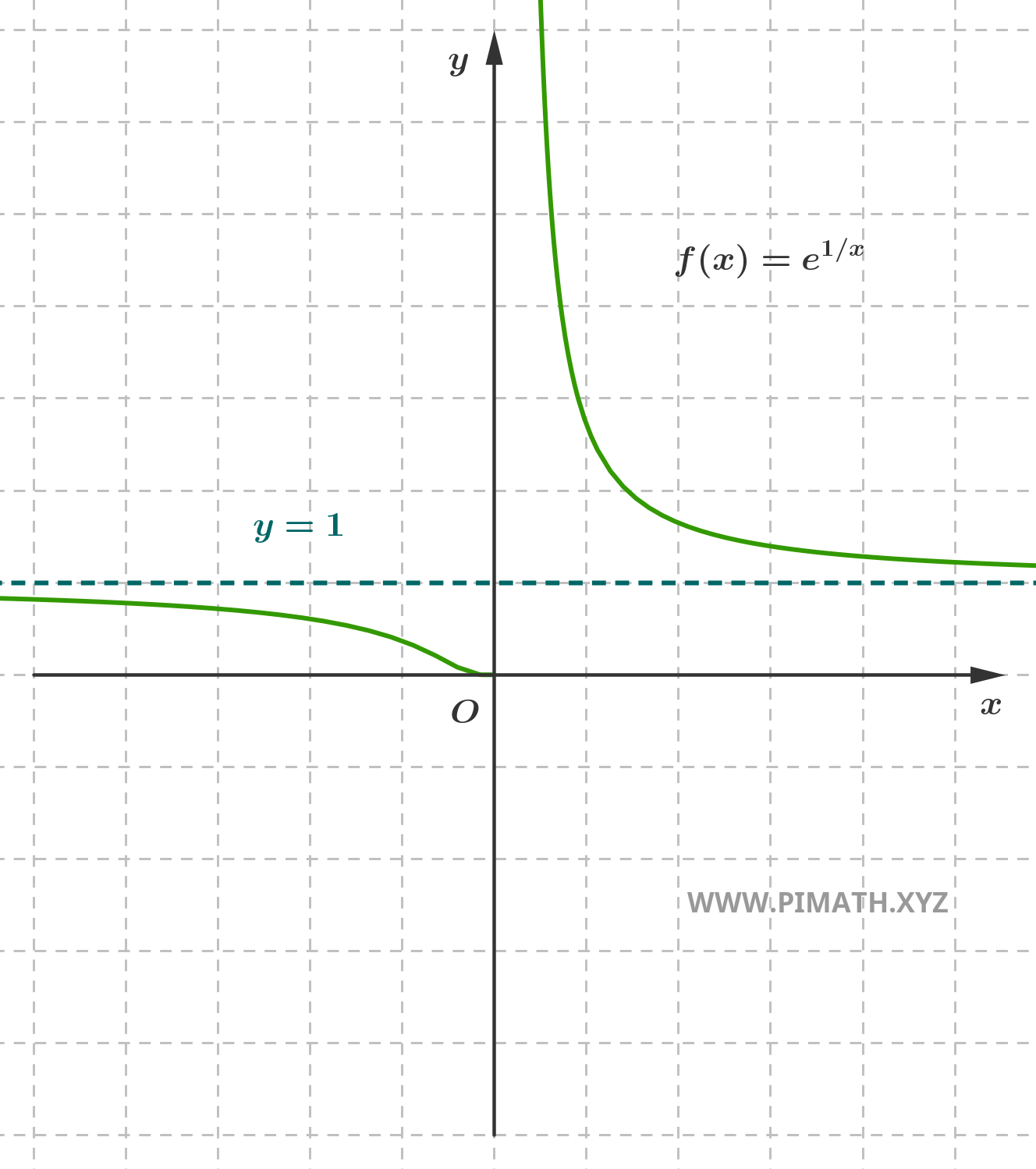
\[ f(x) = e^{1/x} \]
Result
Domain \(\mathbb{R}\setminus\{0\}\), vertical asymptote \(x=0\) (only for \(x \to 0^+\)), horizontal asymptote \(y=1\), always decreasing, inflection point at \(\left(-\frac{1}{2}, e^{-2}\right)\).
Solution
Domain and symmetries
The function is defined for every value that does not make the denominator of the exponent vanish: \(\mathcal{D}=\mathbb{R}\setminus\{0\}\).
It has no even or odd symmetries, since \(f(-x) = e^{-1/x}\), which differs both from \(f(x)\) and from \(-f(x)\).
Sign and intercepts
Being an exponential, the function is always positive (\(f(x) > 0\)) on its domain.
There are no zeros, nor intersections with the \(y\)-axis (since \(x=0\) is outside the domain).
Limits and asymptotes
Behavior at \(0\):
- \(\lim_{x\to 0^+} e^{1/x} = e^{+\infty} = +\infty\) (Vertical asymptote)
- \(\lim_{x\to 0^-} e^{1/x} = e^{-\infty} = 0\) (Limit endpoint)
Behavior at \(\pm\infty\):
- \(\lim_{x\to \pm\infty} e^{1/x} = e^0 = 1\) (Horizontal asymptote \(y=1\))
First derivative and monotonicity
\[ f'(x) = e^{1/x} \cdot \left( -\frac{1}{x^2} \right) = -\frac{e^{1/x}}{x^2} \] Since \(e^{1/x} > 0\) and \(x^2 > 0\) for every \(x \neq 0\), the derivative is always negative.
The function is strictly decreasing on both intervals \((-\infty, 0)\) and \((0, +\infty)\).
Second derivative and concavity
\[ f''(x) = \frac{e^{1/x}(1+2x)}{x^4} \] The sign depends on the linear factor \(1+2x\):
- \(f''(x) > 0\) for \(x > -1/2\) (with \(x \neq 0\)): concave up.
- \(f''(x) < 0\) for \(x < -1/2\): concave down.
There is an inflection point at \(x = -1/2\), with \(y\)-coordinate \(y = e^{-2} \approx 0.135\).
Final result
\[ \boxed{\text{Asymptotes: } x=0^+ \text{ and } y=1; \quad \text{Inflection point at } (-0.5, e^{-2})} \]
Graph of the Function