

Even functions and odd functions are characterized by specific symmetry properties. An even function takes the same value at two opposite points \(x\) and \(-x\), whereas an odd function takes opposite values.
Geometrically, the graph of an even function is symmetric about the \(y\)-axis, while the graph of an odd function is symmetric about the origin. These symmetries simplify the study of a graph and are especially useful in evaluating integrals over symmetric intervals.
Before defining even and odd functions formally, however, we must clarify a fundamental requirement: the domain of the function must be symmetric about the origin. Indeed, in order to compare \(f(x)\) with \(f(-x)\), both values must be defined.
Contents
- Domain symmetric about the origin
- Even functions
- Geometric meaning of even functions
- Odd functions
- Geometric meaning of odd functions
- Functions that are neither even nor odd
- Functions that are both even and odd
- Sum of even and odd functions
- Product of even and odd functions
- Integrals of even and odd functions over symmetric intervals
- Decomposition into even and odd parts
- Uniqueness of the decomposition
Domain symmetric about the origin
To speak properly of an even or an odd function, the domain must satisfy a preliminary property: it must be symmetric about the origin.
A set \(X\subseteq\mathbb R\) is said to be symmetric about the origin if, for every element \(x\in X\), its opposite \(-x\) also belongs to \(X\). In symbols:
\[ x\in X \implies -x\in X. \]
This condition means that the domain always contains the pairs of opposite points \(x\) and \(-x\).
For instance, the sets
\[ \mathbb R, \qquad [-a,a], \qquad (-a,a), \qquad \mathbb R\setminus\{0\} \]
are symmetric about the origin.
By contrast, the sets
\[ [0,+\infty), \qquad (0,+\infty), \qquad [1,3] \]
are not symmetric about the origin. For example, \(1\in[0,+\infty)\), but \(-1\notin[0,+\infty)\).
The symmetry of the domain is essential because, in order to decide whether a function is even or odd, we must compare the values \(f(x)\) and \(f(-x)\). If \(x\) belongs to the domain but \(-x\) does not, then \(f(-x)\) is undefined and the comparison is meaningless.
Consequently, a function can be even or odd only if its domain is symmetric about the origin.
Even functions
Let \(f:X\to\mathbb R\) be a function defined on a domain \(X\subseteq\mathbb R\) symmetric about the origin. The function \(f\) is said to be even if, for every \(x\in X\),
\[ f(-x)=f(x). \]
In other words, a function is even if it takes the same value at two opposite points of the domain. The condition must hold for every element of the domain.
The definition therefore comprises two distinct requirements:
- the domain must be symmetric about the origin;
- the function must take the same value at \(x\) and at \(-x\).
If either of these two conditions fails, the function is not even.
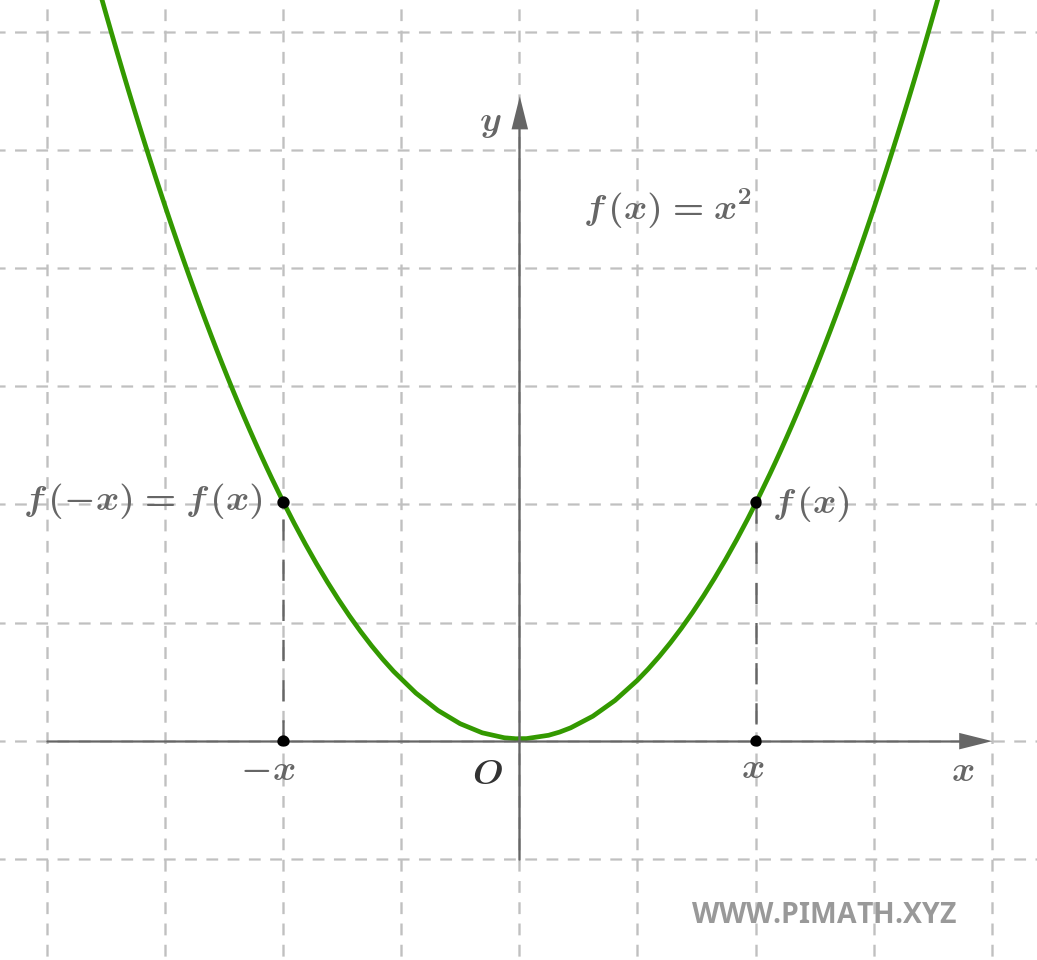
Consider the function
\[ f:\mathbb R\to\mathbb R,\qquad f(x)=x^2. \]
The domain is \(\mathbb R\), which is therefore symmetric about the origin. Moreover, for every \(x\in\mathbb R\),
\[ f(-x)=(-x)^2=x^2=f(x). \]
Hence the function \(f(x)=x^2\) is even.
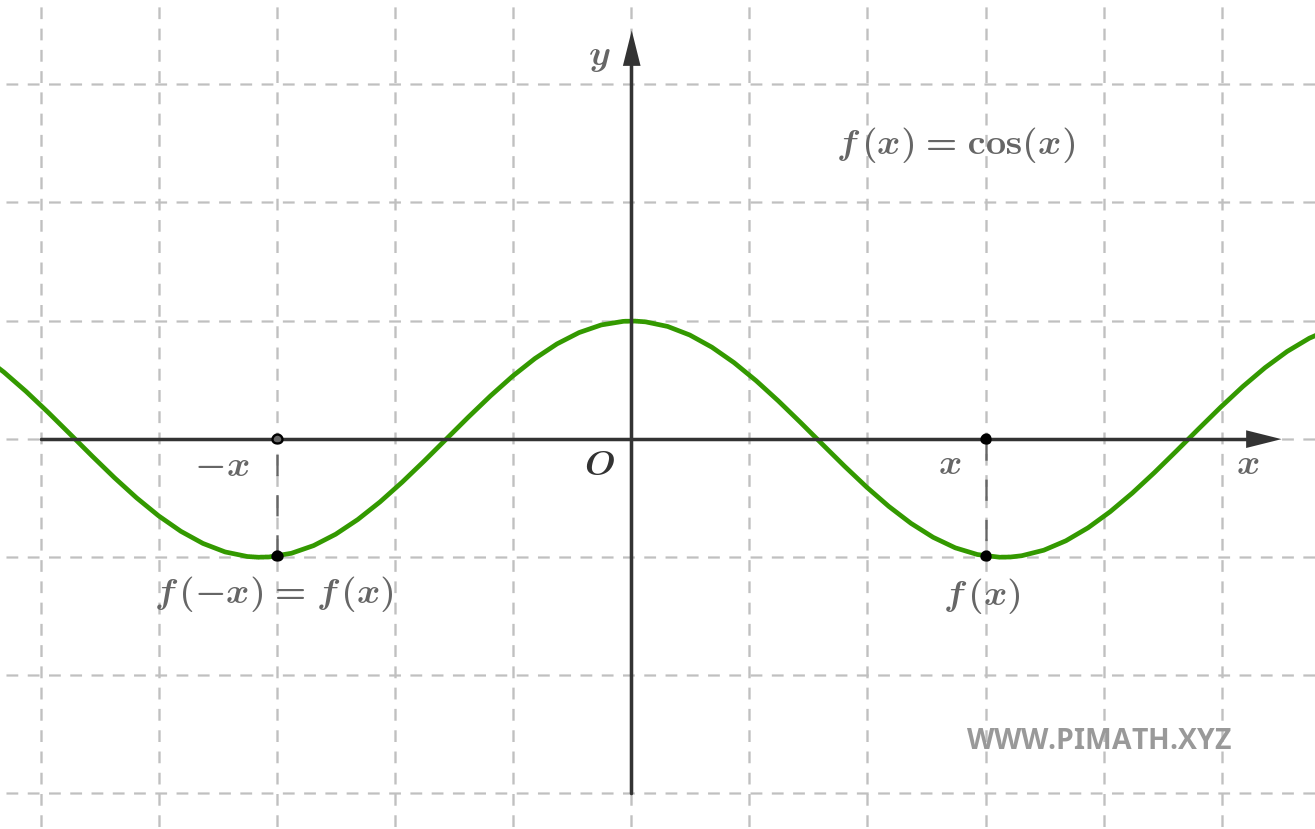
The cosine function is even as well. Indeed, for every \(x\in\mathbb R\) the trigonometric identity
\[ \cos(-x)=\cos x \]
holds. Therefore the function
\[ f:\mathbb R\to\mathbb R,\qquad f(x)=\cos x \]
is even.
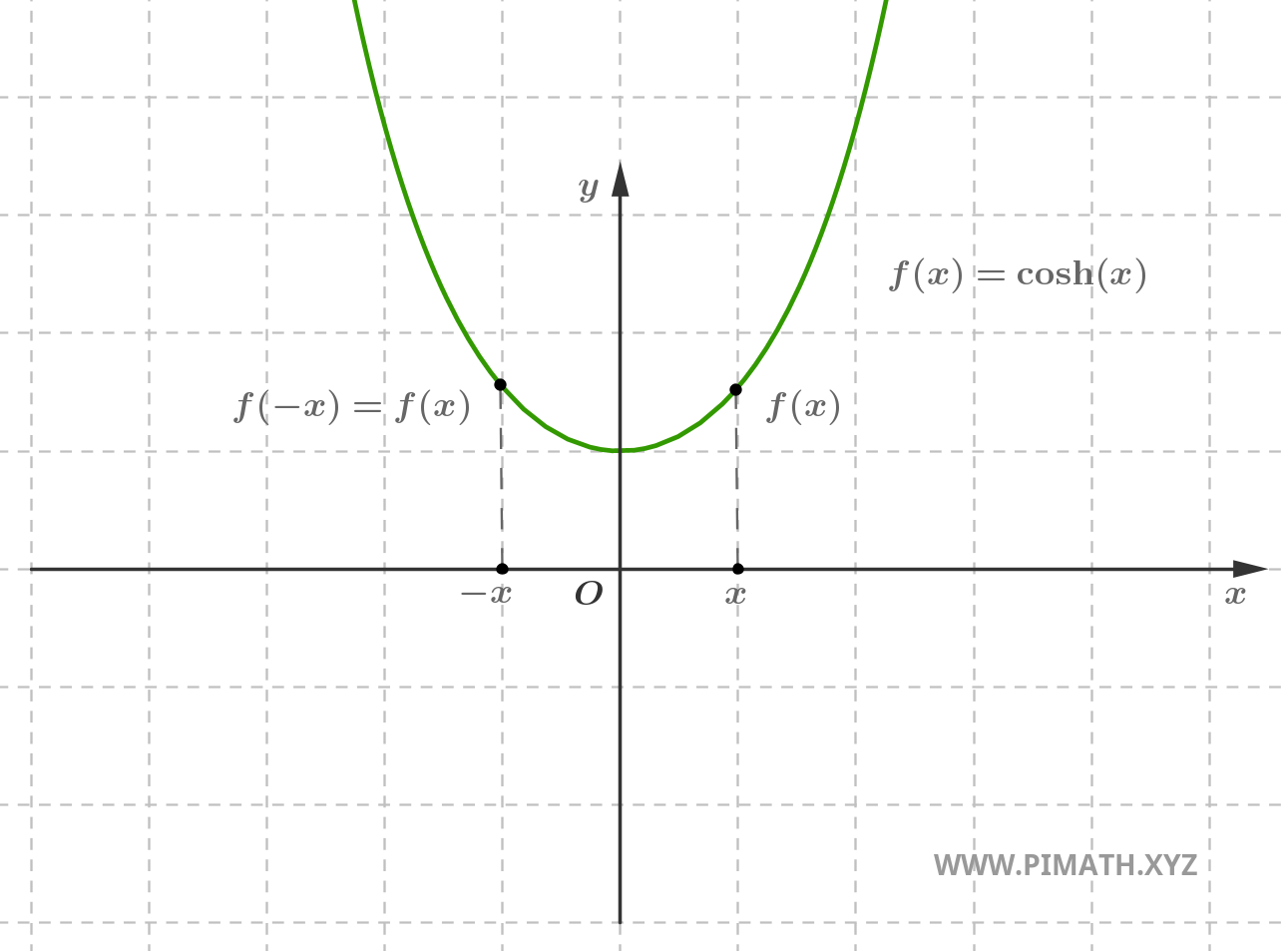
Another example is the hyperbolic cosine. Recalling that
\[ \cosh x=\frac{e^x+e^{-x}}{2}, \]
we obtain
\[ \cosh(-x)=\frac{e^{-x}+e^x}{2}=\frac{e^x+e^{-x}}{2}=\cosh x. \]
Therefore \(f(x)=\cosh x\) is even.
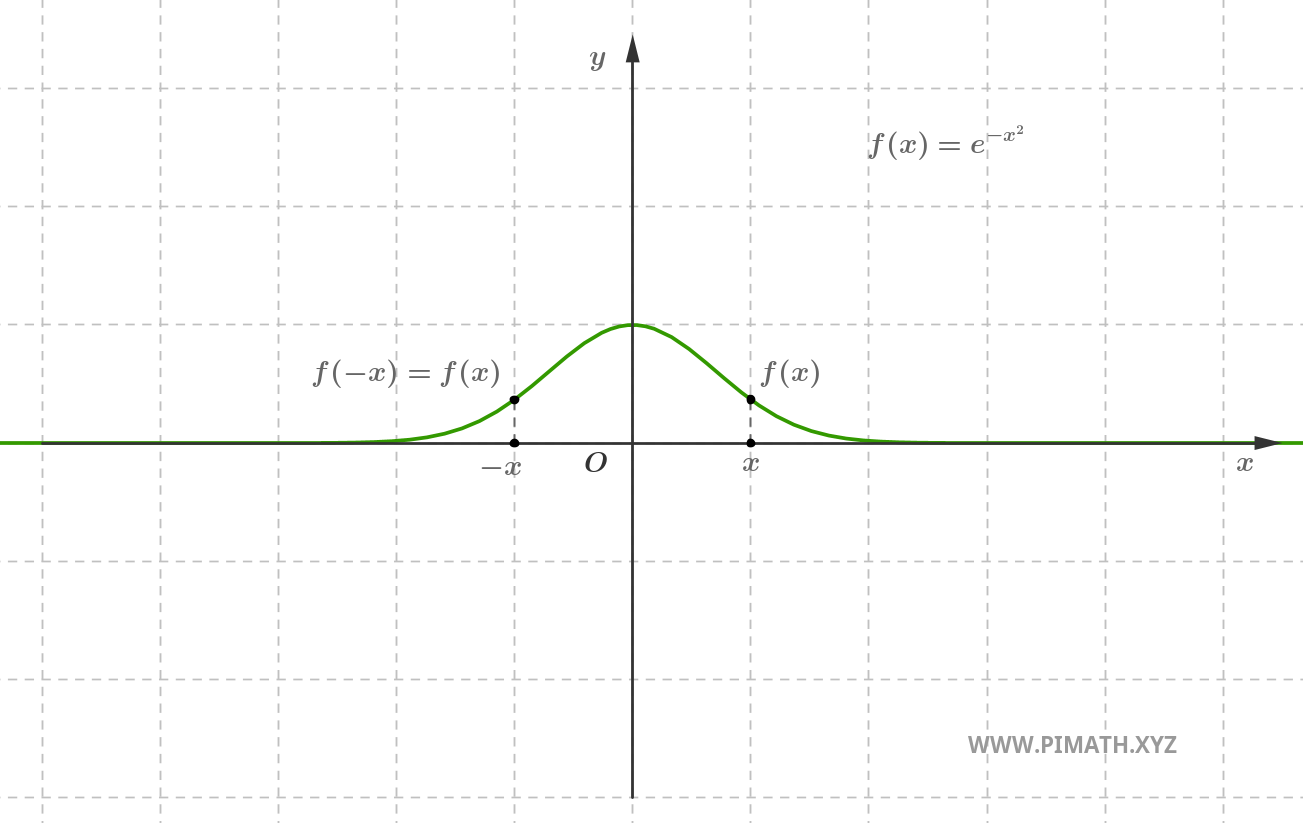
Finally, consider the function
\[ f:\mathbb R\to\mathbb R,\qquad f(x)=e^{-x^2}. \]
For every \(x\in\mathbb R\),
\[ f(-x)=e^{-(-x)^2}=e^{-x^2}=f(x). \]
Thus \(f(x)=e^{-x^2}\) is an even function as well.
Geometric meaning of even functions
The graph of an even function is symmetric about the \(y\)-axis.
Indeed, if \(f\) is even, then for every \(x\) in the domain
\[ f(-x)=f(x). \]
This means that the points of the graph corresponding to \(x\) and to \(-x\) have the same ordinate:
\[ (x,f(x)) \qquad \text{and} \qquad (-x,f(-x))=(-x,f(x)). \]
The two points are symmetric about the \(y\)-axis. Consequently, the entire graph of the function is symmetric about the \(y\)-axis.
This property is useful when studying a graph: if a function is even, it suffices to study it for \(x\ge 0\). The part of the graph corresponding to \(x<0\) is then obtained by symmetry about the \(y\)-axis.
Odd functions
Let \(f:X\to\mathbb R\) be a function defined on a domain \(X\subseteq\mathbb R\) symmetric about the origin. The function \(f\) is said to be odd if, for every \(x\in X\),
\[ f(-x)=-f(x). \]
In other words, a function is odd if it takes opposite values at two opposite points of the domain. Here too the condition must hold for every element of the domain.
The definition thus requires two distinct conditions:
- the domain must be symmetric about the origin;
- the function must take opposite values at \(x\) and at \(-x\).
If either of these two conditions fails, the function is not odd.
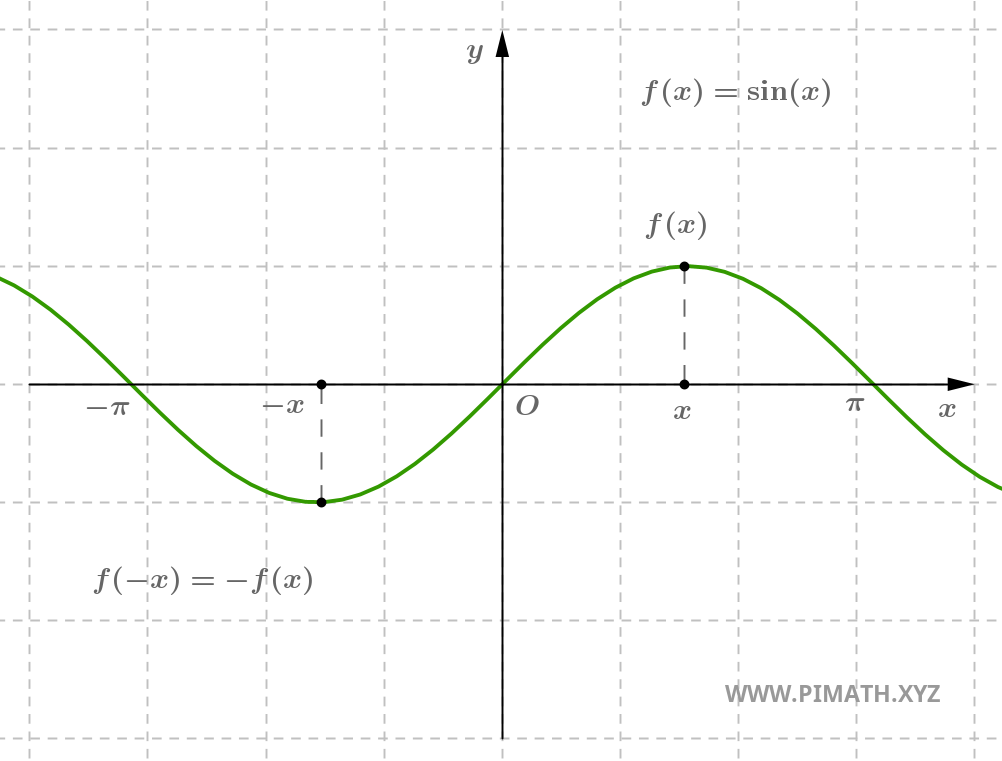
Consider the sine function:
\[ f:\mathbb R\to\mathbb R,\qquad f(x)=\sin x. \]
The domain is \(\mathbb R\), hence symmetric about the origin. Moreover, for every \(x\in\mathbb R\) the trigonometric identity
\[ \sin(-x)=-\sin x \]
holds. Hence the function \(f(x)=\sin x\) is odd.
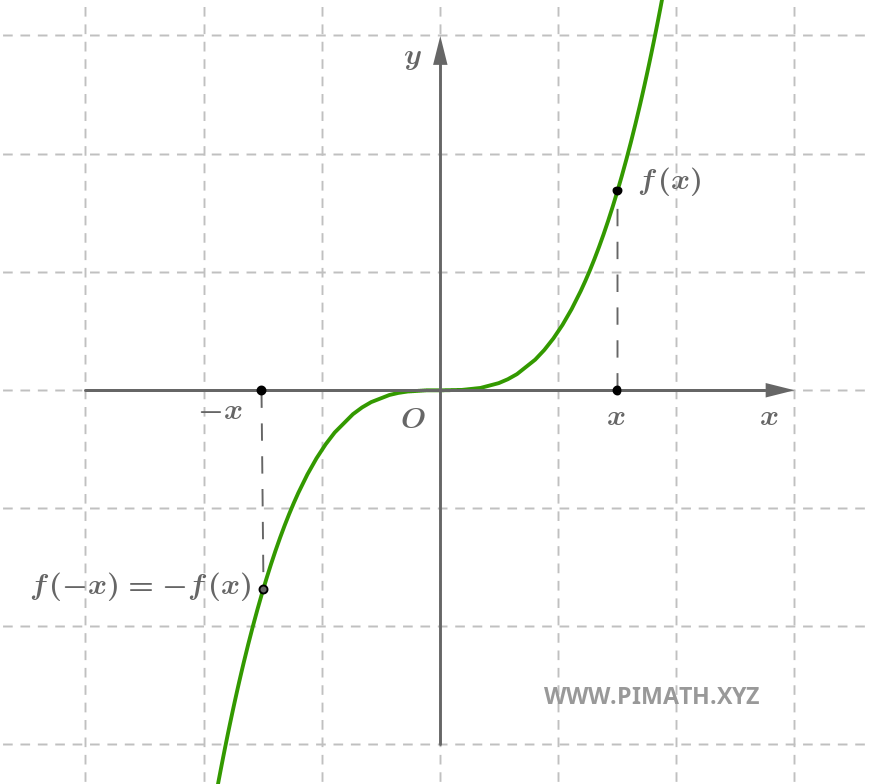
Another fundamental example is the cubic function:
\[ f:\mathbb R\to\mathbb R,\qquad f(x)=x^3. \]
For every \(x\in\mathbb R\),
\[ f(-x)=(-x)^3=-x^3=-f(x). \]
Hence the function \(f(x)=x^3\) is odd.
Many other elementary functions are odd as well, for example
\[ f(x)=x,\qquad f(x)=x^5,\qquad f(x)=\tan x, \]
each considered on its natural domain. In each case, the verification always amounts to computing \(f(-x)\) and checking whether it equals \(-f(x)\).
Geometric meaning of odd functions
The graph of an odd function is symmetric about the origin.
Indeed, if \(f\) is odd, then for every \(x\) in the domain
\[ f(-x)=-f(x). \]
Hence, if the point
\[ (x,f(x)) \]
lies on the graph of the function, then so does the point
\[ (-x,f(-x))=(-x,-f(x)). \]
The points \((x,f(x))\) and \((-x,-f(x))\) are symmetric about the origin. Consequently, the entire graph of the function is symmetric about the origin.
Equivalently, rotating the graph of an odd function by \(180^\circ\) about the origin yields the same graph.
This property is useful when studying a graph: if a function is odd, it suffices to study it for \(x\ge 0\). The part of the graph corresponding to \(x<0\) is then obtained by symmetry about the origin.
Functions that are neither even nor odd
A function may be neither even nor odd. This can happen for two distinct reasons.
The first reason concerns the domain: if the domain is not symmetric about the origin, the function cannot be classified as even or odd according to the definitions given. Indeed, it may happen that \(x\) belongs to the domain while \(-x\) does not, so that the value \(f(-x)\) is undefined.
For example, the function
\[ f:[0,+\infty)\to\mathbb R,\qquad f(x)=x^2 \]
is not regarded as even when defined on \([0,+\infty)\), because its domain is not symmetric about the origin.
The second reason concerns the rule of the function itself. Even when the domain is symmetric about the origin, it may happen that neither
\[ f(-x)=f(x) \]
nor
\[ f(-x)=-f(x) \]
holds. In this case the function is neither even nor odd.
Consider, for example, the function
\[ f:\mathbb R\to\mathbb R,\qquad f(x)=e^x. \]
The domain is \(\mathbb R\), hence symmetric about the origin. However, for every \(x\in\mathbb R\),
\[ f(-x)=e^{-x}. \]
In general \(e^{-x}\ne e^x\), so the function is not even. Moreover, in general \(e^{-x}\ne -e^x\), so the function is not odd.
Therefore \(f(x)=e^x\) is neither even nor odd.
The function
\[ f:\mathbb R\to\mathbb R,\qquad f(x)=x+1 \]
is likewise neither even nor odd. Indeed,
\[ f(-x)=-x+1. \]
In general \(-x+1\ne x+1\), so the function is not even; moreover, \(-x+1\ne -(x+1)\), so the function is not odd.
Functions that are both even and odd
A real function defined on a domain symmetric about the origin can be simultaneously even and odd in only one special case: when it is identically zero on its domain.
Let \(f:X\to\mathbb R\) be a function defined on a domain \(X\subseteq\mathbb R\) symmetric about the origin. If \(f\) is both even and odd, then for every \(x\in X\) the two relations
\[ f(-x)=f(x) \]
and
\[ f(-x)=-f(x) \]
hold simultaneously. Comparing the two equalities, we obtain
\[ f(x)=-f(x). \]
Hence
\[ 2f(x)=0, \]
and therefore
\[ f(x)=0. \]
Since this holds for every \(x\in X\), the function is identically zero:
\[ f\equiv 0. \]
Conversely, the zero function is both even and odd. Indeed, if \(f(x)=0\) for every \(x\in X\), then
\[ f(-x)=0=f(x) \]
and also
\[ f(-x)=0=-0=-f(x). \]
Therefore, on a domain symmetric about the origin, the only real functions that are both even and odd are the identically zero functions.
Sum of even and odd functions
Evenness and oddness behave in a simple way with respect to the sum of functions.
Let \(f\) and \(g\) be two real functions defined on symmetric domains \(D_f\) and \(D_g\), respectively. The sum \(f+g\) is defined on the common domain
\[ D=D_f\cap D_g. \]
Since \(D_f\) and \(D_g\) are symmetric about the origin, so is \(D\).
If \(f\) and \(g\) are both even, then for every \(x\in D\)
\[ (f+g)(-x)=f(-x)+g(-x)=f(x)+g(x)=(f+g)(x). \]
Hence the sum of two even functions is again an even function.
If instead \(f\) and \(g\) are both odd, then for every \(x\in D\)
\[ (f+g)(-x)=f(-x)+g(-x)=-f(x)-g(x)=-(f(x)+g(x)). \]
Since
\[ -(f(x)+g(x))=-(f+g)(x), \]
we obtain
\[ (f+g)(-x)=-(f+g)(x). \]
Hence the sum of two odd functions is again an odd function.
The sum of an even function and an odd function, on the other hand, is in general neither even nor odd. For example,
\[ f(x)=x^2+x \]
is the sum of the even function \(x^2\) and the odd function \(x\), yet it is neither even nor odd.
Product of even and odd functions
The product of even and odd functions likewise obeys precise rules.
Let \(f\) and \(g\) be two real functions defined on symmetric domains \(D_f\) and \(D_g\). The product \(fg\) is defined on the common domain
\[ D=D_f\cap D_g. \]
If \(f\) and \(g\) are both even, then for every \(x\in D\)
\[ (fg)(-x)=f(-x)g(-x)=f(x)g(x)=(fg)(x). \]
Hence the product of two even functions is even.
If \(f\) and \(g\) are both odd, then
\[ (fg)(-x)=f(-x)g(-x)=(-f(x))(-g(x))=f(x)g(x)=(fg)(x). \]
Hence the product of two odd functions is even.
Finally, if \(f\) is even and \(g\) is odd, then
\[ (fg)(-x)=f(-x)g(-x)=f(x)(-g(x))=-f(x)g(x)=-(fg)(x). \]
Hence the product of an even function and an odd function is odd.
In summary:
\[ \text{even}\cdot\text{even}=\text{even}, \qquad \text{odd}\cdot\text{odd}=\text{even}, \qquad \text{even}\cdot\text{odd}=\text{odd}. \]
Integrals of even and odd functions over symmetric intervals
Even and odd functions are especially useful in evaluating definite integrals over intervals symmetric about the origin.
Let \(a>0\) and let \(f\) be a function integrable on \([-a,a]\).
If \(f\) is even, then
\[ \int_{-a}^{a} f(x)\,dx=2\int_0^a f(x)\,dx. \]
Indeed, we may write
\[ \int_{-a}^{a} f(x)\,dx=\int_{-a}^{0} f(x)\,dx+\int_0^a f(x)\,dx. \]
In the first integral we set \(x=-t\). When \(x=-a\), then \(t=a\); when \(x=0\), then \(t=0\). Moreover, \(dx=-dt\). Hence
\[ \int_{-a}^{0} f(x)\,dx = \int_a^0 f(-t)(-dt) = \int_0^a f(-t)\,dt. \]
Since \(f\) is even, \(f(-t)=f(t)\). Therefore
\[ \int_{-a}^{0} f(x)\,dx=\int_0^a f(t)\,dt. \]
Adding the two contributions, we obtain
\[ \int_{-a}^{a} f(x)\,dx = \int_0^a f(x)\,dx+\int_0^a f(x)\,dx = 2\int_0^a f(x)\,dx. \]
If instead \(f\) is odd, then
\[ \int_{-a}^{a} f(x)\,dx=0. \]
Indeed, proceeding as before,
\[ \int_{-a}^{0} f(x)\,dx=\int_0^a f(-t)\,dt. \]
Since \(f\) is odd, \(f(-t)=-f(t)\). Hence
\[ \int_{-a}^{0} f(x)\,dx=-\int_0^a f(t)\,dt. \]
Consequently,
\[ \int_{-a}^{a} f(x)\,dx = -\int_0^a f(x)\,dx+\int_0^a f(x)\,dx=0. \]
Geometrically, for an odd function the signed areas over the two halves of the interval cancel each other. For an even function, by contrast, the two contributions are equal.
Decomposition into even and odd parts
Every real function defined on a domain symmetric about the origin can be written as the sum of an even function and an odd function.
Thus, let
\[ f:X\to\mathbb R \]
be a function defined on a set \(X\subseteq\mathbb R\) symmetric about the origin.
Define the function
\[ f_e:X\to\mathbb R,\qquad f_e(x)=\frac{f(x)+f(-x)}{2}. \]
This function is called the even part of \(f\).
We further define
\[ f_o:X\to\mathbb R,\qquad f_o(x)=\frac{f(x)-f(-x)}{2}. \]
This function is called the odd part of \(f\).
Let us verify that \(f_e\) is even. For every \(x\in X\), using the definition of \(f_e\), we obtain
\[ f_e(-x)=\frac{f(-x)+f(-(-x))}{2} = \frac{f(-x)+f(x)}{2} = f_e(x). \]
Hence \(f_e\) is even.
We now verify that \(f_o\) is odd. For every \(x\in X\),
\[ f_o(-x)=\frac{f(-x)-f(-(-x))}{2} = \frac{f(-x)-f(x)}{2} = -\frac{f(x)-f(-x)}{2} = -f_o(x). \]
Hence \(f_o\) is odd.
Finally, adding \(f_e(x)\) and \(f_o(x)\), we obtain
\[ f_e(x)+f_o(x) = \frac{f(x)+f(-x)}{2} + \frac{f(x)-f(-x)}{2} = f(x). \]
Therefore
\[ f=f_e+f_o. \]
Every real function defined on a symmetric domain can thus be decomposed into the sum of its even part and its odd part:
\[ f(x)=\frac{f(x)+f(-x)}{2}+\frac{f(x)-f(-x)}{2}. \]
Example. Consider the function
\[ f:\mathbb R\to\mathbb R,\qquad f(x)=e^x. \]
The even part of \(f\) is
\[ f_e(x)=\frac{e^x+e^{-x}}{2}=\cosh x. \]
The odd part of \(f\) is
\[ f_o(x)=\frac{e^x-e^{-x}}{2}=\sinh x. \]
Consequently,
\[ e^x=\cosh x+\sinh x. \]
Uniqueness of the decomposition
The decomposition of a function into the sum of an even function and an odd function is unique.
Let \(f:X\to\mathbb R\) be a function defined on a domain \(X\subseteq\mathbb R\) symmetric about the origin. Suppose that \(f\) can be written in two ways as the sum of an even function and an odd function:
\[ f=u+v=\tilde u+\tilde v, \]
where \(u\) and \(\tilde u\) are even functions, while \(v\) and \(\tilde v\) are odd functions.
From the equality
\[ u+v=\tilde u+\tilde v \]
we obtain
\[ u-\tilde u=\tilde v-v. \]
Denote by
\[ h=u-\tilde u=\tilde v-v. \]
Since \(u\) and \(\tilde u\) are even, the difference \(u-\tilde u\) is even. Hence \(h\) is even.
Since \(\tilde v\) and \(v\) are odd, the difference \(\tilde v-v\) is odd. Hence \(h\) is odd.
The function \(h\) is therefore both even and odd. Hence, for every \(x\in X\),
\[ h(-x)=h(x) \]
and
\[ h(-x)=-h(x). \]
Comparing the two equalities, we obtain
\[ h(x)=-h(x). \]
Hence
\[ 2h(x)=0, \]
and therefore
\[ h(x)=0 \]
for every \(x\in X\). Thus \(h\) is the identically zero function.
From
\[ h=u-\tilde u \]
it follows that
\[ u=\tilde u. \]
From
\[ h=\tilde v-v \]
it follows that
\[ v=\tilde v. \]
The two decompositions coincide. Hence the decomposition of \(f\) as the sum of an even function and an odd function is unique.