

Intervals and neighborhoods are particular subsets of the real line. They provide a precise way to describe sets of real numbers lying between two endpoints, or regions of the real line sufficiently close to a given point.
Intervals represent continuous portions of the real line, while neighborhoods describe regions of the real line lying sufficiently close to a fixed point.
In what follows, we study intervals and neighborhoods rigorously, distinguishing between open, closed, bounded, and unbounded intervals, as well as the main types of neighborhood.
Contents
- Intervals on the Real Line
- Formal Definition of an Interval
- Bounded Intervals: Open, Closed, and Half-Open
- Endpoints, Midpoint, Length, and Radius
- Unbounded Intervals and Half-Lines
- Graphical Representation of Intervals
- Open and Closed Sets
- Neighborhoods of a Point
- Open and Closed Neighborhoods
- Right-Hand and Left-Hand Neighborhoods
- Deleted Neighborhoods
- Neighborhoods of \(+\infty\) and \(-\infty\)
- Concluding Remarks
Intervals on the Real Line
An interval is a set of real numbers occupying a continuous portion of the real line.
For example: \[ [2,5] \]
contains all real numbers between \(2\) and \(5\), endpoints included.
The set: \[ (2,5) \qquad \text{or} \qquad ]2,5[ \]
contains all real numbers between \(2\) and \(5\), but excludes the endpoints \(2\) and \(5\).
Many mathematical analysis textbooks use the second notation, with reversed square brackets, to denote open intervals.
The key idea is that an interval has no gaps: if it contains two numbers, then it contains every number lying between them.
Formal Definition of an Interval
In mathematics, an interval is a convex subset of the real line.
Formally, a subset: \[ I\subseteq\mathbb{R} \]
is called an interval if:
\[ \forall x,y\in I,\ \forall z\in\mathbb{R},\quad \min(x,y)<z<\max(x,y) \Longrightarrow z\in I \]
This means that for any two elements of the set, every number lying strictly between them also belongs to the set.
This property guarantees that the set has no internal gaps.
Example. \[ [1,4] \] is an interval.
Indeed, given any two numbers in \([1,4]\), every value strictly between them still belongs to the interval.
Counterexample. \[ [1,2]\cup[3,4] \]
is not an interval.
Indeed: \[ 1.5\in [1,2]\cup[3,4], \qquad 3.5\in [1,2]\cup[3,4] \]
yet: \[ 2.5\notin [1,2]\cup[3,4] \]
even though: \[ 1.5<2.5<3.5 \]
Bounded Intervals: Open, Closed, and Half-Open
Let: \[ a,b\in\mathbb{R}, \qquad a<b \]
Bounded intervals with endpoints \(a\) and \(b\) are classified according to whether the endpoints are included or excluded.
Open interval
The open interval with endpoints \(a\) and \(b\) excludes both endpoints:
\[ (a,b)=]a,b[ =\{x\in\mathbb{R}\mid a<x<b\} \]
Closed interval
The closed interval with endpoints \(a\) and \(b\) includes both endpoints:
\[ [a,b] =\{x\in\mathbb{R}\mid a\leq x\leq b\} \]
Half-open intervals
Half-open intervals contain exactly one of the two endpoints.
There are two cases:
\[ [a,b)=[a,b[ =\{x\in\mathbb{R}\mid a\leq x<b\} \]
and:
\[ (a,b]=]a,b] =\{x\in\mathbb{R}\mid a<x\leq b\} \]
In the first case, the left endpoint \(a\) belongs to the interval, while \(b\) does not. In the second case, \(b\) is included and \(a\) is not.
Endpoints, Midpoint, Length, and Radius
Consider a bounded interval with endpoints \(a\) and \(b\), where:
\[ a<b \]
The following quantities are defined:
- left endpoint: the number \(a\);
- right endpoint: the number \(b\);
- length: \[ b-a \]
- midpoint: \[ \frac{a+b}{2} \]
- radius: \[ \frac{b-a}{2} \]
For example, for the interval: \[ [2,8] \]
the length is: \[ 8-2=6 \]
the midpoint is: \[ \frac{2+8}{2}=5 \]
and the radius is: \[ \frac{8-2}{2}=3 \]
Unbounded Intervals and Half-Lines
An interval is called unbounded if it extends indefinitely to the right, to the left, or in both directions along the real line.
The half-lines extending to the right are:
\[ (a,+\infty)=]a,+\infty[ =\{x\in\mathbb{R}\mid x>a\} \]
and:
\[ [a,+\infty)=[a,+\infty[ =\{x\in\mathbb{R}\mid x\geq a\} \]
Similarly, the half-lines extending to the left are:
\[ (-\infty,b)=]-\infty,b[ =\{x\in\mathbb{R}\mid x<b\} \]
and:
\[ (-\infty,b]=]-\infty,b] =\{x\in\mathbb{R}\mid x\leq b\} \]
It is important to observe that: \[ +\infty\notin\mathbb{R}, \qquad -\infty\notin\mathbb{R} \]
Consequently, infinity can never be included using square brackets.
The entire real line can be written as: \[ \mathbb{R}=(-\infty,+\infty)=]-\infty,+\infty[ \]
Graphical Representation of Intervals
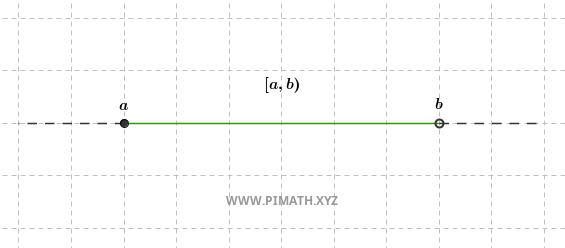
Intervals can be represented graphically on the real line.
In general:
- a filled dot indicates that the endpoint belongs to the interval;
- an open dot indicates that the endpoint does not belong to the interval;
- a solid line represents all points belonging to the interval.
For example, the interval: \[ [-2,3) \qquad \text{that is} \qquad [-2,3[ \]
contains \(-2\), but does not contain \(3\).
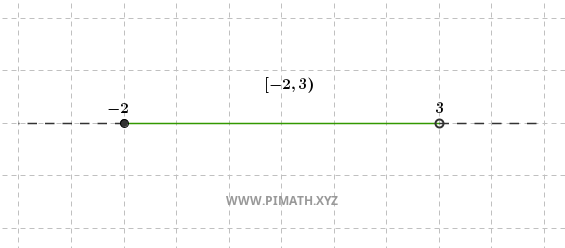
On the real line, this interval is represented with:
- a filled dot at \(-2\);
- an open dot at \(3\);
- a solid line between the two endpoints.
Open and Closed Sets
Intervals provide a natural way to introduce the concepts of open and closed sets on the real line.
An open interval: \[ (a,b)=]a,b[ \]
is an example of an open set, since every point in it can be surrounded by a small interval still entirely contained within the set.
A closed interval: \[ [a,b] \]
is instead an example of a closed set on the real line.
The intervals: \[ [a,b), \qquad (a,b] \]
also written as: \[ [a,b[, \qquad ]a,b] \]
are neither open nor closed.
Neighborhoods of a Point
The concept of a neighborhood formalizes the idea of proximity to a point on the real line.
Let: \[ x_0\in\mathbb{R} \]
A set: \[ U\subseteq\mathbb{R} \]
is called a neighborhood of \(x_0\) if it contains an open interval containing \(x_0\).
Equivalently, \(U\) is a neighborhood of \(x_0\) if there exist real numbers \(a, b\) such that:
\[ x_0\in(a,b)\subseteq U \qquad \text{that is} \qquad x_0\in]a,b[\subseteq U \]
Intuitively, a neighborhood always contains a region lying sufficiently close to the point \(x_0\).
Open and Closed Neighborhoods
The most commonly used neighborhoods are symmetric neighborhoods, that is, intervals centered at a given point.
Let: \[ x_0\in\mathbb{R}, \qquad r>0 \]
where \(r\) is called the radius.
Open neighborhood
The open neighborhood of center \(x_0\) and radius \(r\) is:
\[ I(x_0,r) = \{x\in\mathbb{R}\mid |x-x_0|<r\} \]
Equivalently:
\[ I(x_0,r) = (x_0-r,x_0+r) = ]x_0-r,x_0+r[ \]
The condition: \[ |x-x_0|<r \]
means that the distance between \(x\) and \(x_0\) is less than \(r\).
Closed neighborhood
The closed neighborhood of center \(x_0\) and radius \(r\) is:
\[ \overline{I}(x_0,r) = \{x\in\mathbb{R}\mid |x-x_0|\leq r\} \]
Equivalently:
\[ \overline{I}(x_0,r) = [x_0-r,x_0+r] \]
In this case, the endpoints are also included.
Example. The open neighborhood of center \(3\) and radius \(2\) is:
\[ I(3,2) = (1,5) = ]1,5[ \]
Right-Hand and Left-Hand Neighborhoods
In some situations, it is useful to consider only the points lying to the right or to the left of a given point.
An open right-hand neighborhood of \(x_0\) is a set of the form:
\[ (x_0,x_0+r) = ]x_0,x_0+r[ \]
with: \[ r>0 \]
Similarly, an open left-hand neighborhood of \(x_0\) is:
\[ (x_0-r,x_0) = ]x_0-r,x_0[ \]
with: \[ r>0 \]
The former contains only points greater than \(x_0\), while the latter contains only points less than \(x_0\).
Deleted Neighborhoods
A deleted neighborhood is a neighborhood from which the center has been removed.
Formally:
\[ I^\ast(x_0,r) = \{x\in\mathbb{R}\mid 0<|x-x_0|<r\} \]
Equivalently:
\[ I^\ast(x_0,r) = (x_0-r,x_0)\cup(x_0,x_0+r) = ]x_0-r,x_0[ \cup ]x_0,x_0+r[ \]
The condition: \[ 0<|x-x_0| \]
excludes the point: \[ x=x_0 \]
while: \[ |x-x_0|<r \]
retains all points within distance \(r\) of \(x_0\).
Example. For: \[ x_0=4, \qquad r=1 \]
one obtains:
\[ I^\ast(4,1) = (3,4)\cup(4,5) = ]3,4[ \cup ]4,5[ \]
Neighborhoods of \(+\infty\) and \(-\infty\)
In order to study the behavior of functions as the variable grows without bound, the notion of neighborhood is extended to include the points at infinity.
A neighborhood of \(+\infty\) is defined as any open right-hand half-line of the form:
\[ (M,+\infty) = ]M,+\infty[ \]
with: \[ M\in\mathbb{R}, \qquad M>0 \]
Intuitively, this neighborhood represents the set of all real numbers greater than some large positive value \(M\).
Similarly, a neighborhood of \(-\infty\) is defined as any open left-hand half-line of the form:
\[ (-\infty,-M) = ]-\infty,-M[ \]
with: \[ M\in\mathbb{R}, \qquad M>0 \]
This set describes the portion of the real line consisting of all numbers less than the negative value \(-M\), where \(M\) can be taken as large as desired.
Concluding Remarks
Intervals and neighborhoods provide a rigorous framework for describing subsets of the real line and regions close to a given point.
Intervals distinguish between included and excluded endpoints, while neighborhoods formalize the notion of closeness on the real line.
In particular:
- open intervals do not contain their endpoints;
- closed intervals contain both endpoints;
- half-open intervals contain exactly one endpoint;
- open neighborhoods are open intervals centered at a given point;
- closed neighborhoods also include the endpoints;
- deleted neighborhoods exclude the center point;
- neighborhoods of \(+\infty\) and \(-\infty\) are open half-lines extending beyond a value that can be taken arbitrarily large.
These concepts will be used throughout the study of functions and mathematical analysis.