

Special products are algebraic identities that allow us to expand certain polynomial products quickly, without carrying out every step of term-by-term multiplication each time. Their importance, however, goes beyond mere computational convenience: they are fundamental tools for simplifying expressions, factoring polynomials, and recognising recurring structures in algebra. To study them carefully is to learn to see the pattern behind the symbols.
Contents
- What Are Special Products
- Square of a Binomial
- Square of a Trinomial
- Product of a Sum and a Difference
- Cube of a Binomial
- Sum and Difference of Cubes
- The Reverse Direction: Factoring with Special Products
- Common Mistakes
- General Problem-Solving Strategy
- Remarks
- Practice Problems
What Are Special Products
An algebraic identity is an equality that holds for every value of the variables involved. It is not an equation to be solved, nor a formula valid only under special conditions: it is a universal law, a structural property of algebra.
Special products are identities of this kind, arising from polynomial products that recur throughout algebra. Their importance is twofold: they allow us to expand certain expressions quickly, but — more valuably still — they let us recognise hidden structure and factor polynomials that at first glance appear irreducible.
One word of caution before we begin: every formula that follows should not be memorised mechanically, but understood. A formula that is understood is never forgotten. A formula that is merely memorised will always fail you when you need it most.
Square of a Binomial
Let \(a\) and \(b\) be any two algebraic expressions. Then:
\[ (a+b)^2 = a^2 + 2ab + b^2. \]
Proof. By definition of a power, \((a+b)^2 = (a+b)(a+b)\). Applying the distributive property — first with respect to the left factor, then to the right — gives:
\[ (a+b)(a+b) = a(a+b) + b(a+b) = a^2 + ab + ba + b^2. \]
Since multiplication of algebraic expressions is commutative, \(ab = ba\), so \(ab + ba = 2ab\). Therefore:
\[ (a+b)^2 = a^2 + 2ab + b^2. \quad \square \]
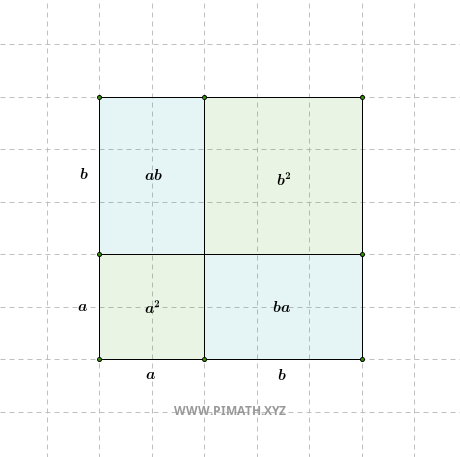
Geometric interpretation. When \(a\) and \(b\) are positive lengths, the formula has an immediate visual meaning. A square of side \(a+b\) can be partitioned into four regions: a square of side \(a\), a square of side \(b\), and two rectangles of dimensions \(a \times b\). The total area is therefore \(a^2 + 2ab + b^2\). This geometric reading makes clear why the middle term \(2ab\) cannot be omitted: it accounts for exactly those two rectangles.
For the square of a difference, it suffices to replace \(b\) with \(-b\) in the identity just proved:
\[ (a-b)^2 = \bigl(a+(-b)\bigr)^2 = a^2 + 2a(-b) + (-b)^2 = a^2 - 2ab + b^2. \]
The structure is the same; only the sign of the middle term changes. In both cases, the result is a perfect square trinomial: the sum of the squares of the two terms, plus or minus twice their product.
Remark. The square of a difference yields an important inequality at once: since \((a-b)^2 \geq 0\) for all \(a, b \in \mathbb{R}\), we always have \[ a^2 + b^2 \geq 2ab, \] with equality if and only if \(a = b\). This is one of the most elegant proofs of the AM-GM inequality for two terms.
Square of a Trinomial
The square of a trinomial extends the previous case in a natural way. Let \(a\), \(b\), \(c\) be three algebraic expressions. Then:
\[ (a+b+c)^2 = a^2 + b^2 + c^2 + 2ab + 2ac + 2bc. \]
Proof. Set \(s = a + b\), so that \((a+b+c)^2 = (s+c)^2\). Applying the square of a binomial, already proved:
\[ (s+c)^2 = s^2 + 2sc + c^2. \]
Now expand \(s^2 = (a+b)^2 = a^2 + 2ab + b^2\) and \(2sc = 2(a+b)c = 2ac + 2bc\). Substituting:
\[ (a+b+c)^2 = a^2 + 2ab + b^2 + 2ac + 2bc + c^2 = a^2 + b^2 + c^2 + 2ab + 2ac + 2bc. \quad \square \]
Structure of the formula. The result is the sum of the squares of each term, plus twice the product of every distinct pair of terms. This pattern generalises: the square of a sum of \(n\) terms contains all \(n\) squares and all \(\binom{n}{2}\) cross terms.
Product of a Sum and a Difference
Among all special products, this is perhaps the most surprising the first time one encounters it:
\[ (a+b)(a-b) = a^2 - b^2. \]
Proof. Applying the distributive property to the left factor:
\[ (a+b)(a-b) = a(a-b) + b(a-b) = a^2 - ab + ba - b^2. \]
By the commutative property of multiplication, \(ba = ab\), so \(-ab + ba = 0\). What remains is:
\[ (a+b)(a-b) = a^2 - b^2. \quad \square \]
The cancellation of the middle terms is not a lucky accident: it is a direct consequence of the fact that the two factors differ only in the sign of the second term. The structure is perfectly symmetric, and it is precisely this symmetry that forces the cancellation.
Geometric interpretation. Suppose \(a > b > 0\). The difference \(a^2 - b^2\) represents the area of a square of side \(a\) with a square of side \(b\) removed — a kind of square frame. This frame can be cut and rearranged to form a rectangle of dimensions \((a+b) \times (a-b)\), exactly as the identity states.
Remark. This formula is remarkably useful in numerical computation. For example: \[ 999 \times 1001 = (1000 - 1)(1000 + 1) = 1000^2 - 1 = 999\,999. \] It is also the key tool for rationalising irrational denominators: to clear a square root from a denominator, one multiplies numerator and denominator by the conjugate of the denominator: \[ \frac{1}{\sqrt{2}+1} = \frac{\sqrt{2}-1}{(\sqrt{2}+1)(\sqrt{2}-1)} = \frac{\sqrt{2}-1}{2-1} = \sqrt{2}-1. \]
Cube of a Binomial
Raising a binomial to the third power gives:
\[ (a+b)^3 = a^3 + 3a^2b + 3ab^2 + b^3. \]
Proof. By definition of a power, \((a+b)^3 = (a+b)^2 \cdot (a+b)\). Substituting the square already proved:
\[ (a+b)^3 = (a^2 + 2ab + b^2)(a+b). \]
Applying the distributive property:
\[ = a^2(a+b) + 2ab(a+b) + b^2(a+b) = a^3 + a^2b + 2a^2b + 2ab^2 + ab^2 + b^3. \]
Collecting like terms:
\[ (a+b)^3 = a^3 + 3a^2b + 3ab^2 + b^3. \quad \square \]
For the cube of a difference, replace \(b\) with \(-b\):
\[ (a-b)^3 = a^3 + 3a^2(-b) + 3a(-b)^2 + (-b)^3 = a^3 - 3a^2b + 3ab^2 - b^3. \]
The signs alternate according to the pattern \(+, -, +, -\), since odd powers of \(-b\) are negative and even powers are positive.
Remark. The coefficients \(1, 3, 3, 1\) are not arbitrary: they are the binomial coefficients \(\binom{3}{0}, \binom{3}{1}, \binom{3}{2}, \binom{3}{3}\), that is, the entries of the fourth row of Pascal's triangle. This connection is not a decorative detail: it is the expression of a general law known as the binomial theorem, which describes the expansion of \((a+b)^n\) for any non-negative integer exponent \(n\).
Sum and Difference of Cubes
The following identities allow us to factor expressions that are neither squares nor cubes of binomials, but have a structure of their own:
\[ a^3 + b^3 = (a+b)(a^2 - ab + b^2), \] \[ a^3 - b^3 = (a-b)(a^2 + ab + b^2). \]
Proof of the difference of cubes. We verify that the two sides are equal. Applying the distributive property to the right-hand side:
\[ (a-b)(a^2+ab+b^2) = a(a^2+ab+b^2) - b(a^2+ab+b^2) \] \[ = a^3 + a^2b + ab^2 - a^2b - ab^2 - b^3. \]
The terms \(a^2b\) and \(-a^2b\) cancel, as do \(ab^2\) and \(-ab^2\). What remains is:
\[ (a-b)(a^2+ab+b^2) = a^3 - b^3. \quad \square \]
The sum of cubes is proved in an entirely analogous way, or alternatively by replacing \(b\) with \(-b\) in the identity just obtained.
An important warning. These identities must not be confused with the cube of a binomial:
\[ (a+b)^3 = a^3 + 3a^2b + 3ab^2 + b^3 \neq a^3 + b^3. \]
The sum \(a^3 + b^3\) is indeed factorable, but the second factor \(a^2 - ab + b^2\) is irreducible over \(\mathbb{R}\): its discriminant in \(a\) is \(b^2 - 4b^2 = -3b^2 < 0\) for every \(b \neq 0\), which guarantees that it has no real roots.
The Reverse Direction: Factoring with Special Products
Special products are two-way tools. Reading them from left to right, one expands; reading them from right to left, one factors. This second direction is often the more important one.
To use them in reverse, one must train the eye to recognise structure. The key patterns to look for are:
- Perfect square trinomial: three terms, two of which are perfect squares with positive coefficients, and the third is twice the product of their square roots. For example \(9x^2 - 12x + 4 = (3x-2)^2\).
- Difference of squares: two terms, both perfect squares, with opposite signs. For example \(25x^2 - 49 = (5x+7)(5x-7)\).
- Sum or difference of cubes: two terms that are perfect cubes, with the appropriate sign. For example \(8x^3 + 27 = (2x)^3 + 3^3 = (2x+3)(4x^2 - 6x + 9)\).
Example. Factor \(x^4 - 16\).
We recognise a difference of squares with \(a = x^2\) and \(b = 4\): \[ x^4 - 16 = (x^2+4)(x^2-4). \] But \(x^2 - 4\) is itself a difference of squares: \[ x^2 - 4 = (x+2)(x-2). \] The factor \(x^2 + 4\) cannot be factored further over \(\mathbb{R}\). The complete factorisation is: \[ x^4 - 16 = (x^2+4)(x+2)(x-2). \]
This example illustrates a general principle: factoring must be applied iteratively, until every factor is irreducible.
Common Mistakes
The most frequent — and most serious — mistake is dropping the middle term.
\[ (a+b)^2 \neq a^2 + b^2. \]
This equality holds only when \(ab = 0\), that is, when at least one of the two terms is zero. In every other case it is false, and the error is surprisingly persistent even among students who are otherwise fluent in algebra.
Similarly:
\[ (a-b)^2 \neq a^2 - b^2 \qquad \text{(this is instead } (a+b)(a-b)\text{)}, \] \[ (a+b)^3 \neq a^3 + b^3 \qquad \text{(this is instead the sum of cubes)}. \]
A second mistake concerns the signs in the cube of a difference. The correct coefficients of \((a-b)^3\) are \(+1, -3, +3, -1\), not \(+1, -3, -3, -1\). The regular alternation of signs is a direct consequence of the substitution \(b \mapsto -b\) and must not be overlooked.
General Problem-Solving Strategy
When working with special products, it helps to proceed systematically:
- Identify the structure. Does the expression resemble the square of a binomial? A difference of squares? A cube? A sum or difference of cubes? It is often necessary to rewrite terms as explicit powers to make the structure visible (for example, \(4x^2 = (2x)^2\), or \(27y^3 = (3y)^3\)).
- Identify \(a\) and \(b\). Once the type of special product has been recognised, establish explicitly which expressions play the role of \(a\) and \(b\) (and \(c\), in the case of the trinomial).
- Apply the formula. Substitute \(a\) and \(b\) into the chosen identity, taking careful account of signs and exponents.
- Simplify. Evaluate powers and numerical products, and collect like terms.
- Check. Verify that the result has the expected structure: in a square, the middle term must be present; in a cube, the coefficients must be \(1, 3, 3, 1\); in a difference of squares, there must be no middle term at all.
Remarks
Pascal's triangle. The coefficients of the powers of a binomial are not arbitrary. For every exponent \(n\), the coefficients of \((a+b)^n\) are the entries of the \((n+1)\)-th row of Pascal's triangle:
\[ \begin{array}{c} n=0: \quad 1 \\ n=1: \quad 1 \quad 1 \\ n=2: \quad 1 \quad 2 \quad 1 \\ n=3: \quad 1 \quad 3 \quad 3 \quad 1 \\ n=4: \quad 1 \quad 4 \quad 6 \quad 4 \quad 1 \end{array} \]
Each entry is the sum of the two entries immediately above it. This structure lies at the heart of the binomial theorem, one of the most powerful identities in combinatorial algebra.
The difference of squares in rationalisation. One of the most elegant applications of the product of a sum and a difference arises when simplifying irrational expressions. To clear a square root from a denominator, one multiplies numerator and denominator by the conjugate of the denominator, exploiting the identity \((a+b)(a-b) = a^2 - b^2\). This turns the radical into a rational number and greatly simplifies the computation.
Practice Problems
Example 1. Expand \((x+5)^2\).
Solution. With \(a = x\) and \(b = 5\): \[ (x+5)^2 = x^2 + 2 \cdot x \cdot 5 + 5^2 = x^2 + 10x + 25. \]
Example 2. Expand \((3x-2)^2\).
Solution. With \(a = 3x\) and \(b = 2\): \[ (3x-2)^2 = (3x)^2 - 2 \cdot 3x \cdot 2 + 2^2 = 9x^2 - 12x + 4. \]
Example 3. Expand \((2x+7)(2x-7)\).
Solution. We recognise the product of a sum and a difference with \(a = 2x\) and \(b = 7\): \[ (2x+7)(2x-7) = (2x)^2 - 7^2 = 4x^2 - 49. \]
Example 4. Expand \((2x^2 - 3y)^3\).
Solution. We recognise the cube of a difference with \(a = 2x^2\) and \(b = 3y\). We compute the four terms separately: \[ a^3 = (2x^2)^3 = 8x^6, \] \[ 3a^2b = 3 \cdot (2x^2)^2 \cdot 3y = 3 \cdot 4x^4 \cdot 3y = 36x^4y, \] \[ 3ab^2 = 3 \cdot 2x^2 \cdot (3y)^2 = 3 \cdot 2x^2 \cdot 9y^2 = 54x^2y^2, \] \[ b^3 = (3y)^3 = 27y^3. \] Applying the formula \((a-b)^3 = a^3 - 3a^2b + 3ab^2 - b^3\): \[ (2x^2-3y)^3 = 8x^6 - 36x^4y + 54x^2y^2 - 27y^3. \]
Example 5. Factor \(x^4 - 81\) completely.
Solution. Write \(x^4 = (x^2)^2\) and \(81 = 9^2\), recognising a difference of squares with \(a = x^2\) and \(b = 9\): \[ x^4 - 81 = (x^2+9)(x^2-9). \] The factor \(x^2 - 9 = x^2 - 3^2\) is itself a difference of squares: \[ x^2 - 9 = (x+3)(x-3). \] The factor \(x^2 + 9\) cannot be factored further over \(\mathbb{R}\), as it has no real roots. The complete factorisation is: \[ x^4 - 81 = (x^2+9)(x+3)(x-3). \]
Example 6. Factor \(8x^3 - 125\).
Solution. Write both terms as perfect cubes: \(8x^3 = (2x)^3\) and \(125 = 5^3\). We recognise a difference of cubes with \(a = 2x\) and \(b = 5\): \[ 8x^3 - 125 = (2x-5)\bigl((2x)^2 + (2x)(5) + 5^2\bigr) = (2x-5)(4x^2+10x+25). \] The trinomial \(4x^2 + 10x + 25\) is irreducible over \(\mathbb{R}\): its discriminant is \(\Delta = 100 - 4 \cdot 4 \cdot 25 = 100 - 400 = -300 < 0\).
Example 7. Simplify the expression: \[ \frac{(x+h)^2 - x^2}{h}, \qquad h \neq 0. \]
Solution. Expand the square in the numerator using \((x+h)^2 = x^2 + 2xh + h^2\): \[ (x+h)^2 - x^2 = x^2 + 2xh + h^2 - x^2 = 2xh + h^2. \] Factor out \(h\) from the numerator: \[ 2xh + h^2 = h(2x+h). \] Since \(h \neq 0\), we may cancel: \[ \frac{h(2x+h)}{h} = 2x + h. \] This is not merely an algebraic exercise: the original expression is the difference quotient of \(f(x) = x^2\), whose limit as \(h \to 0\) yields the derivative \(f'(x) = 2x\). Special products, then, appear at the very first steps of differential calculus.
Example 8. Prove that for every integer \(n\), the difference \((n+1)^2 - (n-1)^2\) is always a multiple of \(4\), and determine which multiple.
Solution. Expand both squares using the known formulas: \[ (n+1)^2 = n^2 + 2n + 1, \] \[ (n-1)^2 = n^2 - 2n + 1. \] Subtracting: \[ (n+1)^2 - (n-1)^2 = (n^2 + 2n + 1) - (n^2 - 2n + 1) = 4n. \] The result is \(4n\), which is a multiple of \(4\) for every \(n \in \mathbb{Z}\). Alternatively, one can recognise a difference of squares directly: \[ (n+1)^2 - (n-1)^2 = \bigl((n+1)+(n-1)\bigr)\bigl((n+1)-(n-1)\bigr) = 2n \cdot 2 = 4n. \] Both approaches reach the same result, but the second is faster and illustrates how much can be gained by learning to recognise structure.