

A parabola is a plane curve defined as the locus of points equidistant from a fixed point, called the focus, and a fixed line, called the directrix. Its axis of symmetry passes through the focus and is perpendicular to the directrix.
Contents
- Canonical Equation of the Parabola
- Parabola with Vertical Axis and Parabola with Horizontal Axis
- Parabola in Vertex Form
- Vertex, Focus, Directrix and Axis of Symmetry
- Equation of a Parabola Given Its Vertex and a Point
- Practice Problems on the Parabola
Canonical Equation of the Parabola
A parabola is the locus of points in the plane equidistant from a fixed point, called the focus, and a fixed line, called the directrix.
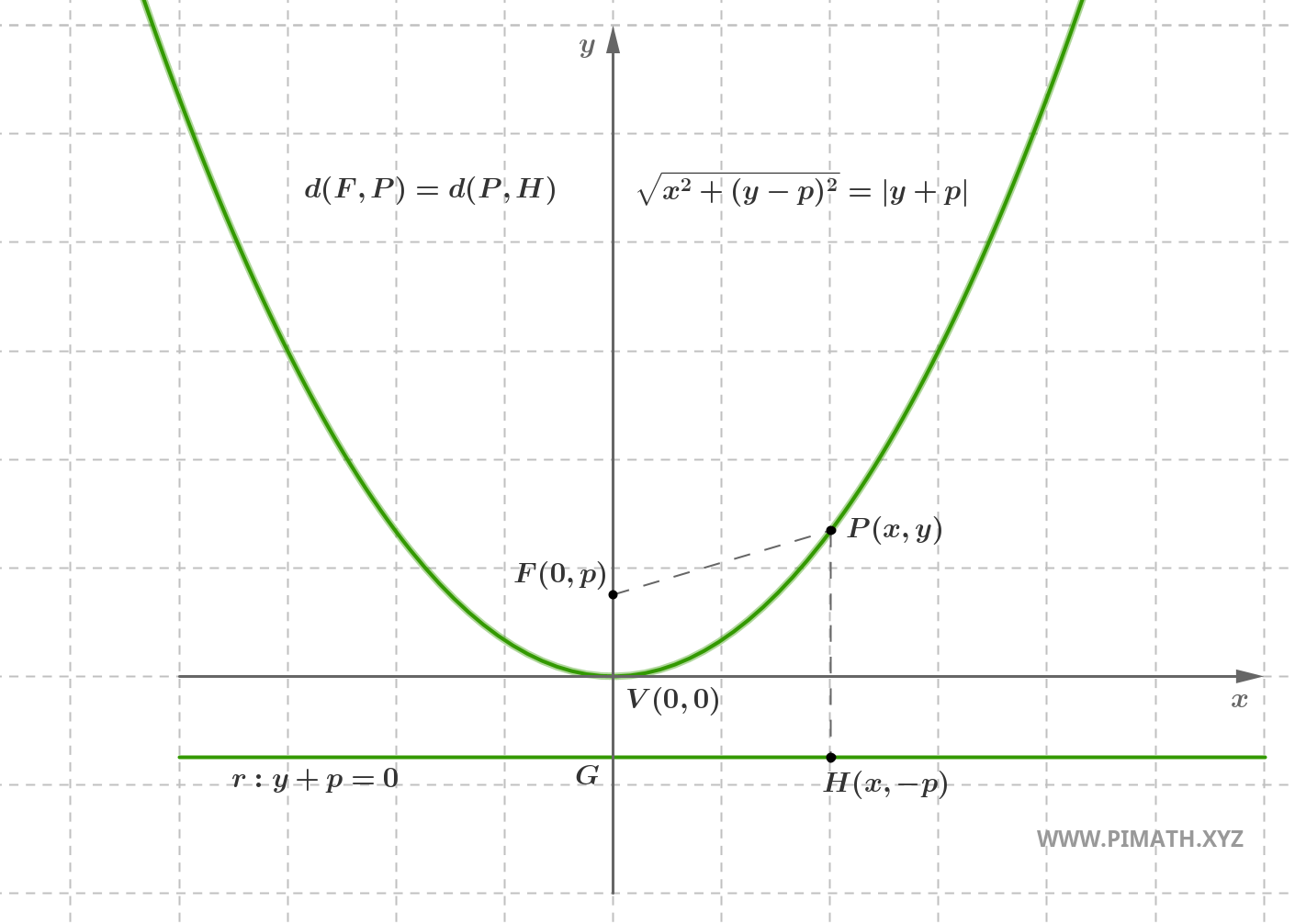
Consider the simplest case: the focus is \(F(0,p)\), with \(p>0\), and the directrix is the line \(y=-p\). A point \(P(x,y)\) lies on the parabola if and only if its distance from the focus equals its distance from the directrix:
\[ d(P,F)=d(P,r). \]
Since
\[ d(P,F)=\sqrt{x^2+(y-p)^2} \]
and
\[ d(P,r)=|y+p|, \]
we obtain the equation
\[ \sqrt{x^2+(y-p)^2}=|y+p|. \]
In this case the parabola lies above the directrix, so \(y\geq -p\) and \(y+p\geq 0\). We may therefore write:
\[ \sqrt{x^2+(y-p)^2}=y+p. \]
Squaring both sides gives
\[ x^2+(y-p)^2=(y+p)^2. \]
Expanding the squares:
\[ x^2+y^2-2py+p^2=y^2+2py+p^2. \]
Simplifying, we obtain
\[ x^2=4py. \]
Since \(p>0\), we may divide by \(4p\) to obtain:
\[ y=\frac{1}{4p}x^2. \]
Setting
\[ a=\frac{1}{4p}, \]
the equation becomes
\[ y=ax^2. \]
This is the canonical equation of the parabola with vertex at the origin and axis of symmetry coinciding with the \(y\)-axis.
In the case just examined we have \(a>0\), so the parabola opens upwards. More generally, for every \(a\neq 0\), the parabola with equation
\[ y=ax^2 \]
has vertex \(V(0,0)\), axis of symmetry \(x=0\), focus
\[ F\left(0,\frac{1}{4a}\right) \]
and directrix
\[ y=-\frac{1}{4a}. \]
The quantity
\[ \frac{1}{4|a|} \]
represents the distance between the vertex and the focus. The parabola opens upwards if \(a>0\), and downwards if \(a<0\).
Parabola with Vertical Axis and Parabola with Horizontal Axis
The equation of a parabola takes different forms according to the orientation of its axis of symmetry. The two fundamental cases are the parabola with vertical axis and the parabola with horizontal axis.
Parabola with Vertical Axis
A parabola with vertical axis and vertex at the origin has equation
\[ y=ax^2, \qquad a\neq 0. \]
The axis of symmetry coincides with the \(y\)-axis, that is, with the line \(x=0\). If \(a>0\), the parabola opens upwards; if instead \(a<0\), it opens downwards.
The characteristic elements are: vertex \(V(0,0)\), axis of symmetry \(x=0\), focus \(F\left(0,\displaystyle \frac{1}{4a}\right)\) and directrix \(y=-\displaystyle \frac{1}{4a}\).
The same equation may also be written in the form
\[ x^2=4py, \]
where \(p=\displaystyle \frac{1}{4a}\) is the parameter of the parabola. The sign of \(p\) indicates the direction in which the curve opens, while the distance between the vertex and the focus is \( |p|=\displaystyle \frac{1}{4|a|} \).
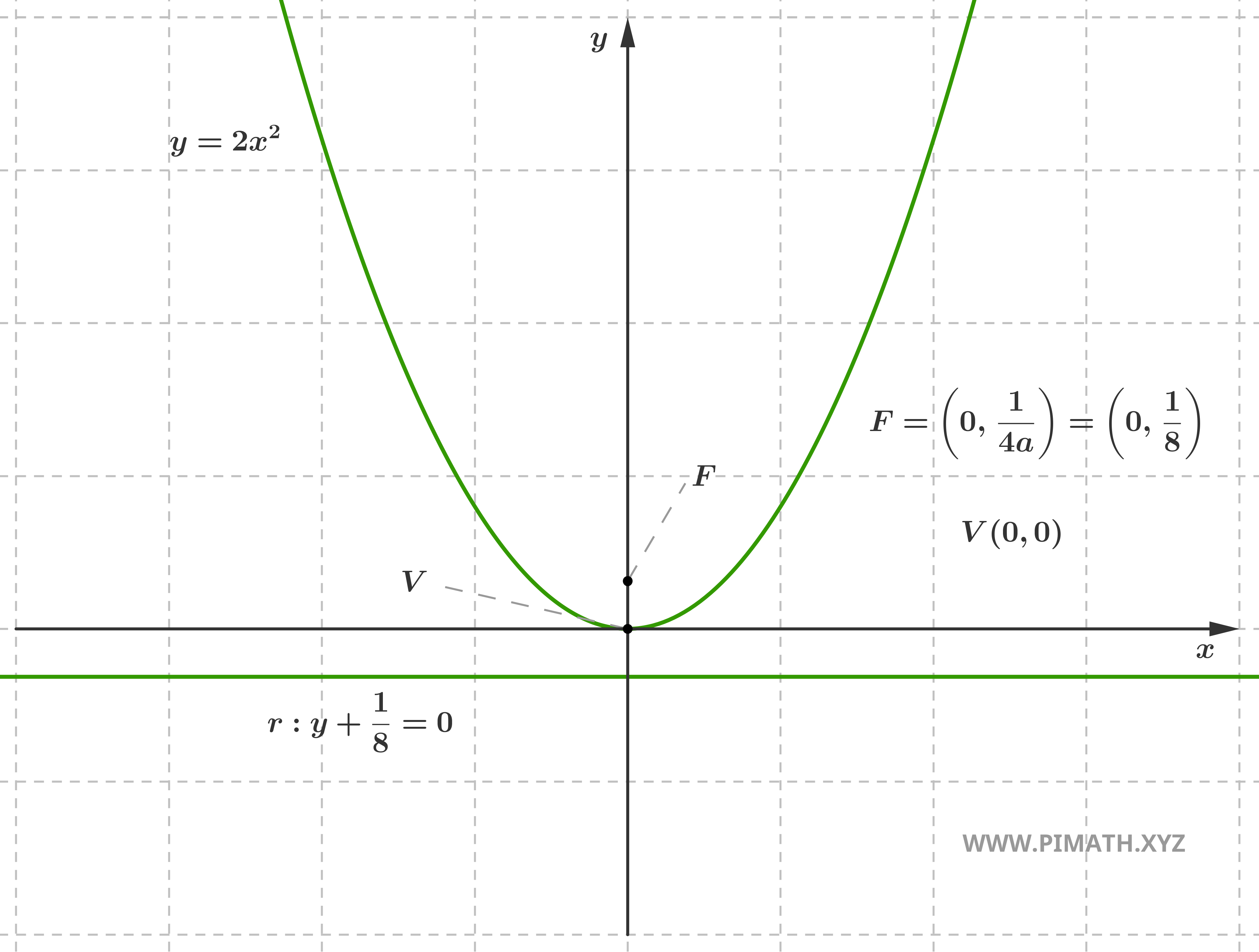
Example. Consider the parabola
\[ y=2x^2. \]
Here \(a=2\), so
\[ \frac{1}{4a}=\frac{1}{8}. \]
The vertex is \(V(0,0)\), the axis of symmetry is \(x=0\), the focus is \(F\left(0,\displaystyle \frac{1}{8}\right)\) and the directrix has equation \(y=-\displaystyle \frac{1}{8}\). Since \(a>0\), the parabola opens upwards.
Parabola with Horizontal Axis
A parabola with horizontal axis and vertex at the origin has equation
\[ x=ay^2, \qquad a\neq 0. \]
In this case the axis of symmetry coincides with the \(x\)-axis, that is, with the line \(y=0\). If \(a>0\), the parabola opens to the right; if instead \(a<0\), it opens to the left.
The characteristic elements are: vertex \(V(0,0)\), axis of symmetry \(y=0\), focus \(F\left(\displaystyle \frac{1}{4a},0\right)\) and directrix \(x=-\displaystyle \frac{1}{4a}\).
Equivalently, the equation may be written in the form
\[ y^2=4px, \]
where again \(p=\displaystyle \frac{1}{4a}\) is the parameter of the parabola. The sign of \(p\) indicates the direction in which the curve opens, while \( |p|=\displaystyle \frac{1}{4|a|} \) represents the distance between the vertex and the focus.
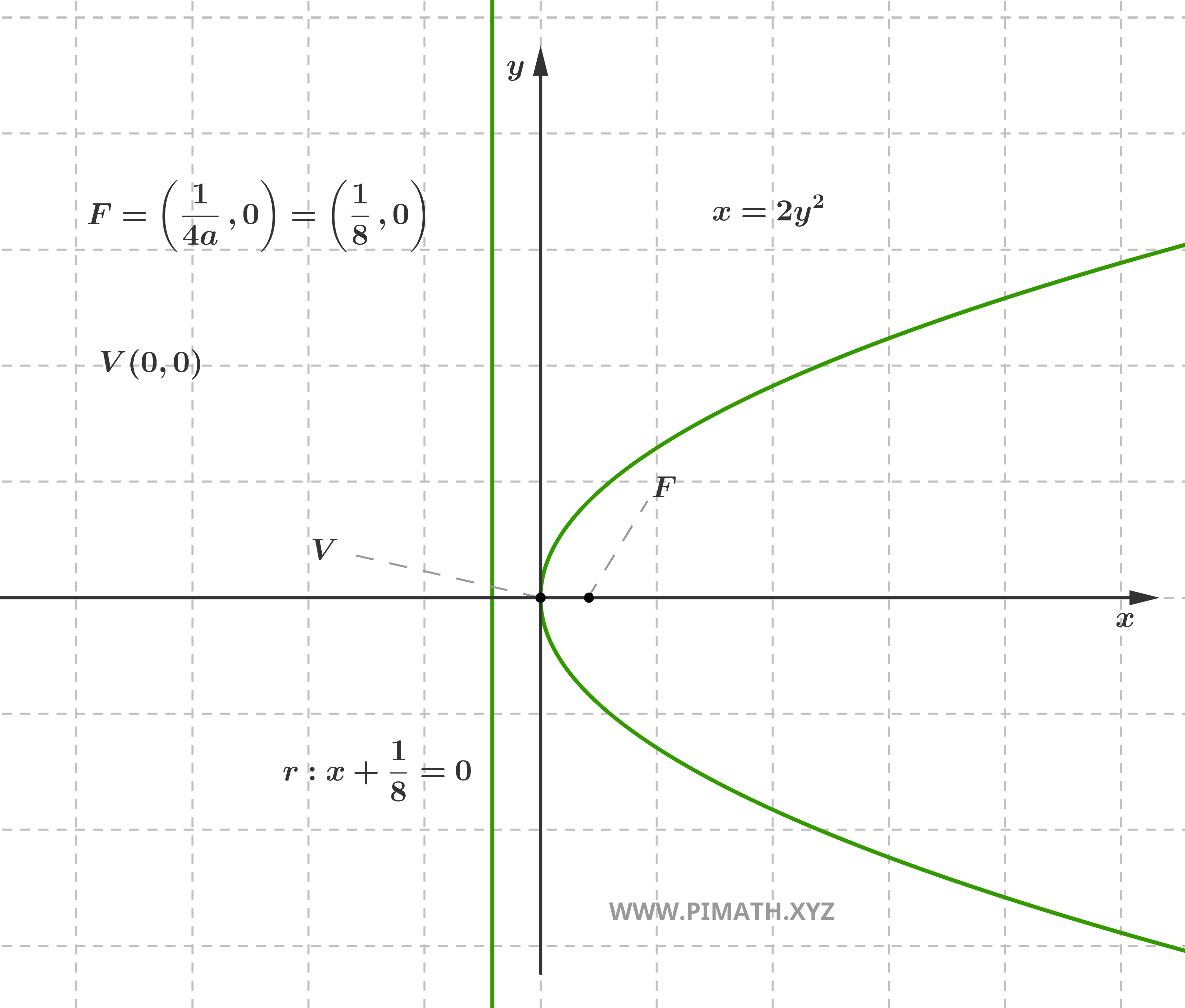
Example. Consider the parabola
\[ x=2y^2. \]
Here \(a=2\), so
\[ \frac{1}{4a}=\frac{1}{8}. \]
The vertex is \(V(0,0)\), the axis of symmetry is \(y=0\), the focus is \(F\left(\displaystyle \frac{1}{8},0\right)\) and the directrix has equation \(x=-\displaystyle \frac{1}{8}\). Since \(a>0\), the parabola opens to the right.
Relation between the Coefficient and the Parameter of the Parabola
In the canonical forms
\[ y=ax^2 \qquad \text{and} \qquad x=ay^2, \]
the coefficient \(a\) determines both the opening and the orientation of the parabola. More precisely, the parameter of the parabola is
\[ p=\frac{1}{4a}. \]
If \(a>0\), then \(p>0\) and the parabola opens in the positive direction along its axis of symmetry. If \(a<0\), then \(p<0\) and the parabola opens in the negative direction along its axis of symmetry.
The distance between the vertex and the focus, by contrast, is always positive and is given by
\[ |p|=\frac{1}{4|a|}. \]
This distinction is important: \(p\) retains information about the direction of opening, whereas \( |p| \) measures a distance.
Parabola in Vertex Form
So far we have considered parabolas with vertex at the origin. In many cases, however, the vertex lies at an arbitrary point of the plane. This situation is referred to as a translated parabola.
A translation shifts every point of the plane by the same vector. For this reason, translating a parabola leaves its shape unchanged: only the position of the vertex, the focus, the directrix and the axis of symmetry change.
Translated Parabola with Vertical Axis
Let us start from the canonical parabola
\[ y=ax^2. \]
If the vertex is moved to the point \(V(h,k)\), the equation becomes
\[ y=a(x-h)^2+k. \]
This form is called the vertex form. It is particularly useful because it allows one to read off the vertex of the parabola immediately.
Indeed, in the parabola
\[ y=a(x-h)^2+k, \]
the vertex is \(V(h,k)\), while the axis of symmetry is the line
\[ x=h. \]
The sign of \(a\) determines the direction in which the parabola opens: the parabola opens upwards if \(a>0\), and downwards if \(a<0\).
From Vertex Form to General Form
Expanding the square in the vertex form, we obtain:
\[ y=a(x-h)^2+k =a(x^2-2hx+h^2)+k. \]
Hence
\[ y=ax^2-2ahx+ah^2+k. \]
Setting
\[ b=-2ah, \qquad c=ah^2+k, \]
we recover the general form
\[ y=ax^2+bx+c. \]
Conversely, starting from the general form \(y=ax^2+bx+c\), with \(a\neq 0\), the coordinates of the vertex are
\[ h=-\frac{b}{2a}, \qquad k=c-\frac{b^2}{4a}. \]
Geometric Elements of the Translated Parabola
For a parabola with vertical axis and equation
\[ y=a(x-h)^2+k, \qquad a\neq 0, \]
the characteristic elements are: vertex \(V(h,k)\), axis of symmetry \(x=h\), focus \(F\left(h,k+\displaystyle \frac{1}{4a}\right)\) and directrix \(y=k-\displaystyle \frac{1}{4a}\).
The distance between the vertex and the focus is
\[ \frac{1}{4|a|}, \]
while the distance between the focus and the directrix is
\[ \frac{1}{2|a|}. \]
Example. Consider the parabola
\[ y=2(x-3)^2-5. \]
This is obtained by translating the parabola \(y=2x^2\) by \(3\) units to the right and \(5\) units downwards.
The vertex is therefore
\[ V(3,-5), \]
and the axis of symmetry has equation
\[ x=3. \]
Since \(a=2\), we have
\[ \frac{1}{4a}=\frac{1}{8}. \]
The focus is
\[ F\left(3,-5+\frac{1}{8}\right) = F\left(3,-\frac{39}{8}\right), \]
while the directrix has equation
\[ y=-5-\frac{1}{8} = -\frac{41}{8}. \]
Vertex, Focus, Directrix and Axis of Symmetry
The fundamental geometric elements of a parabola are its vertex, its focus, its directrix and its axis of symmetry. These elements allow one to describe fully the position of the parabola in the Cartesian plane.
In this section we consider parabolas with vertical axis, that is, parabolas represented by the equation
\[ y=ax^2+bx+c, \qquad a\neq 0. \]
Vertex of the Parabola
For a parabola with vertical axis, the vertex is the point at which the quadratic function attains its minimum value, if \(a>0\), or its maximum value, if \(a<0\).
To determine the coordinates of the vertex, we start from the general equation
\[ y=ax^2+bx+c. \]
Factoring \(a\) out of the first two terms:
\[ y=a\left(x^2+\frac{b}{a}x\right)+c. \]
We complete the square by adding and subtracting the term \(\left(\displaystyle \frac{b}{2a}\right)^2\):
\[ y=a\left[ x^2+\frac{b}{a}x+ \left(\frac{b}{2a}\right)^2 - \left(\frac{b}{2a}\right)^2 \right]+c. \]
We thus obtain:
\[ y=a\left(x+\frac{b}{2a}\right)^2-\frac{b^2}{4a}+c. \]
Since \(\Delta=b^2-4ac\), we may write:
\[ -\frac{b^2}{4a}+c = -\frac{b^2-4ac}{4a} = -\frac{\Delta}{4a}. \]
The parabola can therefore be rewritten in the form
\[ y=a\left(x+\frac{b}{2a}\right)^2-\frac{\Delta}{4a}. \]
Comparing this expression with the vertex form
\[ y=a(x-h)^2+k, \]
we obtain:
\[ h=-\frac{b}{2a}, \qquad k=-\frac{\Delta}{4a}. \]
Hence the vertex of the parabola \(y=ax^2+bx+c\) is
\[ V\left(-\frac{b}{2a},-\frac{\Delta}{4a}\right). \]
Axis of Symmetry
The axis of symmetry is the line passing through the vertex that divides the parabola into two symmetric parts. For a parabola with vertical axis and equation
\[ y=ax^2+bx+c, \]
the axis of symmetry has equation
\[ x=-\frac{b}{2a}. \]
This line contains both the vertex and the focus of the parabola.
Focus of the Parabola
The focus is the fixed point appearing in the geometric definition of the parabola. Every point of the parabola is equidistant from the focus and the directrix.
If the parabola is written in vertex form
\[ y=a(x-h)^2+k, \]
its focus is
\[ F\left(h,k+\frac{1}{4a}\right). \]
In the general form \(y=ax^2+bx+c\), we have
\[ h=-\frac{b}{2a}, \qquad k=-\frac{\Delta}{4a}. \]
Substituting these values, we obtain:
\[ F\left( -\frac{b}{2a}, -\frac{\Delta}{4a}+\frac{1}{4a} \right). \]
This formula holds both for \(a>0\) and for \(a<0\). If \(a>0\), the focus lies above the vertex; if \(a<0\), it lies below the vertex.
Directrix of the Parabola
The directrix is the fixed line with respect to which the parabola is defined. Every point of the parabola is equidistant from the focus and the directrix.
If the parabola is written in the form
\[ y=a(x-h)^2+k, \]
the directrix has equation
\[ y=k-\frac{1}{4a}. \]
For the parabola with equation \(y=ax^2+bx+c\), using again
\[ k=-\frac{\Delta}{4a}, \]
we obtain:
\[ y=-\frac{\Delta}{4a}-\frac{1}{4a}. \]
This formula, too, automatically accounts for the sign of \(a\). If \(a>0\), the directrix lies below the vertex; if \(a<0\), it lies above the vertex.
Focal Distance
The distance between the vertex and the focus is called the focal distance. In the vertex form
\[ y=a(x-h)^2+k, \]
the focus is obtained from the vertex by a signed displacement equal to
\[ \frac{1}{4a} \]
along the axis of symmetry. Consequently, the focal distance is
\[ \frac{1}{4|a|}. \]
The distance between the focus and the directrix is therefore twice this value:
\[ \frac{1}{2|a|}. \]
Summary of Formulae
For a parabola with vertical axis and equation
\[ y=ax^2+bx+c, \qquad a\neq 0, \]
setting \(\Delta=b^2-4ac\), we have: vertex \(V\left(-\displaystyle \frac{b}{2a},-\displaystyle \frac{\Delta}{4a}\right)\), axis of symmetry \(x=-\displaystyle \frac{b}{2a}\), focus \(F\left(-\displaystyle \frac{b}{2a},-\displaystyle \frac{\Delta}{4a}+\displaystyle \frac{1}{4a}\right)\), directrix \(y=-\displaystyle \frac{\Delta}{4a}-\displaystyle \frac{1}{4a}\) and focal distance \(\displaystyle \frac{1}{4|a|}\).
Example. Consider the parabola
\[ y=2x^2-8x+3. \]
Here
\[ a=2, \qquad b=-8, \qquad c=3. \]
The discriminant is
\[ \Delta=b^2-4ac=(-8)^2-4\cdot 2\cdot 3=64-24=40. \]
The vertex is therefore
\[ V\left(-\frac{-8}{2\cdot 2},-\frac{40}{4\cdot 2}\right) = V(2,-5). \]
The axis of symmetry has equation
\[ x=2. \]
Since
\[ \frac{1}{4a}=\frac{1}{8}, \]
the focus is
\[ F\left(2,-5+\frac{1}{8}\right) = F\left(2,-\frac{39}{8}\right), \]
while the directrix has equation
\[ y=-5-\frac{1}{8} = -\frac{41}{8}. \]
Finally, the focal distance is
\[ \frac{1}{4|a|} = \frac{1}{8}. \]
Equation of a Parabola Given Its Vertex and a Point
A parabola with a vertical axis is uniquely determined once its vertex and one further point on the curve are known, provided that this point does not have the same \(x\)-coordinate as the vertex.
Suppose, then, that the vertex is
\[ V(h,k) \]
and that the parabola passes through the point
\[ P(x_0,y_0), \qquad x_0\neq h. \]
Since the vertex is known, it is convenient to use the vertex form:
\[ y=a(x-h)^2+k. \]
In this equation, the only parameter left to determine is \(a\). To find it, we impose that the parabola pass through the point \(P(x_0,y_0)\). Substituting the coordinates of the point, we obtain:
\[ y_0=a(x_0-h)^2+k. \]
Hence:
\[ y_0-k=a(x_0-h)^2. \]
Since \(x_0\neq h\), we may divide by \((x_0-h)^2\) to obtain:
\[ a=\frac{y_0-k}{(x_0-h)^2}. \]
The equation of the parabola is therefore
\[ y=\frac{y_0-k}{(x_0-h)^2}(x-h)^2+k. \]
Example. Let us determine the equation of the parabola with vertical axis, vertex
\[ V(3,-2) \]
and passing through the point
\[ P(5,6). \]
Since the vertex is \(V(3,-2)\), we write the parabola in the form:
\[ y=a(x-3)^2-2. \]
We now impose that the parabola pass through the point \(P(5,6)\):
\[ 6=a(5-3)^2-2. \]
Hence:
\[ 6=4a-2. \]
So:
\[ 8=4a \]
and therefore
\[ a=2. \]
The required equation is therefore
\[ y=2(x-3)^2-2. \]
If we wish to write it in general form, we expand the square:
\[ y=2(x^2-6x+9)-2. \]
We obtain:
\[ y=2x^2-12x+18-2, \]
that is,
\[ y=2x^2-12x+16. \]
Check. Let us verify that the parabola obtained does indeed have vertex \(V(3,-2)\). In the equation
\[ y=2x^2-12x+16 \]
we have \(a=2\), \(b=-12\), \(c=16\). The abscissa of the vertex is:
\[ x_V=-\frac{b}{2a} = -\frac{-12}{2\cdot 2} = 3. \]
The corresponding ordinate is:
\[ y_V=2\cdot 3^2-12\cdot 3+16 = 18-36+16 = -2. \]
The vertex is therefore indeed \(V(3,-2)\).
The Case of a Parabola with Horizontal Axis
The procedure is analogous for a parabola with horizontal axis. If the vertex is \(V(h,k)\), the vertex form is
\[ x=a(y-k)^2+h. \]
If the parabola passes through the point \(P(x_0,y_0)\), with \(y_0\neq k\), substituting the coordinates of the point gives:
\[ x_0=a(y_0-k)^2+h. \]
Hence:
\[ a=\frac{x_0-h}{(y_0-k)^2}. \]
Here too, once \(a\) has been determined, the equation of the parabola is completely known.
Focus and Directrix
Having determined the coefficient \(a\), we may also calculate the geometric elements of the parabola.
For a parabola with vertical axis and equation
\[ y=a(x-h)^2+k, \]
the focus is
\[ F\left(h,k+\frac{1}{4a}\right), \]
while the directrix has equation
\[ y=k-\frac{1}{4a}. \]
The distance between the vertex and the focus is
\[ \frac{1}{4|a|}. \]
Practice Problems on the Parabola
We conclude with a number of practice problems on the parabola. These examples collect the situations that arise most frequently: determining the characteristic elements, deriving the equation from given geometric data, studying a parabola with horizontal axis, and solving simple problems involving symmetry.
Practice Problem 1. Given the parabola with equation
\[ y=3x^2-12x+7, \]
determine the vertex, the focus, the directrix and the focal distance.
The equation is in the form
\[ y=ax^2+bx+c. \]
Here
\[ a=3,\qquad b=-12,\qquad c=7. \]
We calculate the discriminant:
\[ \Delta=b^2-4ac=(-12)^2-4\cdot 3\cdot 7=144-84=60. \]
The vertex of the parabola is
\[ V\left(-\frac{b}{2a},-\frac{\Delta}{4a}\right). \]
Substituting the values found, we obtain:
\[ V\left(-\frac{-12}{2\cdot 3},-\frac{60}{4\cdot 3}\right) = V(2,-5). \]
Since
\[ \frac{1}{4a}=\frac{1}{12}, \]
and since \(a>0\), the focus lies above the vertex:
\[ F\left(2,-5+\frac{1}{12}\right) = F\left(2,-\frac{59}{12}\right). \]
The directrix, by contrast, lies below the vertex:
\[ y=-5-\frac{1}{12} = -\frac{61}{12}. \]
Finally, the focal distance is
\[ \frac{1}{4|a|} = \frac{1}{12}. \]
Practice Problem 2. Determine the equation of the parabola with vertical axis that has vertex \(V(-1,4)\) and passes through the point \(P(2,-5)\).
Since we know the vertex, we use the vertex form:
\[ y=a(x-h)^2+k. \]
Here \(h=-1\) and \(k=4\), so:
\[ y=a(x+1)^2+4. \]
The parabola passes through the point \(P(2,-5)\). Substituting \(x=2\) and \(y=-5\), we obtain:
\[ -5=a(2+1)^2+4. \]
Hence:
\[ -5=9a+4. \]
So:
\[ -9=9a, \]
and therefore
\[ a=-1. \]
The equation of the parabola is therefore
\[ y=-(x+1)^2+4. \]
Expanding the square, we obtain:
\[ y=-(x^2+2x+1)+4, \]
that is,
\[ y=-x^2-2x+3. \]
Practice Problem 3. Given the parabola with horizontal axis
\[ x=2y^2-8y+6, \]
determine the vertex, the focus and the directrix.
Since the parabola has horizontal axis, we complete the square with respect to the variable \(y\):
\[ \begin{aligned} x &=2y^2-8y+6 \\ &=2(y^2-4y)+6 \\ &=2(y^2-4y+4-4)+6 \\ &=2(y-2)^2-8+6 \\ &=2(y-2)^2-2. \end{aligned} \]
The parabola is therefore in the form
\[ x=a(y-k)^2+h. \]
Comparing the two expressions, we obtain:
\[ a=2,\qquad h=-2,\qquad k=2. \]
The vertex is therefore
\[ V(-2,2). \]
Moreover,
\[ \frac{1}{4a}=\frac{1}{8}. \]
Since \(a>0\), the parabola opens to the right. The focus therefore lies to the right of the vertex:
\[ F\left(-2+\frac{1}{8},2\right) = F\left(-\frac{15}{8},2\right). \]
The directrix, by contrast, lies to the left of the vertex:
\[ x=-2-\frac{1}{8} = -\frac{17}{8}. \]
Practice Problem 4. Given the parabola
\[ y=-2x^2+8x-5, \]
determine the equation of the parabola symmetric to it with respect to the \(x\)-axis. Also find the points of intersection between the two parabolas.
Reflection in the \(x\)-axis maps every point \((x,y)\) to the point \((x,-y)\). To find the equation of the reflected parabola, we therefore substitute \(-y\) for \(y\) in the original equation:
\[ -y=-2x^2+8x-5. \]
Multiplying both sides by \(-1\), we obtain:
\[ y=2x^2-8x+5. \]
This is the equation of the parabola symmetric with respect to the \(x\)-axis.
To find the points of intersection between the two parabolas, we solve the system:
\[ \begin{cases} y=-2x^2+8x-5 \\ y=2x^2-8x+5. \end{cases} \]
Equating the two expressions for \(y\), we obtain:
\[ -2x^2+8x-5=2x^2-8x+5. \]
Bringing everything to one side:
\[ 4x^2-16x+10=0. \]
Dividing by \(2\):
\[ 2x^2-8x+5=0. \]
Applying the quadratic formula, we obtain:
\[ x= \frac{8\pm\sqrt{64-40}}{4} = \frac{8\pm\sqrt{24}}{4} = \frac{8\pm 2\sqrt6}{4} = \frac{4\pm\sqrt6}{2}. \]
Since a curve and its reflection in the \(x\)-axis meet on the \(x\)-axis itself, the ordinates of the points of intersection are zero. The points of intersection are therefore:
\[ A\left(\frac{4+\sqrt6}{2},0\right), \qquad B\left(\frac{4-\sqrt6}{2},0\right). \]
Practice Problem 5. Determine the equation of the parabola with vertical axis that has focus \(F(1,5)\) and directrix \(y=3\). Also determine whether the point \(P(3,6)\) lies on the parabola.
The focus is \(F(1,5)\) and the directrix is the line \(y=3\). Since the directrix is horizontal, the axis of the parabola is vertical and passes through the focus.
The vertex lies midway between the focus and the directrix. It therefore has the same abscissa as the focus, and its ordinate is the average of \(5\) and \(3\):
\[ V\left(1,\frac{5+3}{2}\right) = V(1,4). \]
The focal distance is
\[ 5-4=1. \]
Since the focus lies above the vertex, the parabola opens upwards. Hence the parameter of the parabola is \(p=1\), and therefore:
\[ a=\frac{1}{4p}=\frac{1}{4}. \]
The equation of the parabola is therefore
\[ y=\frac{1}{4}(x-1)^2+4. \]
Let us now check whether the point \(P(3,6)\) lies on the parabola. Substituting \(x=3\) into the equation found, we obtain:
\[ y=\frac{1}{4}(3-1)^2+4 = \frac{1}{4}\cdot 4+4 = 5. \]
For \(x=3\), the parabola has \(y\)-coordinate \(5\), whereas the given point has \(y\)-coordinate \(6\). The point \(P(3,6)\) therefore does not lie on the parabola.
We may confirm the same result using the geometric definition directly. The distance of \(P\) from the focus is
\[ d(P,F) = \sqrt{(3-1)^2+(6-5)^2} = \sqrt5, \]
while the distance of \(P\) from the directrix is
\[ d(P,\text{directrix}) = |6-3| = 3. \]
Since \(\sqrt5\neq 3\), the point does not lie on the parabola.